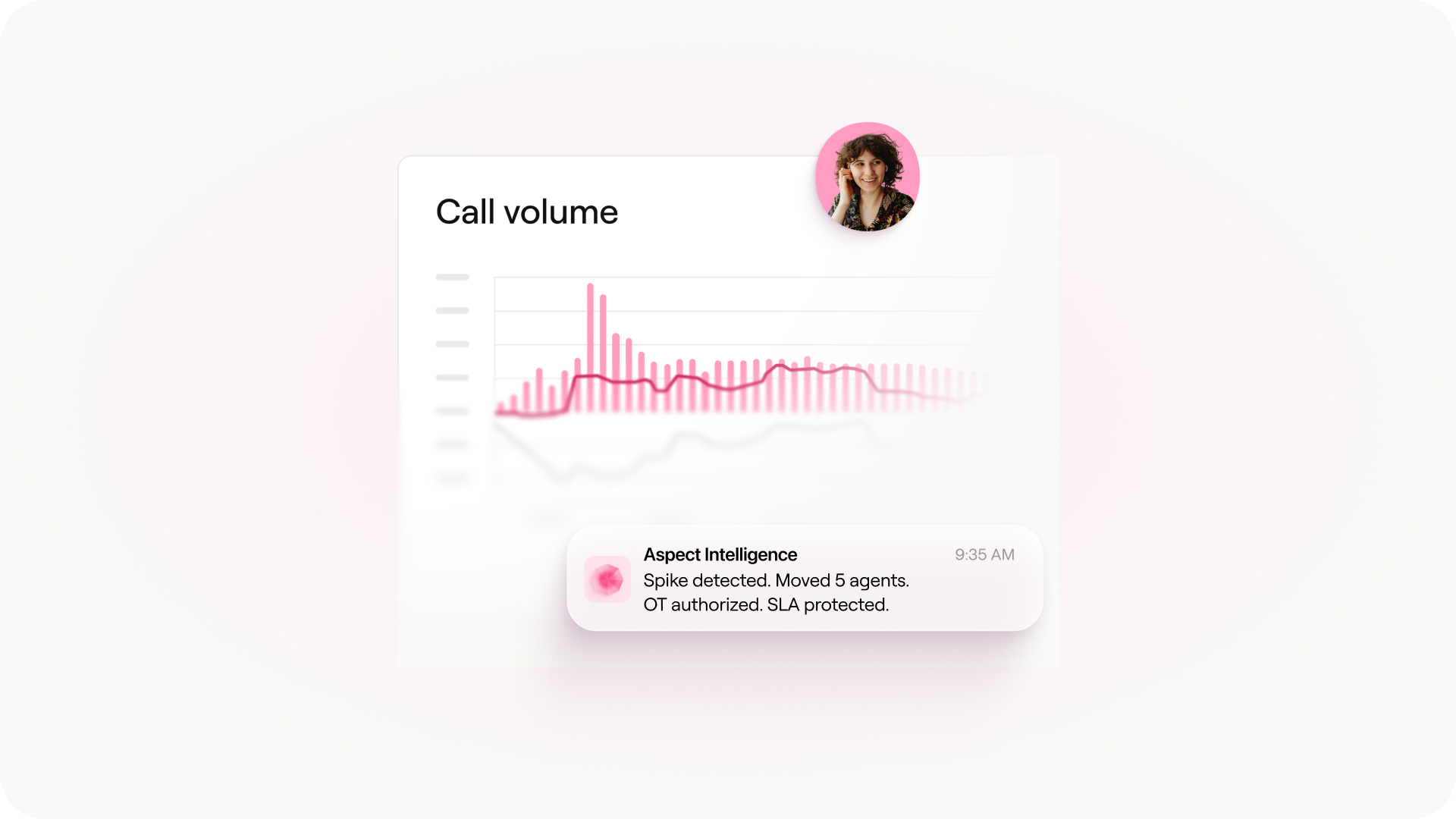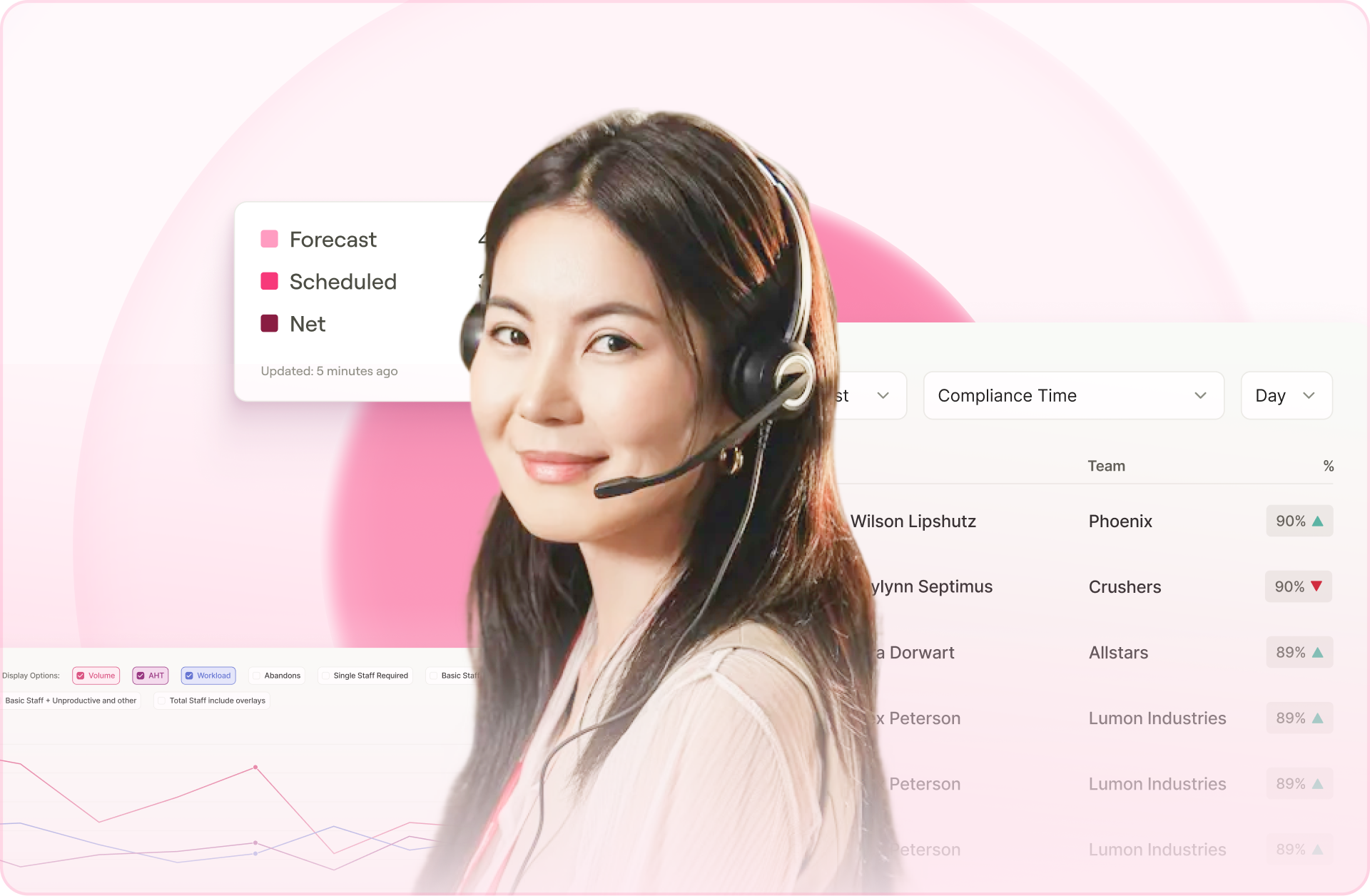


Managing hybrid teams across remote and on-site contact center environments has become one of the biggest challenges facing contact center leaders today.
While this hybrid model offers flexibility and cost savings, its success relies on strong visibility into operations, fairness in how schedules are distributed, and the ability to maintain consistent performance standards across different work locations.
Workforce management (WFM) solutions can help contact centers meet these challenges. Platforms like Aspect Workforce bring scheduling, forecasting, and performance management together in one system, giving leaders the real-time visibility they need across all locations.
This article explores the key challenges of managing hybrid contact centers and how modern workforce management platforms address them.
The shift to hybrid work in contact centers
The move toward hybrid work in contact centers accelerated during the pandemic, but the model has remained in place because it delivers measurable benefits for both employers and employees.
Remote work options have become a standard expectation for many agents, and organizations that offer flexibility often find it easier to attract and retain talent.
At the same time, maintaining an on-site presence continues to be important for training, collaboration, and certain types of customer interactions that benefit from in-person support.
This combination of remote and on-site work creates a hybrid model that requires more sophisticated management than either approach alone.
Forecasting demand, building schedules, tracking adherence, and maintaining consistent performance standards all become more difficult when teams are distributed across multiple locations.
Organizations that succeed in this environment use unified platforms that bring these functions together and provide visibility across the entire operation.
Read more: Embracing flexible workforce management in global work models.

How to manage a hybrid contact center workforce
The following strategies provide contact center leaders with greater control and reduced friction when managing hybrid workforces.
Use a unified approach across all locations
Remote and on-site agents should be coached, measured, and supported in the same way. When rules vary by location, confusion and resentment follow.
To build a unified approach across all locations:
- Define clear service standards and performance targets. Agents should understand what strong performance looks like and how their work is evaluated, regardless of where they work each day.
- Use shared dashboards that display metrics to agents, supervisors, and leadership. When everyone works from the same data, conversations stay grounded in facts rather than perceptions, maintaining alignment and accountability across distributed teams.
Read more: Boost remote team engagement with real-time feedback.
Maintain transparent, continuous communication
In hybrid settings, waiting until problems arise to share updates can lead to breakdowns. Remote agents may start their day unaware of current demands, while supervisors might miss early signs that support is needed—often only noticing once customer wait times climb.
Continuous, transparent communication closes that gap. Real-time dashboards and digital channels keep hybrid teams connected and informed throughout every shift, ensuring everyone stays aligned.
Plan strategically with data-driven forecasting
Hybrid work amplifies the impact of poor forecasts. When demand is underestimated, coverage gaps appear quickly. When overestimated, labor costs climb without improving service.
Data-driven forecasting enables leaders to plan staffing with confidence and fewer last-minute adjustments. Over time, this reduces schedule volatility and creates a more predictable work experience for agents—a factor often overlooked but closely tied to retention.
Build flexibility into every shift plan
No hybrid contact center runs exactly as planned. Agents call out sick, call patterns shift unexpectedly, and technology issues emerge without warning.
Flexibility makes the difference between stable operations and daily disruption. Intraday management tools let you adjust coverage without scrambling. Instead of relying on emergency overtime or manual workarounds, you can make smaller, controlled changes that keep service on track.
Give agents ownership over their workday
Hybrid work has raised expectations around fairness and autonomy. Agents want to understand how schedules are built and how decisions are made. They also want options when personal needs change.
Self-service scheduling supports that balance. When agents can submit requests, view available shifts, and swap schedules with peers, trust increases. That trust shows up in lower attrition and stronger accountability.
Workforce success: How Simply Business maximized employee engagement with gamification.
Why hybrid workforce models matter
Hybrid operations have become the new standard in customer service because they balance organizational needs with employee expectations.
- Flexibility for agents: Working from home allows employees to manage personal commitments while meeting their responsibilities.
- Operational efficiency: Organizations can reduce reliance on fixed office space and adjust staffing based on real-time demand, helping control costs.
- Employee satisfaction and retention: Agents who feel trusted to manage their schedules tend to be more engaged, productive, and likely to stay with the company.
At the same time, hybrid work introduces challenges that require careful management.
Communication can become fragmented when teams are spread across locations. Forecasting demand accurately becomes harder without full visibility into who is available and when. Maintaining consistent performance standards across both remote and on-site agents becomes more difficult.
Hybrid workforce management offers advantages for both contact centers and their employees.

For employers
- Access to broader talent pools: Contact centers can recruit qualified agents regardless of location. This expanded reach is especially valuable in tight labor markets where local talent is scarce or expensive.
- Reduced turnover: The model can significantly reduce attrition by providing the flexibility employees increasingly demand.
- Improved operational agility: Organizations can respond more effectively to demand fluctuations, seasonal volume changes, and unexpected business conditions.
- Cost savings: Savings come from more efficient scheduling that minimizes overstaffing during low-demand periods, reduced overtime expenses, lower real estate costs, and decreased spending on facilities management.
- Global expansion: Organizations expanding into new markets can manage teams across time zones and regions without establishing physical locations in every market—significantly reducing the cost and complexity of international growth.
For employees
- Greater fairness and control: Hybrid workforce management provides more equitable scheduling practices and increased autonomy over work arrangements.
- Flexible work options: Remote work reduces commute-related stress and supports better work-life balance, increasing engagement and job satisfaction.
- Clear visibility: Transparent access to shift availability, time-off requests, and performance metrics helps employees understand expectations and manage their workday effectively. This transparency reduces frustration and builds trust between agents and management.
Common challenges of managing hybrid contact centers
Managing a hybrid contact center creates challenges that don't exist in fully on-site operations. The most common difficulties include:
- Disconnected tools: When forecasting, scheduling, and adherence live in separate systems, managers struggle to maintain an accurate view of staffing and performance. Adjustments in one system may not appear elsewhere, creating gaps and inefficiencies.
- Uneven visibility: Without real-time insights, it's difficult to know which agents are available, how they're performing, and whether service standards are being met. Limited visibility leads to reactive management, errors, and inconsistent service delivery.
- Inconsistent adherence: Remote and on-site teams may follow different rules or processes, creating confusion and uneven performance. Manually tracking adherence adds administrative work and increases the chance of mistakes.
- Scheduling fairness: When remote and on-site agents are treated differently—or shift swaps and time-off requests are handled manually—frustration grows and engagement drops.
Aspect addresses these challenges by integrating forecasting, scheduling, and adherence data into a single intelligent platform. Managers gain real-time visibility into staffing, performance, and workload distribution across hybrid teams, while employees benefit from fair, transparent schedules.
This reduces inefficiencies, prevents burnout, and maintains consistent service quality across remote and on-site agents.
Read more: Beyond fragmented systems: The business case for unified workforce management.
Securing and governing the hybrid contact center
Hybrid contact centers face distinct security and compliance challenges.
Agents work from different locations on various networks. Sensitive customer data flows between systems and endpoints. Staffing and scheduling decisions affect both remote and on-site teams.
Without consistent policy enforcement, organizations risk data breaches, regulatory violations, and oversight gaps—all of which can result in significant penalties.
Aspect's platform includes built-in compliance. Policies apply directly to scheduling, staffing, and performance decisions, ensuring every action follows established standards.
The platform gives managers clear insight into how forecasts are generated, why specific scheduling recommendations are made, and how other decisions are reached. This transparency creates a clear audit trail, making it easy to verify that decisions are compliant with regulations, and free from bias or inconsistency.
By bringing security, governance, and operations together in a single platform, Aspect helps organizations protect sensitive information while maintaining smooth hybrid operations.
The future of hybrid contact centers

Hybrid contact centers continue to evolve as technology and workforce expectations shift. Several key trends are emerging:
- AI-powered forecasting: Contact centers are moving beyond historical averages to use predictive models that account for changing customer behavior, new channels, and regional demand patterns. This helps leaders anticipate staffing needs earlier and reduce last-minute schedule changes that strain managers and agents.
- Global workforce optimization: Hybrid models enable organizations to draw from broader talent pools while aligning coverage to demand across time zones. The challenge is managing this complexity without losing visibility or control, which requires systems built to scale across regions and operating models.
- Predictive engagement analytics: By identifying early signs of disengagement, performance decline, or burnout, leaders can act before issues affect service or retention. This shifts workforce management from reactive oversight to proactive support.
Aspect supports this next phase of hybrid operations. Our platform creates adaptable, predictable workforce systems that grow alongside changing contact center models. By combining forecasting, scheduling, and engagement insights in one environment, Aspect helps organizations prepare for what's next without adding complexity to daily operations.
Why choose Aspect for hybrid workforce management

Aspect offers a practical approach to managing hybrid contact center teams. The platform helps organizations coordinate remote and on-site agents while maintaining consistency, fairness, and control across daily operations.
Unified scheduling and forecasting across locations
Aspect combines scheduling and forecasting into a single system. This makes it easier to plan coverage across channels, time zones, and work locations. Leaders gain a clear view of demand and staffing needs without switching between tools or reconciling conflicting data. The result: more accurate plans and fewer last-minute changes.
Real-time adherence and operational visibility
Hybrid teams need constant awareness of what's happening throughout the day. Aspect provides real-time adherence insights that help managers see when agents are in or out of compliance—and take action quickly. This visibility keeps teams aligned and lets supervisors respond to changes before service levels suffer.
Fair scheduling that supports engagement and retention
Scheduling fairness is critical in hybrid environments. Aspect applies consistent scheduling logic across remote and on-site teams, helping distribute workloads more evenly and reduce perceptions of bias. Agents gain clearer insight into how schedules are built, which builds trust and improves long-term retention.
Explainable AI built for trust and compliance
Aspect's AI-driven recommendations are transparent and auditable. Managers can understand how forecasts, schedules, and adjustments are created. This supports compliance requirements and builds confidence in day-to-day decisions—especially important in large, regulated environments where accountability matters.
Take control of your hybrid workforce
Ready to optimize your hybrid contact center operations? Aspect's unified workforce management platform helps you forecast demand, build fair schedules, and maintain visibility across remote and on-site teams—all from one intelligent system.
Explore Aspect Workforce Management to see how we can help you deliver consistent service, improve agent engagement, and scale your hybrid operations with confidence.
- What is a hybrid contact center?

- How do you measure success in a hybrid contact center?
- What tools do managers need to support hybrid workforce operations?
- How does AI help manage hybrid contact centers?