

Workforce management has come a long way. For decades, organizations focused on planning, scheduling, and adherence to ensure the right number of people were in the right place at the right time. These fundamentals still matter, especially for contact centers and service operations.
But modern operations need real-time data, predictive insights, and decision support that adapts to changing conditions.
Workforce Intelligence represents this evolution. It's the shift from reactive workforce management to proactive, data-driven workforce decisioning.
Rather than replacing traditional workforce management (WFM), Workforce Intelligence build on its foundation. It adds an intelligence layer that transform workforce data into forward-looking insights, helping organizations anticipate demand, understand risk, and optimize performance in dynamic environments.
Want to go deeper on Workforce Intelligence? Download the report: Workforce intelligence: An AI-fueled approach to Workforce Engagement Management (WEM).
What is Workforce Intelligence?
Workforce intelligence is the practice of combining workforce data, operational signals, and AI-driven analytics to help organizations predict demand, optimize staffing levels, and make smarter real-time workforce decisions.
Three core elements define Workforce Intelligence:
- Data integration unifies information from WFM systems, contact center platforms, CRM tools, HR databases, and operational systems, providing complete context about demand patterns, employee availability, skills, and performance.
- Predictive analytics uses AI and machine learning to identify patterns, forecast demand, and anticipate staffing needs by incorporating historical trends, real-time signals, seasonal factors, and behavioral data.
- Decision support translates insights into actionable recommendations, telling supervisors and workforce analysts what actions to take and when, enabling faster, more confident decisions.
Learn more: Predictive analytics and AI: What worked, what changed and what’s next in 2026.
Workforce Intelligence vs Workforce Management
Understanding the relationship between workforce intelligence and traditional workforce management helps clarify how the two approaches work together.
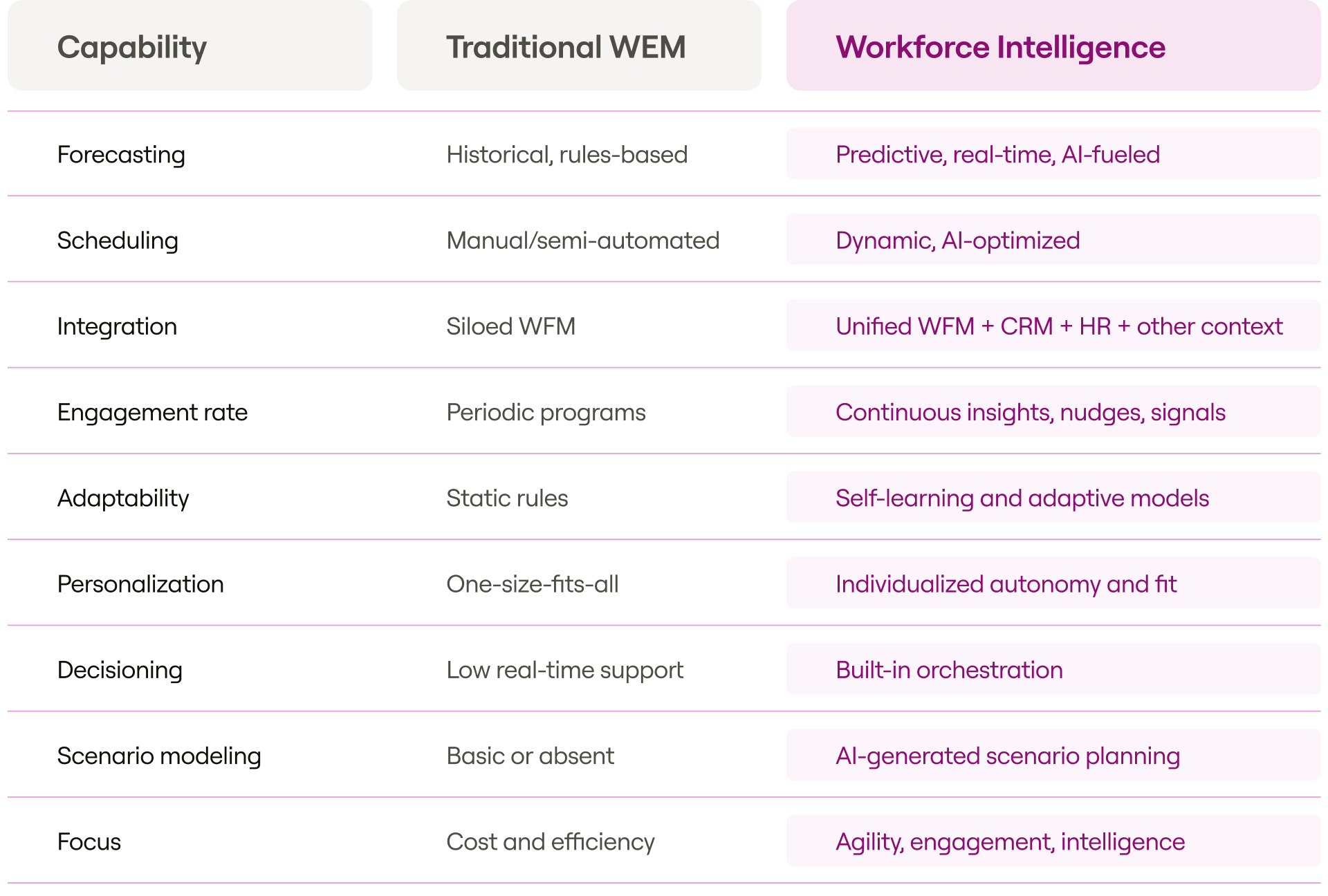
Traditional Workforce Management provides the operational foundation. It supports core functions such as forecasting demand, building schedules, tracking time and attendance, monitoring adherence, and reporting performance.
Workforce Intelligence adds the adaptive layer. It enhances WFM with AI-powered forecasting, dynamic schedule adjustments, predictive staffing insights, automated scenario planning, and real-time decision recommendations.
Here's how the two approaches compare:
Keep reading: From WFM to Workforce Intelligence: The evolution of contact center technology.
Benefits of Workforce Intelligence
The value of Workforce Intelligence shows up in measurable operational outcomes across forecasting accuracy, efficiency, employee experience, and service performance.
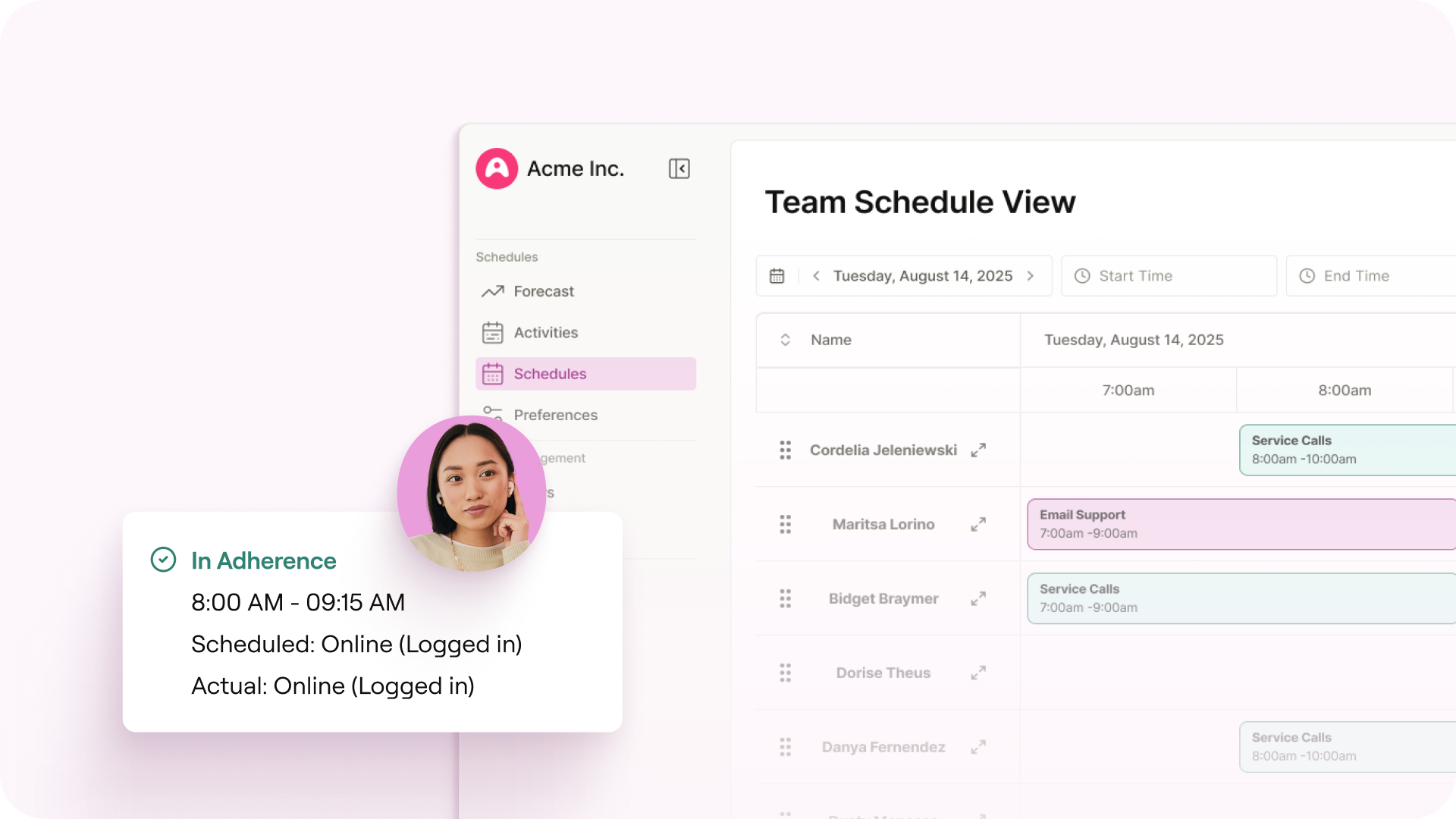
More accurate forecasting
Instead of relying solely on last year's patterns, organizations can incorporate current trends, seasonality, and emerging behaviors. This leads to forecasts that better reflect real demand, reducing the gap between planned and actual need.
Better staffing efficiency
Workforce Intelligence helps organizations reduce overstaffing during slow periods and minimize understaffing during peaks. Clear visibility into when and where capacity is needed enables more strategic scheduling decisions and better utilization of available staff.
Reduced overtime and employee burnout
When staffing levels align more closely with actual demand, agents are no longer routinely asked to work extra hours to cover gaps that could have been anticipated.
Predicting fluctuations and adjusting proactively distributes workload more evenly and reduces the strain on employees.
Improved service levels and customer experience
Shorter wait times, faster resolution, and more consistent service quality are direct results of better workforce decisioning. When staffing matches demand, customers notice.
Faster response to intraday disruptions
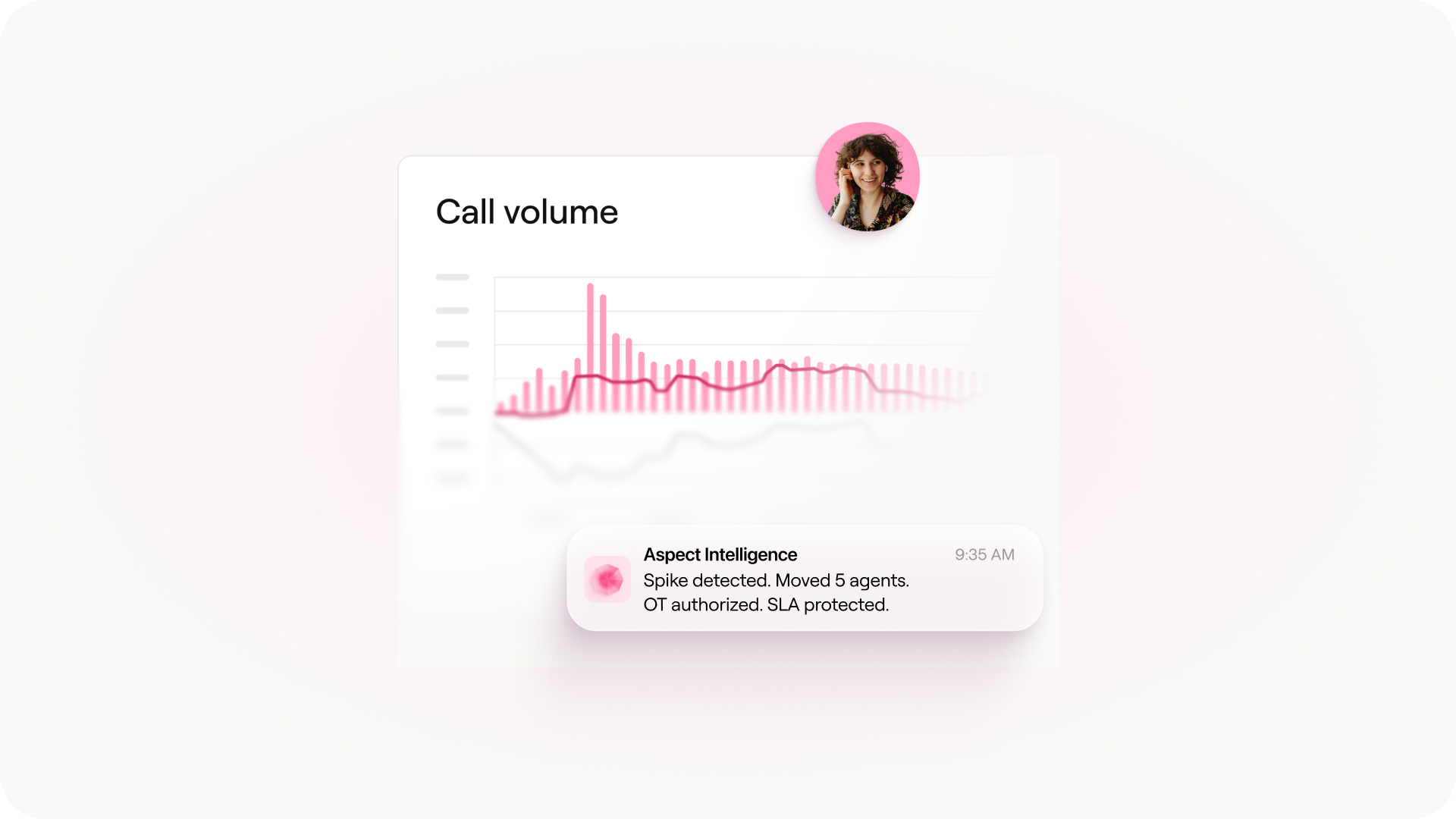
If call volume spikes unexpectedly or multiple agents call out, Workforce Intelligence delivers immediate recommendations, such as rebalancing schedules, offering voluntary time off, or adding coverage.
More confident strategic decision-making
Scenario modeling helps leaders understand the likely outcomes of different workforce strategies before acting. This reduces risk and enables more confident long-term planning.
Workforce Intelligence use cases across industries
Different industries apply Workforce Intelligence to solve distinct operational challenges, but all share the same need: to balance service quality, operational efficiency, and employee experience in fast-changing environments.
Financial services
Banks and financial services use Workforce Intelligence to manage regulatory-driven workloads, seasonal tax and enrollment surges, and complex skills-based routing. More accurate forecasting helps maintain service levels during volatile periods while controlling labor costs across large, distributed teams.
Healthcare
Healthcare providers apply Workforce Intelligence to coordinate clinical and administrative staff across facilities. Predictive analytics help anticipate patient volume, optimize nurse scheduling, and balance workload across departments to support both patient care and staff well-being.
Retail
Retail organizations use Workforce Intelligence for omnichannel customer support, seasonal demand planning, and coordination between in-store and remote customer service teams. Dynamic scheduling adapts to traffic patterns that vary by location, day of week, and time of year.
Telecommunications
Telecom companies manage large contact center environment with complex product portfolios and technical support needs. Workforce Intelligence helps forecast demand for specialized skills, optimize training investments, and maintain service levels across voice, chat, and digital channels.
Airlines and travel
Airlines and travel organizations face extreme volatility driven by weather, delays, cancellations, and booking patterns. Workforce Intelligence enables rapid response to disruptions and helps optimize staffing across reservations, customer service, and loyalty programs.
The future of Workforce Intelligence
Workforce intelligence continues evolving as AI capabilities advance and operational environments grow more complex.

Faster, more autonomous real-time decisioning
The gap between recognizing an issue and taking action will shrink from minutes to seconds. Systems will recommend - and in some cases automatically execute - approved responses to common scenarios, such as staffing shortages, demand spikes, or schedules imbalances.
Expanded data sources for richer predictions
Forecasts and recommendations will be enhanced by external signals such as weather, traffic patterns, economic indicators, and event data, further improving forecasts and recommendations.
Deeper personalization at scale
Workforce Intelligence will better understand what motivates each agent, how they prefer to work, and how to create schedules that improve engagement while meeting operational requirements.
A shift from reactive to proactive operations
Instead of responding to disruptions after they occur, predictive models will surface early warning signals and recommend preventive actions before problems emerge.
Read more: Why workforce intelligence is the next evolution of workforce engagement management.
Aspect’s approach to Workforce Intelligence
Aspect’s approach to Workforce Intelligence is grounded in the belief that AI’s highest purpose is to augment, not replace human decision-making.
Aspect’s AI strategy is guided by three principles:
- Trust and transparency: Clear, explainable insights leaders can understand and validate.
- Real-world usefulness: Practical intelligence that solves everyday operational problems.
- Human-centric design: Technology that supports people, not just processes.
Aspect has established a dedicated AI workstream focused on infusing intelligence into products through a machine learning pipeline and experiments using rich historical datasets across industries.
Early focus areas include:
- Predictive forecasting to improve forecast accuracy across domains (contact centers, retail foot traffic, back-office workloads).
- AI-driven scheduling optimization that balances demand, skills, and employee preferences.
- Intelligent assistants and automation to reduce admin burden and enable scenario planning, schedule drafting, and proactive risk flagging.
Want to go deeper on Workforce Intelligence? Download the report: Workforce intelligence: An AI-fueled approach to Workforce Engagement Management (WEM).
- What is Workforce Intelligence in simple terms?

- What data is used for Workforce Intelligence?
- How does AI improve Workforce Management (WFM)?
- Is Workforce Intelligence only for large enterprises?