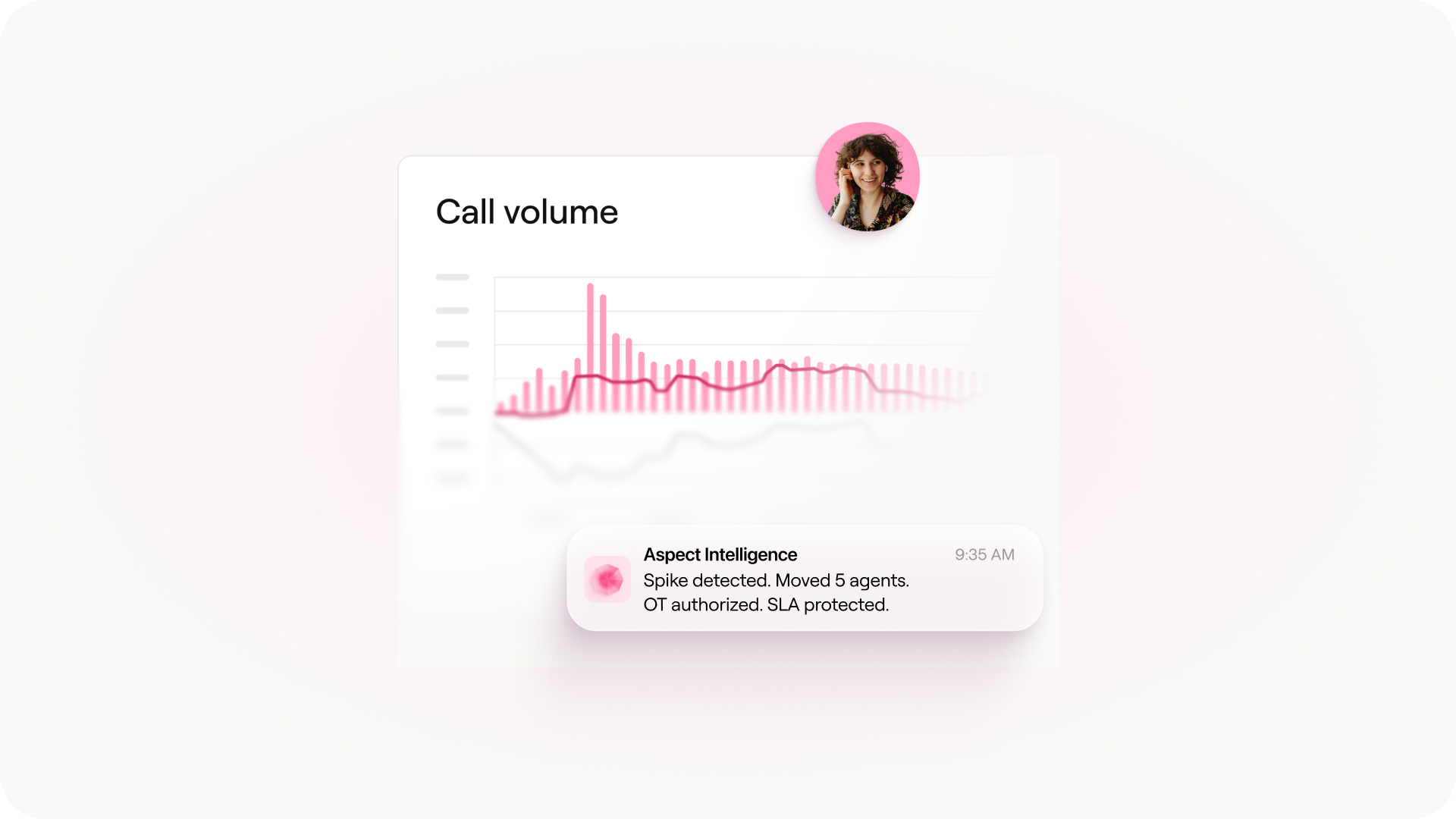



Most contact centers track and collate workforce management metrics, with dashboards that show weekly, quarterly, and annual numbers. Yet, they often struggle with properly interpreting what those numbers mean operationally.
A big part of why this challenge persists is the way teams treat metrics. Many use them for reporting purposes only, pulling them up for weekly or monthly reviews, then filing them away. This creates a record of what happened but doesn’t show why performance changed or what operational action should follow.
The better approach? Applying workforce efficiency metrics as a decision-making tool. When leaders understand what each metric signals and how it connects to other metrics, they can use them as early warning signs that staffing coverage or service quality is about to slip.
This article breaks down the workforce management metrics that matter the most, what they signal operationally, and how leaders can act on them to improve staffing efficiency, service levels, employee experience, and operational cost control.
What Are Workforce Management Metrics?
Workforce management metrics are data points that measure how efficiently a contact center handles staffing levels, customer demand, workload distribution, employee availability, and operational performance.
But these aren't just individual KPIs that belong in a quarterly report. They reflect the operational health of scheduling and staffing decisions made across departments in the workforce. These metrics are interconnected signals that trigger or identify other problems across different areas of a contact center.
No one metric tells the full story about how a contact center is performing, so, instead of applying and optimizing them in isolation, the best results are seen when teams track how metrics move together.
For example, analyzing schedule adherence alone shows whether agents are following their assigned schedules. However, when combined with occupancy rates and service levels, it reveals whether staffing coverage is holding under real demand, and where the gaps are creating pressure on the floor.
Workforce Management Metrics vs Workforce Planning Metrics
It's easy to think that workforce management metrics and workforce planning metrics mean the same thing. While closely related, they serve different purposes.
- Workforce management metrics focus on how daily operations are executed. They help teams measure whether adherence, occupancy, shrinkage, and service levels align with customer demand. With these metrics, supervisors can act before performance shifts.
- Workforce planning metrics focus on staffing strategy and long-term capacity management. Metrics such as headcount forecasting, time-to-hire, attrition trends, and other growth projections help organizations prepare for future demand. They guide leaders’ decisions on hiring needs and labor costs.
The key difference between them is timeframe. Workforce operations require short-term visibility for execution and accurate staffing, while workforce planning prepares organizations for future demand and structural changes.
Having said that, both metric types work together to maintain operational stability and workforce efficiency. Attrition trends and headcount projections from workforce planning shape how schedules are built around peak demand, while adherence and occupancy patterns from daily operations feed back into long-term staffing decisions.
Managing them separately means that operational data rarely reaches the planning level, and long-term staffing decisions are made without the context of how the workforce is actually performing day to day.
The Workforce Metrics That Matter Most in Contact Centers
Every metric in a contact center’s workforce dashboard focuses on a different part of daily operation, but they all interact with forecasting, scheduling, and staffing decisions.
The ones below have the most direct impact on staffing efficiency and service quality.
Schedule Adherence
Schedule adherence measures how closely agents follow their planned schedules during a shift, whether that’s handling calls, completing after-call work, or being available on-queue at the times they were assigned.
Poor schedule adherence can lead to:
- Gaps in staffing coverage when agents fall off schedule, leaving others to handle extra volume.
- Workload imbalance and potential burnout.
- Higher likelihood of missed service-level targets.
- Unreliable forecasting and intraday management, because the adherence data used to create forecasts are inaccurate baselines.
Occupancy Rate
Occupancy rate tracks how much time agents spend handling customer calls and related activities like after-call work and hold times. It shows how much employees work during shifts and can be an early indicator of burnout risk.
High occupancy isn’t the goal. When agents move from one interaction to the next, they have little to no recovery time, which, over time, affects their performance and leads to employee attrition.
Low occupancy, on the other hand, suggests overstaffing and increased labor costs. It occurs because of a misalignment with actual demand.
Average Handle Time (AHT)
Average handle time measures the total amount of time spent on a customer interaction, including talk time, hold time, and after-call work. Workforce managers use it to estimate workload and staffing needs.
AHT needs to be analyzed alongside service levels and quality metrics, not treated as a standalone performance target.
When AHT is aggressively reduced, agents may rush conversations to meet their KPIs instead of properly addressing customers’ issues. Reducing AHT without addressing why contact calls take so long will only decrease first-contact resolution (FCR) and customer satisfaction (CSAT) rates.
At the same time, if the AHT suddenly increases, it could be because calls are becoming more complex, whether due to training gaps or recent product and policy changes.
Shrinkage
Shrinkage covers the time when agents are scheduled to work but aren’t available for customer interactions. This includes breaks, meetings, training or coaching sessions, system downtime, and unplanned absences.
Shrinkage directly affects staffing accuracy by reducing the number of agents available to handle contacts at any given time. The higher the shrinkage rate, the wider the gap between scheduled headcount and actual working capacity.
Contact centers that underestimate shrinkage end up building schedules that are impractical. The agents who do show up and remain available have to absorb the shortfall, service levels erode because coverage is thinner than planned, and overtime costs increase.
Service Level
Service level measures how many customer interactions are answered or addressed within a specific time frame. It’s usually expressed as the percentage of calls answered within a number of seconds.
Service level reflects how well staffing decisions meet customer experience. Forecasting accuracy, schedule adherence, occupancy levels, and intraday staffing adjustments directly affect it.
When service levels drop, it doesn’t always mean that agents are performing poorly. Instead, it's likely a sign that there’s a timing mismatch between demand and available agents, or an adherence issue that managers didn't catch and correct early enough.
Forecast Accuracy
Forecast accuracy measures how close predicted contact volume matches the actual demand over a period of time. It’s the most fundamental workforce metric because every downstream action (scheduling, staffing levels, intraday adjustments, and overtime planning) is built on the forecast. If the forecast is wrong, so is everything else.
Forecasting errors cascade quickly. Missed shifts or schedules can lead to increased overtime, unstable service levels, adherence issues, and higher operational costs. Contact centers that forecast accurately spend less time reacting and more time making proactive staffing decisions.
Proven Strategies to Retain Contact Center Employees
Workforce metrics are effective operational warning systems. However, a single metric showing a dip (or gain) likely doesn’t tell the full story. The root cause almost always shows up in the relationship between metrics, not in any one number on its own, which is why they’re best used combined.
Here are some helpful metric combinations:
- High occupancy + poor adherence: This combination is a sign that burnout risk is near. It's a case where the available agents are already stretched thin, and the schedules are not being followed consistently.
- Low service level + inaccurate forecasting: This combination indicates that the staffing plan/schedule is inaccurate due to a mismatch between customer demand and call volume. If the organization cannot accurately predict busy periods, peak periods will be understaffed, resulting in customer support delays.
- High shrinkage + overtime increases: This pattern means that a capacity problem is building up. It means agents spend most of their time in meetings, trainings, and unplanned absences, while the contact center has to account for overtime work costs to fill the gaps.
- Stable AHT + declining CSAT: This is a quality signal disguised as stability. Agents complete interactions within the expected time frame, but customers remain unsatisfied, and their issues aren’t resolved. Agents are closing contacts to hit handle time targets rather than helping customers.
How Workforce Leaders Should Act on Workforce Metrics
Workforce management metrics can help contact center executives drive operational decisions while avoiding service disruptions and workload imbalance.
Here are some steps leaders can take based on metrics they collect:
- Adjusting schedules based on intraday trends: Intraday data shows how contact volume and staffing levels shift throughout the day. As staffing gaps appear, leaders can reassign agents to high-volume queues or adjust break times as needed.
- Improving forecasting models using historical data: Historical data helps teams identify patterns and refine predictions. Regularly reviewing forecasting models makes it easier to plan for seasonal demand changes and reduce the need for last-minute adjustments.
- Rebalancing workloads across teams: Workforce metrics show where workload distribution is uneven across the operation. Team leaders can make skill-based adjustments or rotate the high-intensity workloads so no one agent keeps getting overworked.
- Using performance visibility to identify coaching opportunities: Tracking patterns in adherence, AHT, quality scores, and customer satisfaction shows where agents need operational support, whether through coaching, one-on-one guidance, or product knowledge.
- Using real-time adherence to stabilize staffing conditions: When adherence patterns shift, it's usually the first sign that coverage is slipping. Supervisors can spot unscheduled downtime early and redirect staffing resources before service levels drop. Early visibility into adherence, occupancy, and shrinkage trends gives leaders time to act before overtime becomes the only option.
Want to learn more? Read our content How to manage a call center: Key metrics, people, and tools
Common Workforce Metric Mistakes Contact Centers Make
Many contact centers track workforce data, yet still deal with rising labor costs and inconsistent service levels. The problem is how that data gets treated once it's been collected, or whether it gets acted on at all.
Below are some of the mistakes leaders make when dealing with the metrics they've measured:
- Optimizing one KPI at the expense of others: Workforce management metrics are interconnected. Improving one metric without considering its effect on the others causes new operational problems. For example, drastically reducing the AHT target without examining why calls take long will negatively affect customers and increase repeat contacts.
- Using outdated forecasting assumptions: Customer demand patterns shift constantly, meaning that forecasting models built on outdated predictions won't reflect current conditions. This mismatch results in overstaffing during slow periods and understaffing during peak demand.
- Treating metrics as reporting tools instead of operational inputs: Some teams review workforce metrics only during weekly or monthly reporting cycles. By the time those reviews happen, the conditions that caused performance to drop have passed. Metrics guide intraday management better when they are monitored continuously.
- Focusing only on productivity metrics without visibility into workforce experience: Occupancy and AHT measure output, but they don't show what agents are experiencing and how the workloads are affecting them. A team running at high occupancy for weeks may look productive on a dashboard, yet burnout and attrition are slowly building. Leaders need visibility in both performance and workforce conditions.
- Ignoring intraday changes until service levels decline: Contact center conditions shift quickly as the day goes by. By the time sudden call volume spikes become visible in reports, the staffing gap that caused the service failure has already been open for hours without anyone addressing it. At that stage, recovery is much harder and more expensive.
How Workforce Intelligence Improves Workforce Metrics
Contact centers generate significant operational data, but that information is often scattered across disconnected systems and reports. Leaders end up with metrics but no unified picture of what those metrics are signaling together.
Workforce intelligence connects those individual metrics into a single view. When forecasting accuracy, scheduling, adherence monitoring, workload distribution, and performance trends are visible in one place, it becomes easier for leadership teams to understand not just which metrics are changing, but why and what operational actions should follow.
This intelligence-driven workflow matters because reactive management is expensive.
With a connected operational view, contact center leaders can now:
- Spot gaps between forecasted and actual volume early and adjust staffing plans before peak periods arrive.
- Monitor adherence in real time and address coverage gaps before they affect service levels.
- Track workload distribution across teams and rebalance assignments as conditions shift during the day.
- Connect performance data to scheduling decisions, so coaching and operational adjustments happen in the same workflow.
- Identify patterns across metrics that a single-metric view would miss.
As content centers grow more complex, the importance of workforce intelligence software becomes clearer. Integrating it into metrics analysis and operational systems means teams spend less time recovering from metric failures and more time using metrics to prevent them.
Meet Aspect Intelligence: AI that acts before service slips
Why Enterprise Contact Centers Choose Aspect
Aspect gives enterprise contact center leaders a single operational layer across forecasting, scheduling, adherence monitoring, intraday management, and performance tracking.
Instead of managing workforce data across disconnected systems, leaders get a unified view of what's happening across the operation and the tools to act on it.
These are the platform’s capabilities that help contact centers improve workforce efficiency.
Forecasting accuracy
Aspect’s multi-model forecasting engine analyzes historical data and real-time demand signals to predict volume across voice and digital channels. The forecasts are updated as new data becomes available, reducing the frequency of reactive intraday adjustments and unplanned overtime costs.
Real-time workforce visibility
Aspect provides visibility into agents’ activities and workload distribution throughout the day. Real-time adherence monitoring, shrinkage analysis, and occupancy tracking give supervisors the insight to act before staffing gaps reach the customer.
Performance data is consolidated into a single view, becoming a consistent foundation for intraday decisions.
Intraday management
When conditions shift during the day, Aspect's Automatic Schedule Update immediately updates schedules based on defined adherence triggers, all while complying with labor rules and policies. Supervisors spend less time manually adjusting schedules and more time coaching.
Performance management
Performance dashboards show adherence, average handle time, occupancy, and shrinkage patterns that affect service consistency. Supervisors can identify where additional coaching is needed before the performance gaps affect customers’ experience.
Quality management
These Quality management tools connect customer interaction data directly to agent development, so supervisors can easily see what's causing performance to rise or drop. That visibility strengthens coaching consistency across contact centers.
Employee experience and service consistency
Aspect improves employee experience by making the conditions that lead to burnout and disengagement visible before they cause attrition.
When occupancy stays elevated for a particular team or workload distribution skews unevenly across agents, leaders can see it early and, therefore, rebalance assignments and adjust schedules.
As a result, service consistency and quality improve. Agents who aren't chronically overworked or constantly absorbing the fallout from understaffing can better interact with customers and provide a more reliable service.
Built for enterprise complexity
Aspect is designed for the operational complexity of large enterprise contact centers. The platform supports organizations navigating union rules and labor regulations on a per-country basis, with compliance built directly into scheduling and adherence workflows.
For organizations with varied infrastructure requirements, Aspect supports on-premise, hosted, public cloud, and hybrid deployment models.
One such example is RCN, a U.S.-based internet and TV service provider that used Aspect Workforce, Aspect Performance, and Aspect Quality to replace scattered spreadsheets from multiple systems with a single centralized view.
Read the full case study to learn more. RCN boosted employee productivity with real-time metrics
- What are workforce management metrics?

- What is the difference between workforce management metrics and workforce planning metrics?
- What is a good occupancy rate for a contact center?
- Why is schedule adherence important?
- How does forecasting accuracy impact workforce efficiency?