


Workforce management now shapes the customer experience across the whole operation, because the things that decide whether customers get good service increasingly start outside the contact center and finish in teams the contact center never sees. Demand rises and falls with billing runs, system outages, product changes and the AI assistants customers bring with them. The work that resolves a customer's issue moves between the contact center, the back office, branches and outsourcing partners, and more and more often between people and AI.
That puts the workforce plan close to the decisions that shape service across the customer operation. Forecasts and real-time staffing decisions carry consequences for customer experience well beyond the queue they were built for. That reach is why workforce management matters more to CX leaders today than it ever has, and four shifts explain it.

1. Demand now starts well outside the contact center
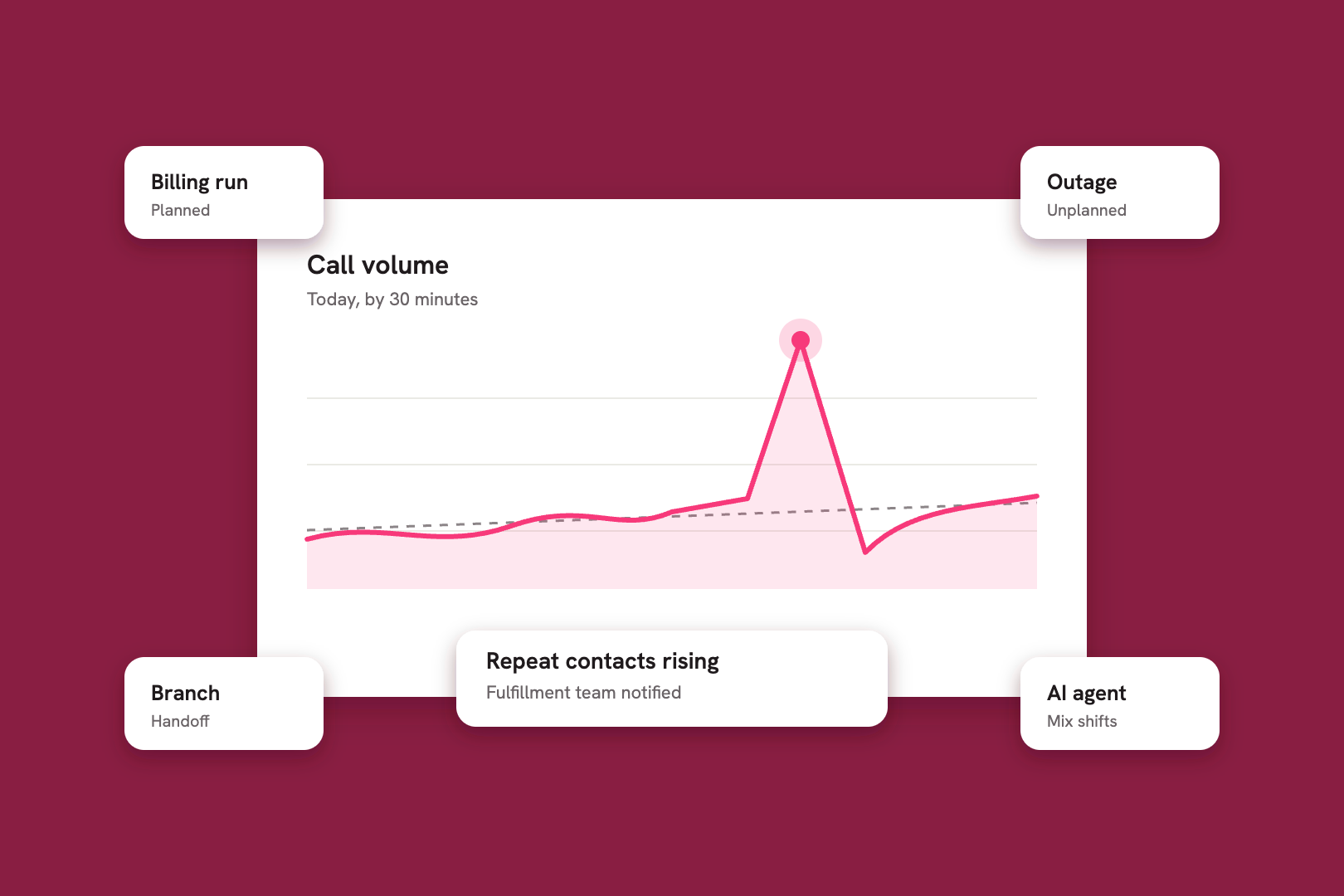
Contact volume has always followed the business, and the connection is now tighter and faster than it used to be. A pricing change, a delayed shipment, a payment system that goes down for an hour or a storm that grounds flights can each send customers looking for help within minutes. Planned changes are known somewhere in the business before the first contact arrives, and the workforce team may still learn about them from the queue.
Forecasts built only on contact history treat these events as unexplained noise. Workforce teams that stay in regular contact with the people who plan pricing changes and product releases, and keep a record of how past events moved volume and handle time, are better placed to prepare for the next one. Over time that record becomes a practical account of how the business drives demand, which is useful to every team that serves customers.
2. Workforce data can be the first sign of a problem elsewhere
The contact center can be one of the first places a problem elsewhere in the business becomes visible, and workforce data is where it shows up. Consider an illustrative example. A carrier delay holds up a large batch of orders overnight, and by mid-morning repeat contacts are climbing while handle times rise because every call needs a status check. The afternoon is heading for a service miss, and the fulfillment team may not yet know how many customers are affected.
Spotted early, that pattern gives the workforce team time to adjust staffing before service slips. It also gives the business a chance to tell the fulfillment team while the problem is still small, which shortens the time customers spend affected by it.
Repeat contacts are among the clearest of these signals. They show up as volume the forecast did not expect, and they usually point to an issue that started somewhere else in the customer journey.
3. The service promise runs through more teams than the contact center
Many customer issues continue after the conversation ends. A claim moves to an adjuster or a refund goes to a payments team, and in many industries part of the work happens in branches or with outsourcing partners. Each of those teams carries part of the service promise, and a delay in any of them can come back to the contact center as another contact.
Those handoffs are easy to miss when each team watches only its own queue. Leaders who share backlog information with the back office and outsourcing partners can catch a delay before it turns into repeat contacts, and can hold every team that touches the customer to the same service commitments.
4. AI is on both sides of the conversation
Companies are deploying AI agents to handle routine work, and customers are starting to bring AI assistants of their own. Both change how demand arrives and what reaches people. The contacts left for human agents tend to be the harder ones, and the mix between people and AI can shift from week to week as automation expands or is pulled back.
A staffing plan built for a stable headcount handling a stable mix of work struggles in that environment. Workforce teams need to track which contacts now reach people, and plan hiring and training around the harder work that remains. That is a workforce management question, and the answer shapes how the customer experience performs

What connected workforce management looks like in practice
Connected workforce management starts with understanding why demand moved. When workforce teams share what they see with the leaders whose decisions drive volume, everyone spends less time reconciling separate reports and more of it acting on what the numbers show.
It also gives leaders a clear account of where paid time goes. Executives want to know how workforce capacity is spent across handling contacts, training, coaching, back office work and time lost to unplanned events, and the workforce plan is the natural source of that answer. A clear account of paid time turns the conversation about cost and service into a factual one.
Decisions stay with people throughout. As more of the response is automated, leaders need to see which rules applied and who approved each change, so the operation can trust what the automation is doing on its behalf.
Where Aspect fits
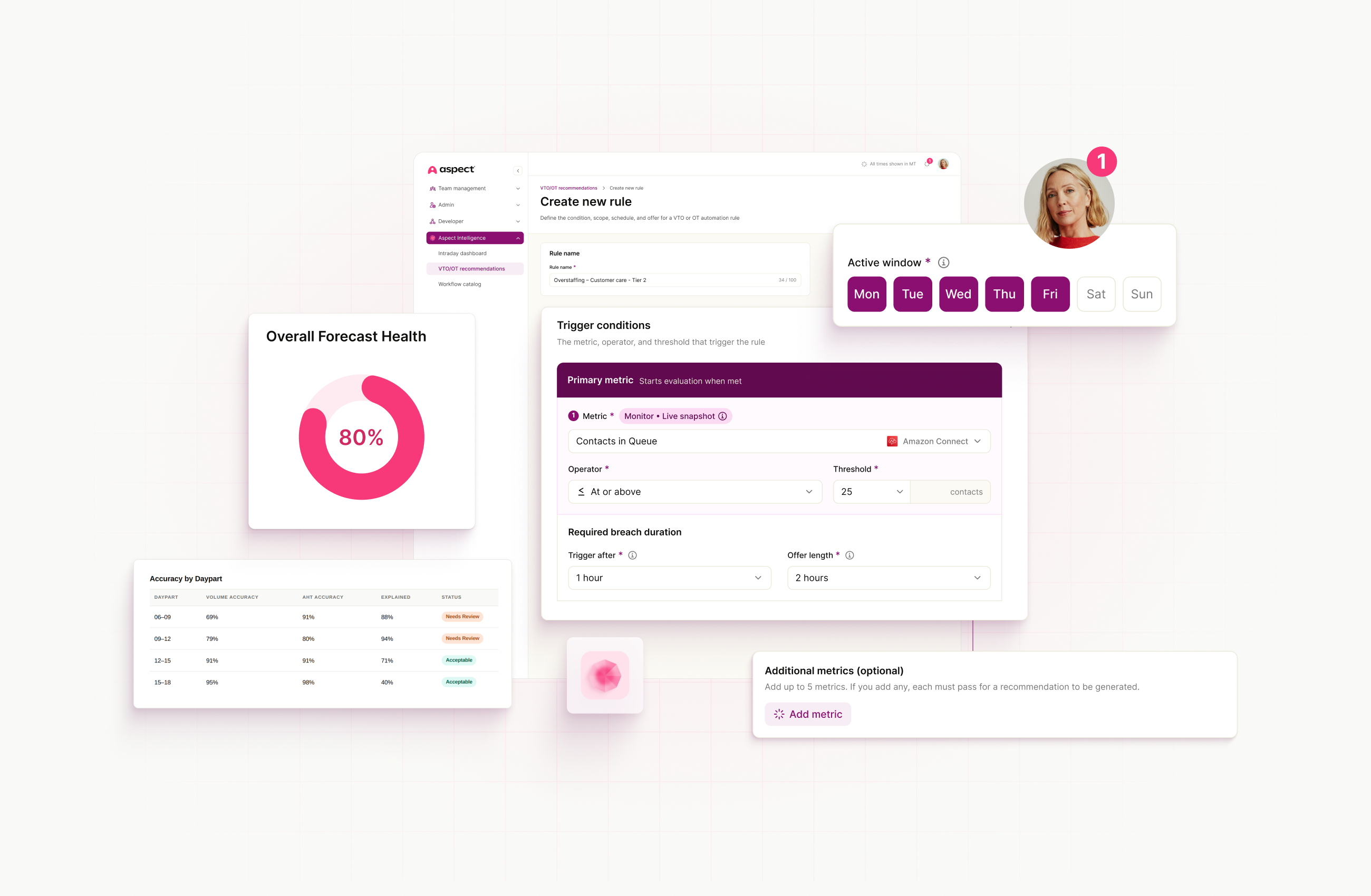
Aspect Intelligence is designed to serve as the intelligence layer across the workforce operation. It is built for transparent, explainable decisions within rules-based guardrails, and its Automatic Schedule Updates apply policy-aligned rules so schedules stay accurate at scale. Planners and leaders keep control of the decisions that require human judgment, with the system identifying risk early and guiding policy-aware action.
What this means for CX leaders
Workforce management now sits at the center of the customer experience. The decisions made in the workforce plan shape how quickly customers get help and what that service costs, across every team that touches the customer.
CX leaders who connect the workforce plan to the rest of the operation get earlier warning of problems and a clearer account of where capacity goes. As demand becomes harder to predict and the workforce becomes more varied, that connection is one of the most valuable things a customer operation can have.
- How does workforce management affect customer experience?

- Why is workforce management more important now than before?
- Can workforce data reveal problems in other parts of the business?
- Why do the back office and outsourcing partners matter to customer experience?