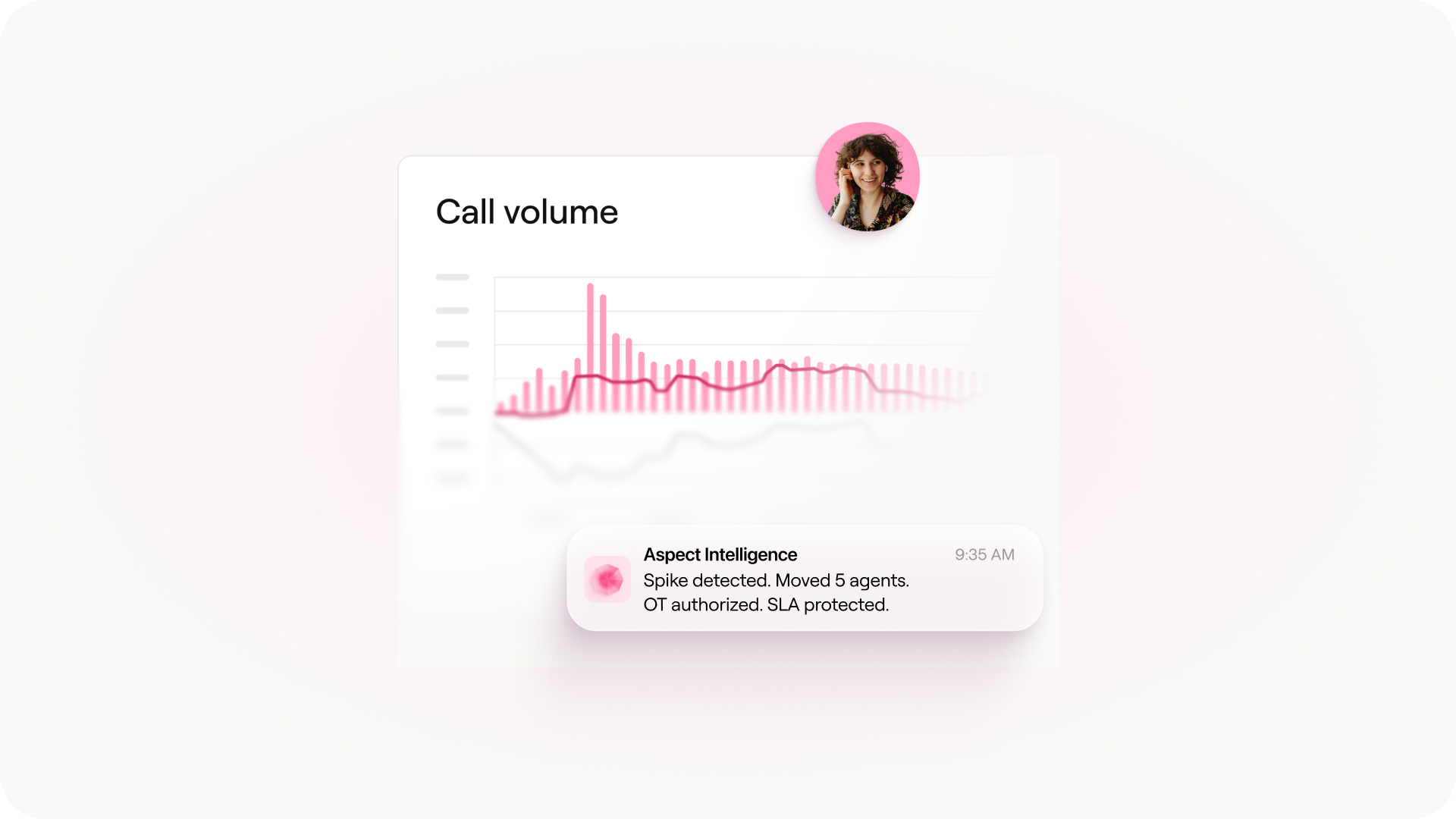


The moment an AI assistant starts handling your simple contacts, your forecast stops describing reality. The volume that used to arrive as thousands of short, predictable calls now splits in two. AI absorbs the routine questions, and what reaches a human is the longer, harder, more variable work that was always the difficult part of the day. Your historical averages were built on the old mix, and they quietly stop matching what actually hits the floor.
This is the forecasting problem almost nobody was ready for. Most workforce models were designed for a world where one contact meant one agent busy for one fairly predictable stretch of time. Take the easy contacts out of that model and hand them to AI, and the math underneath your staffing plan starts describing a contact center that no longer exists. The work that remains is real, it is demanding, and it needs a different kind of forecast.
Why does AI deflection make forecasting harder, not easier?
AI deflection makes forecasting harder because it changes the composition of the work, not just the volume of it. When AI contains the simple, high-frequency contacts, the interactions that escalate to a person are disproportionately the complex, emotional, exception-heavy ones. Handle times get longer and more variable, and the tidy averages your plan was built on no longer fit the calls your agents actually take.
Think about what this does to a traditional forecast. A model trained on last year's data has learned an average handle time that blended thousands of two-minute password resets with a smaller number of fifteen-minute billing disputes. Route the resets to AI, and the average handle time your agents experience jumps, because the easy contacts that used to pull it down are gone. If your forecast still assumes the old blended number, you will understaff every interval, and you will not understand why the floor keeps falling behind.
Containment rates and escalation flows become forecasting inputs as fundamental as the arrival curve itself. You now have to predict not only how much work arrives, but how much AI will hold, what fraction will escalate, and what that escalated work will demand from a person. A staffing model that cannot see the AI side of the floor is forecasting the wrong operation.
What data do you need to forecast a hybrid workforce?
You need visibility into both sides of the split, which means your forecast has to ingest AI containment data alongside your traditional human-side metrics. At minimum that means knowing how many contacts AI is handling, what percentage it successfully contains, which contact types escalate and at what rate, and how handle time and complexity shift for the work that reaches a person after AI has taken the first pass.
Most operations do not have this cleanly today, and that is the honest starting point. The AI side often lives in one system, the human workforce data in another, and the two were never designed to be forecast together. Before the model can be accurate, someone has to connect those sources so containment and escalation feed the same plan that schedules your people. This is unglamorous integration work, and it is exactly the work that determines whether a hybrid forecast is trustworthy or fictional.
The size of the shift is worth taking seriously. Research covered by Retell AI puts the current call center AI market near $4.89 billion, with AI increasingly handling the 60 to 70 percent of inbound contacts that follow structured patterns. When a majority of your simple volume moves to AI, the assumption that your historical data still describes your floor stops being safe.
How do you staff for work that AI has already filtered?
You staff for a harder average and a wider spread, because the work AI leaves behind is both longer and less predictable than the blended workload you used to plan around. That means building your capacity plan on the handle time and complexity of escalated work specifically, rather than on a company-wide average that AI has made obsolete.
It also means planning for skill, not just headcount. When the simple contacts are gone, every remaining interaction is more likely to need judgment, product depth, or the authority to resolve an exception. A floor of generalists sized to an old average will struggle even when the headcount number looks right, because the work now demands more from each person. Skills-based forecasting, where you predict demand for specific capabilities and staff against it, becomes the difference between a plan that holds and one that looks fine on paper and fails by mid-morning.
There is a human cost to getting this wrong that shows up in retention. When a floor is chronically understaffed because the forecast underestimated the difficulty of escalated work, the agents absorbing that pressure are handling a relentless stream of hard interactions with no breathing room. Independent research from Insignia Resources puts contact center turnover at 40 to 45 percent annually, with each replacement costing $10,000 to $20,000. A forecast that miscounts the real weight of the work feeds directly into that number.
Where does AI fit in the planning itself, not just the queue?
AI belongs in the forecast as much as it belongs in the queue, predicting demand across the whole hybrid operation and re-forecasting as conditions change through the day. The useful role is a system that learns the containment and escalation patterns of each contact type, projects total demand across AI and human work as one connected picture, and updates that projection in near real time as actuals come in, rather than freezing the plan at the morning forecast.
This is where Aspect thinks about workforce intelligence as one connected layer rather than a stack of separate forecasts. Aspect Intelligence models the work as a single operation, flags where service is at risk as the day moves, and proposes the next move within the guardrails a planner controls. The planner stays in charge of the assumptions and the final call, which is what keeps the intelligence honest rather than a black box nobody in operations will trust.
The direction is set. According to CMSWire reporting, 76 percent of contact center leaders are formalizing a human-AI split where AI handles scheduling, routing, and availability while people manage the complex, high-stakes interactions. The operations that plan for that split deliberately will run calmer floors than the ones still forecasting as though the easy contacts never left.
What this means for your workforce strategy
The hybrid floor is not a temporary transition state you can wait out. It is the operating model contact centers are settling into, and the forecast has to catch up to it. The centers that treat AI containment as a first-class forecasting input, staff for the harder work that escalates, and plan for skill rather than raw headcount will run service levels their competitors cannot match on the same budget.
The uncomfortable truth underneath all of this is that AI does not make workforce planning simpler. It makes it more important, because the work left for people is exactly the work where getting staffing wrong hurts the most.

- Why does AI make contact center forecasting harder?

- What is skills-based forecasting?
- What data does a hybrid workforce forecast need?
- Does AI reduce the number of agents a contact center needs?
- How often should a hybrid forecast be updated?