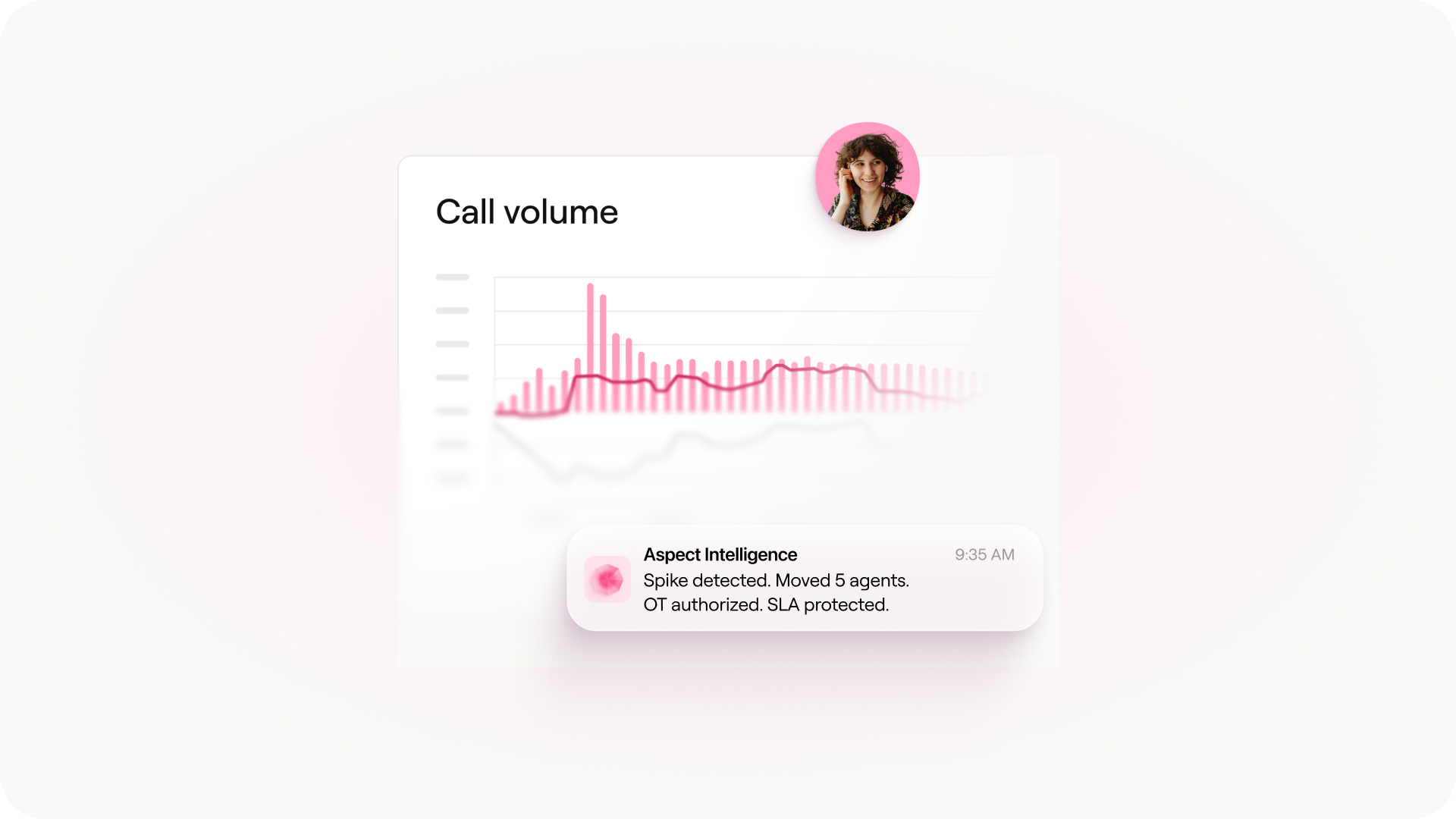



For most contact centers, a lack of schedules isn’t the reason for missed service levels. The real issue is not being able to quickly see when the situation on the floor has deviated from the staffing plans.
A call center adherence report helps leaders catch these deviations early enough so service levels remain stable. It compares scheduled agent activities with what’s happening in real-time, showing whether agents are in the right place doing the right thing at the right time.
Some treat adherence reports as end-of-day compliance checks to simply identify who fell outside their scheduled activities. However, these reports can offer contact centers greater value by showing intraday managers what’s happening right now and what staffing action needs to happen next.
Used as a real-time tool, adherence reports give contact centers something to act on while there's still time to change the outcome, rather than simply documenting what went wrong.
What Is a Call Center Adherence Report?
A call center adherence report is a workforce management tool that shows whether agents are on schedule and handling the right activities.
The report tracks whether agents followed their laid-out schedules, tracking activities such as:
- Login times
- Available time
- Breaks, lunches, meetings, training, etc
- After-call work
- Unscheduled offline time
It compares scheduled agent activities with what actually happened at different intervals. This matters in contact centers because staffing plans rely on having the right number of agents available at every moment. When agents aren’t available at the times the schedule expects them to be, even a plan built on precise headcount assumptions breaks down.
Adherence reporting is not only about guaranteeing that agents stay disciplined. It helps leaders identify staffing gaps, detect exceptions that can affect the schedule, flag late logins, and catch extended breaks before they affect service levels.
What Should a Call Center Adherence Report Include?
Adherence reports must provide enough context to drive a decision, not just a compliance number. Core elements typically include:
- Scheduled activity: The agent's planned duties at each point in the day.
- Actual activity: The tasks the agent actually performed.
- Agent status: The agent's current state in the workforce management system, such as available, on break, in after-call work, or offline.
- Time in adherence: Total time the agent followed the schedule.
- Time out of adherence: The time an agent spends outside the schedule, such as taking a long break, returning late from lunch, or being stuck on a call.
- Adherence percentage: How much scheduled time an agent spent in the right activity.
- Late logins: Agents who were not logged in and available when the shift started.
- Early logouts: Agents who disconnected before the shift ended.
- Extended breaks or lunches: Time taken beyond the planned break or lunch window.
- Unscheduled offline time: Unavailability that wasn't planned or approved, such as a system issue or an agent stepping away without notice.
- Exceptions or approved deviations: Schedule changes that should not count against adherence, such as a system outage and shift swap.
- Team, queue, or skill group: Groups adherence data so leaders can see patterns by team, queue, or skill group rather than individual agents only.
The best reports give managers enough context to help avoid false assumptions. An agent may appear out of adherence because of an approved meeting, a system issue, or a schedule change that wasn't updated correctly. Without that context, managers end up investigating non-problems while the real coverage gaps remain unaddressed.
Real-Time vs Historical Adherence Reports
Real-time and historical adherence reports are built to work together, but their differences matter.
Real-time adherence reports show what agents are doing right now compared with what they are scheduled to do. These reports update throughout the day, giving intraday managers visibility to act before service levels erode.
When the queue starts building at 11:00 a.m., and real-time adherence shows four agents are suddenly unavailable, the intraday manager can quickly react by shifting available agents or moving breaks before conditions deteriorate.
Historical adherence reports show patterns over days, weeks, or months. These reports help identify recurring schedule issues, coaching opportunities, and planning gaps that typically only become apparent over time.
Both of these reports are important. Without real-time reports, intraday managers can’t identify coverage gaps as they develop, leaving them to respond after service levels have become unstable. Without historical reports, recurring schedule problems go undetected, and the same adherence issues repeat.
Why Adherence Reports Matter for Staffing Decisions
A staffing plan is only as good as its execution. Accurate and well-constructed forecasts, headcounts, and schedules won’t hold if agents aren't available when the plan expects them to be.
Adherence gaps don't need to be large to cause problems; even a handful of agents drifting off schedule during the same busy period can back up the queue just as badly as if the contact center were short-staffed.
Adherence reports support staffing decisions by giving leaders answers to key operational questions that come up during the day, such as:
- Are enough agents available to handle the current queue volume?
- Are breaks and lunches occurring at the wrong times, creating coverage gaps?
- Are agents missing their scheduled activities, and if so, why?
- Are service level issues caused by agent behavior, forecast misses, higher-than-expected shrinkage, or a schedule that was inadequate from the beginning and would never have held up under real conditions?
- Does coverage need to be adjusted before things get worse?
The report sits between the workforce plan and what's happening in real-time. It shows where the plan is breaking down and gives managers a chance to act while it still matters. Without it, declining response times are usually the first sign that there’s a problem.
How Leaders Use Adherence Reports for Intraday Management
Adherence data only has value when acted on quickly. A report reviewed at the end of the day is an after-action review rather than a management tool.
Effective intraday managers are the ones who use adherence reports to:
- Adjust breaks and lunches when queue pressure increases by pulling breaks from low call volume periods to relieve pressure at busier times.
- Rebalance agents across queues or skill groups when some teams have capacity, and others are struggling to keep up.
- Investigate exceptions before concluding noncompliance.
- Flag unscheduled offline time during critical intervals, especially when it's happening across multiple agents simultaneously.
- Escalate recurring issues to supervisors when an adherence pattern suggests a structural problem rather than an individual one.
- Get ahead of service-level problems before they require more disruptive fixes, such as emergency overtime or pulling agents from other queues.
Take a morning, for example, where service level starts slipping at 11:00 a.m. The adherence report shows several agents out of their scheduled activity during the same period. Some have logged exceptions; others don't.
In such a case, the intraday manager checks the exceptions and clears the ones with valid reasons, moves some breaks, and redirects two available agents to cover the gap. This ensures queue stabilization before things get worse.
How to Interpret Adherence Report Patterns
An adherence percentage on its own doesn't tell leaders much. The number becomes more meaningful only when read alongside what else is happening on the floor.
The same adherence score can point to completely different problems, depending on the context.
The list below highlights key adherence patterns and their interpretations.
- Low adherence + falling service level: A possible live coverage gap that needs immediate intraday action
- Good adherence + poor service level: A forecast or staffing model problem where agents are following the schedule, but the schedule wasn't built for actual demand
- Low adherence concentrated around breaks: A break management issue or a lack of clarity around schedule expectations
- Low adherence across one team: A coaching gap or supervisory issue, rather than one agent’s behavioral problem
- High adherence + high occupancy: A burnout risk because schedules are too rigid, and agents have no time to rest between calls
Reading adherence in isolation leads to the wrong conclusions. A manager may assume that low adherence is because of noncompliance when it actually stems from an inaccurate forecast, poorly designed schedule, or a shrinkage assumption that was never realistic.
Adherence data must be read alongside service level, occupancy, shrinkage, absenteeism, AHT, and forecast accuracy before drawing any conclusions about what's actually wrong and what fix is required.
Common Adherence Reporting Mistakes Contact Centers Make
Most contact centers aren't short on adherence data. The problem is how that data gets used.
Below are a few patterns that stop adherence reports from driving better staffing decisions:
- Reviewing adherence only after the day ends: End-of-day reviews have their place, but can't change what already happened. Adherence data that isn't visible in real-time becomes less valuable and acts as a log of missed opportunities.
- Treating the report as an agent scorecard: When adherence reporting is mostly used as a performance rating mechanism, the operational function gets lost. “Did an agent’s deviation create a coverage gap?” is more important than “Was an agent out of adherence?”
- Ignoring approved exceptions: Reports that don't highlight approved deviations make legitimate schedule changes look like compliance failures. Over time, this erodes trust in the data and in the managers who rely on it.
- Relying on a single daily adherence percentage: A 92% daily adherence score looks acceptable until it becomes clear that the 8% deviation happened during the three busiest periods of the day. Interval-level context is what makes the number meaningful.
- Disconnecting adherence from service level performance: Adherence and service level need to be read together. A deviation that doesn't affect service level is low priority, while a pattern that corresponds with low service levels is a planning problem that needs fixing.
- Not feeding historical patterns back into scheduling: If the same intervals show low adherence week after week, the schedule needs to be redesigned and not simply remain as reports.
- Focusing on compliance without fixing supervisor workflows: Supervisors who spend their shifts manually tracking deviations have less capacity to address the operational issues behind those deviations.
The issue is rarely a shortage of reports, but that the reports arrive too late, lack the context needed to act on them, or are too focused on individual behavior instead of improving operations.
How Adherence Reports Support Better Coaching
Adherence data gives supervisors a more objective starting point for coaching conversations, reducing reliance on gut feelings and observations alone. Used correctly, it makes coaching more consistent and grounded. Used poorly, it makes agents feel that every minor deviation is being tracked against them.
Here are the principles that make adherence-based coaching more effective and help agents see that the aim is maintaining work order fairness and optimal service levels:
- Coach the pattern, not one-off deviations: A single deviation rarely warrants a conversation. Repeated late logins or consistent extended breaks are worth addressing.
- Check exceptions before drawing conclusions: An agent who appears out of adherence may have had a supervisor-directed task or an approved schedule change that wasn't logged correctly. Get more context about exceptions before striking a conversation, if still needed.
- Connect schedule behavior to operational impact: Agents respond better when they understand how schedule adherence affects colleagues and customers. The coworkers who absorb extra volume, and the customers waiting longer in the queue.
- Use the data to separate behavior from planning problems: If agents consistently take longer to wrap up calls than the schedule accounts for, the issue may be in how the staffing model was built, not in how agents are working. Coaching without fixing the root cause would produce the same result every cycle.
- Show agents the team-level picture: When one agent takes longer breaks during a peak period, someone else picks up the slack. Making that consequence visible helps agents understand that adherence goes beyond individual compliance and is about the team functioning as a unit.
How Historical Adherence Data Improves Future Scheduling
Historical adherence data does more than spot recurring schedule gaps; it keeps contact center managers more informed regarding workforce planning decisions.
Here are some ways contact center leaders use this data to improve schedule adherence:
- Better break and lunch placement: When the data shows breaks consistently running long or agents returning late during the same periods week after week, leaders can adjust the break times as needed.
- More accurate shrinkage assumptions. A single shrinkage figure applied across the whole day masks significant variations. Historical adherence data shows how availability actually shifts across different periods, making shrinkage planning more precise.
- Improved schedule design. Recurring out-of-adherence events during the same window are usually a sign that the schedule was built around assumptions that don't reflect how the floor actually operates. Historical data makes those mismatches visible.
- More realistic staffing models. If the scheduled headcount consistently falls short during certain periods, the staffing model needs to be adjusted, not just the agents managing it.
- Stronger coaching priorities. Patterns across weeks and months tell supervisors where to focus, rather than reacting to whatever happened yesterday.
- More grounded forecast review cycles. Volume history alone doesn't explain why service levels slipped. Historical adherence data gives forecast reviews a more complete picture of what affected a call center's performance.
Historical adherence reporting should feed the next staffing plan, not just the next performance review. Contact centers that consistently use that data in their planning cycles build schedules that are harder to break.
How Workforce Intelligence Makes Adherence Reports More Actionable
Adherence data becomes more useful when connected to the full operational picture: forecasts, schedules, live queue conditions, and service level targets.
In isolation, an out-of-adherence event is just a flag. In context, it's either a problem requiring action or a signal that something in the underlying plan needs to change.
Workforce intelligence software is what connects those layers and gives leaders a bird's-eye view of operations.
When intraday managers can see a deviation alongside live queue metrics and current service level performance, they can quickly tell whether that deviation is creating a coverage gap right now or whether staffing levels are still holding up despite it.
That clarity changes how quickly teams respond and where they focus their attention. Instead of investigating every deviation or waiting for a service level alert to confirm what the adherence report was already showing, managers can act on deviations that carry real operational risk and deprioritize the ones that don't.
It also changes how exceptions get handled. When approved deviations surface automatically alongside raw adherence data, managers spend less time chasing false signals and more time addressing genuine coverage gaps. And when data points to a recurring planning problem rather than an individual behavior issue, that information is used in the next scheduling cycle.
Why Enterprise Contact Centers Choose Aspect
Adherence monitoring is only as useful as the platform behind it. For enterprise contact centers, knowing there's a coverage problem and being able to act on it in time are two very different things.
Aspect is the operational layer that connects adherence data to the decisions that actually keep service levels on track, from real-time coverage adjustments to scheduling cycles to coaching conversations.
Aspect Workforce gives intraday managers real-time visibility into what agents are doing across every team, queue, and skill group, so coverage decisions are based on what's actually happening on the floor rather than what the schedule assumed would happen. When adherence gaps develop during peak periods, managers have the data to respond quickly.
Aspect Intelligence™ connects adherence data with forecasting and scheduling so leaders can see whether a deviation is creating a real coverage risk or falling within tolerance. That connection reduces the time managers spend investigating false signals and gives them clearer direction on where action is needed.
Over time, the platform helps contact centers build better schedules by feeding historical adherence patterns back into forecasting and planning cycles. Recurring gaps get addressed at the source rather than managed shift by shift. Coaching conversations are grounded in operational data rather than observation alone, which makes them more consistent and effective.
The result is a workforce operation that runs with less friction: more accurate schedules, faster intraday responses, stronger service level performance, and greater management efficiency for supervisors.
See how a global automotive company used Aspect's real-time adherence monitoring to make their workforce more efficient.
- What is an adherence report in a call center?

- What is the difference between adherence and conformance?
- Why is real-time adherence important?
- How do adherence reports improve staffing decisions?
- What causes low schedule adherence in a call center?