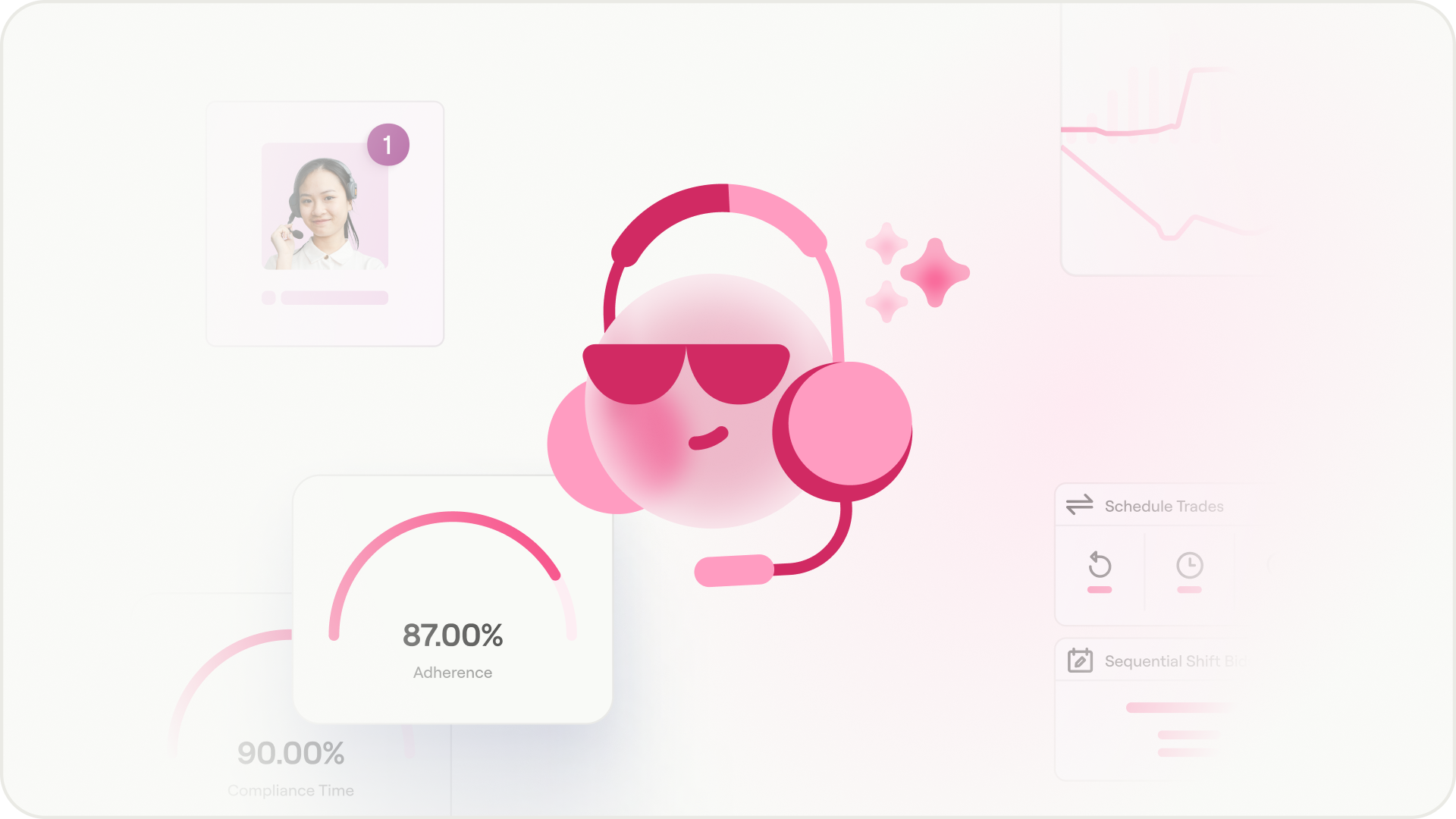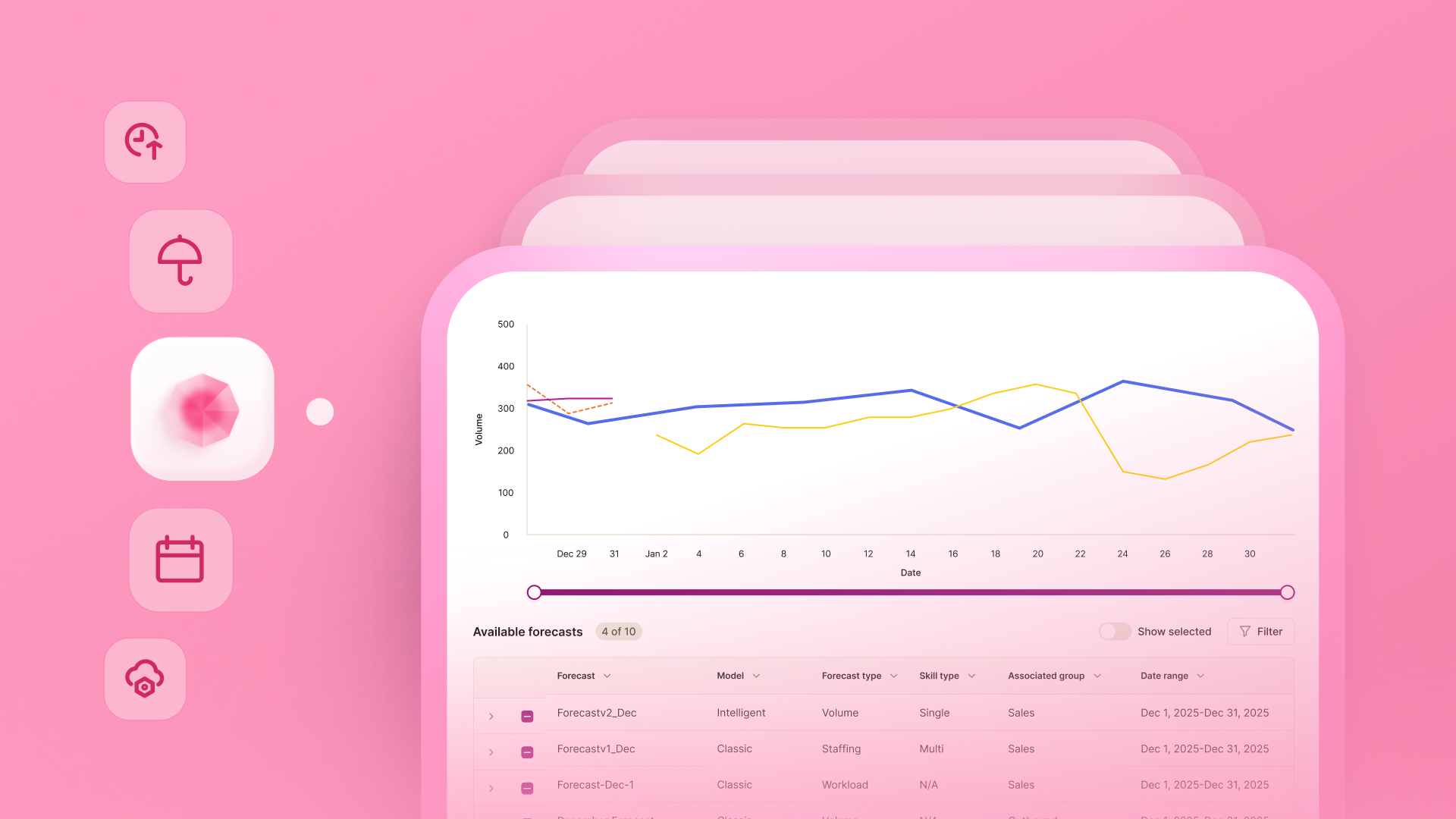


Most workforce management runs open-loop. You forecast, you schedule, you manage the day, and then you report on what happened. The report tells you your service level and your adherence, and next week you do the whole thing again, mostly disconnected from whether any of it moved the outcomes your customers or your executives actually care about. The loop never closes.
The direct answer is this. Closed-loop workforce intelligence connects every scheduling and intraday decision to the customer outcome it produced, then feeds that result back into the next forecast and schedule. Instead of measuring WFM only on internal metrics like adherence and occupancy, you measure it on whether it improved first contact resolution and customer satisfaction, and the business results that follow from both, and you use that signal to make the next decision better.
This is what moves an operation from workforce management to Workforce Intelligence. Management keeps the trains running. Intelligence learns from what each decision produced and gets sharper over time. Closing the loop is the difference between the two.
What is closed-loop workforce intelligence?
Closed-loop workforce intelligence is a way of running operations where the outcomes of your workforce decisions flow back into the decisions themselves, so the system improves each cycle instead of repeating the same guesses. In an open loop, you forecast demand, build schedules, manage intraday, and report results as four separate activities that hand off in one direction and never circle back. In a closed loop, the results of last week's decisions, what actually happened to service level, resolution, and customer satisfaction, become inputs to this week's forecast and schedule.
Concretely, closing the loop means your quality and CX data live in the same view as your forecast and adherence data, and you can trace a line from a staffing decision to its effect on the customer. When you shifted people to chat on Tuesday, what happened to resolution on voice. When adherence dropped in an afternoon, did customer satisfaction move with it. Those connections are invisible in most operations because the data sits in separate systems owned by separate teams, which is the coordination cost this whole approach is built to remove.
The schedule intelligence idea sits right here. Treat a schedule as a hypothesis about how to produce a customer outcome. A closed loop tells you whether that hypothesis held and adjusts the next one.

Why can't most WFM teams tie a schedule change to a CX outcome?
Most teams cannot connect a schedule change to a CX outcome because the data lives in systems that were never designed to talk to each other, and the teams that own them report to different leaders with different goals. WFM owns the forecast and the schedule. Quality owns CSAT and evaluations. The CX or analytics team owns the customer surveys and the outcome metrics. Each has its own tools, its own definitions, and its own weekly meeting, and the numbers rarely line up because nobody built the join between them.
So when a leader asks whether better scheduling improved customer satisfaction, the honest answer in most operations is that no one can tell. The forecast accuracy report says one thing, the CSAT dashboard says another, and there is no shared key that connects a specific decision to a specific result. This is the hidden operational tax of siloed workforce decisions, and it is expensive precisely because it is invisible. You keep investing in WFM without being able to prove what it returns.
McKinsey's most recent State of AI research puts a number on how common this gap is. Nearly two-thirds of organizations have not yet begun to scale AI beyond pilots, and only 39% report enterprise-level EBIT impact from it. The pattern behind those numbers is almost always the same. Teams deploy tools without closing the loop between action and outcome, so they cannot see what works, cannot double down on it, and stall out before the investment pays back.
How do you build a weekly operating cadence that closes the loop?
Build a single weekly cadence where the forecast, the schedule, the intraday actions, and the customer outcomes get reviewed together by the people who own each one. The mechanics matter less than the fact that everyone is looking at the same connected data at the same time. Start by reconciling last week. Where did the forecast miss, what did you do about it intraday, and what happened to resolution and satisfaction in those hours. Then carry the lesson forward into this week's plan explicitly rather than hoping someone remembers.
A cadence that works tends to move through a few stages. You review forecast accuracy and the reasons behind the misses. You look at how intraday decisions played out, which reforecasts and schedule changes helped and which did not. You connect those to the CX outcomes for the same periods, so the customer result is in the room. And you agree on two or three specific changes to make next week, with an owner for each. The point is that the outcome data actually changes the next decision, which is the part open-loop operations skip.
The teams that do this well stop arguing about whose number is right. When the forecast, the adherence data, and the CSAT trend sit in one view, the conversation moves from defending metrics to improving outcomes, and that shift alone removes a surprising amount of wasted effort.
What should you measure to connect WFM decisions to CX?
Measure a small set of metrics that bridge the operational side and the customer side, so you can see cause and effect rather than two disconnected scoreboards. On the operational side, keep forecast accuracy and schedule adherence, plus the speed at which you can adjust when something changes. On the customer side, track first contact resolution and customer satisfaction at the same time granularity, ideally by interval and channel, so you can line them up against the operational decisions that drove them.
The bridge metric most teams are missing is time-to-adjust, the gap between when conditions change and when your staffing responds. This matters because a closed loop is only as fast as its slowest link, and in most operations the slowest link is the human process of noticing a problem, deciding what to do, and making the change. Shrink that gap and every other metric improves, because you are acting on reality instead of on the forecast you built last month.
Gartner's data on executive pressure shows why leaders increasingly demand this connection. In a survey of 321 customer service and support leaders, 91% said they are under executive pressure to implement AI, and the emphasis has shifted from cutting costs to directly improving customer satisfaction. That means WFM teams are now expected to show their work in CX terms, and the operations that can trace a scheduling decision to a satisfaction outcome will win the budget arguments that the operations running open-loop will lose.
Where does AI fit in closing the loop without hiding the reasoning?
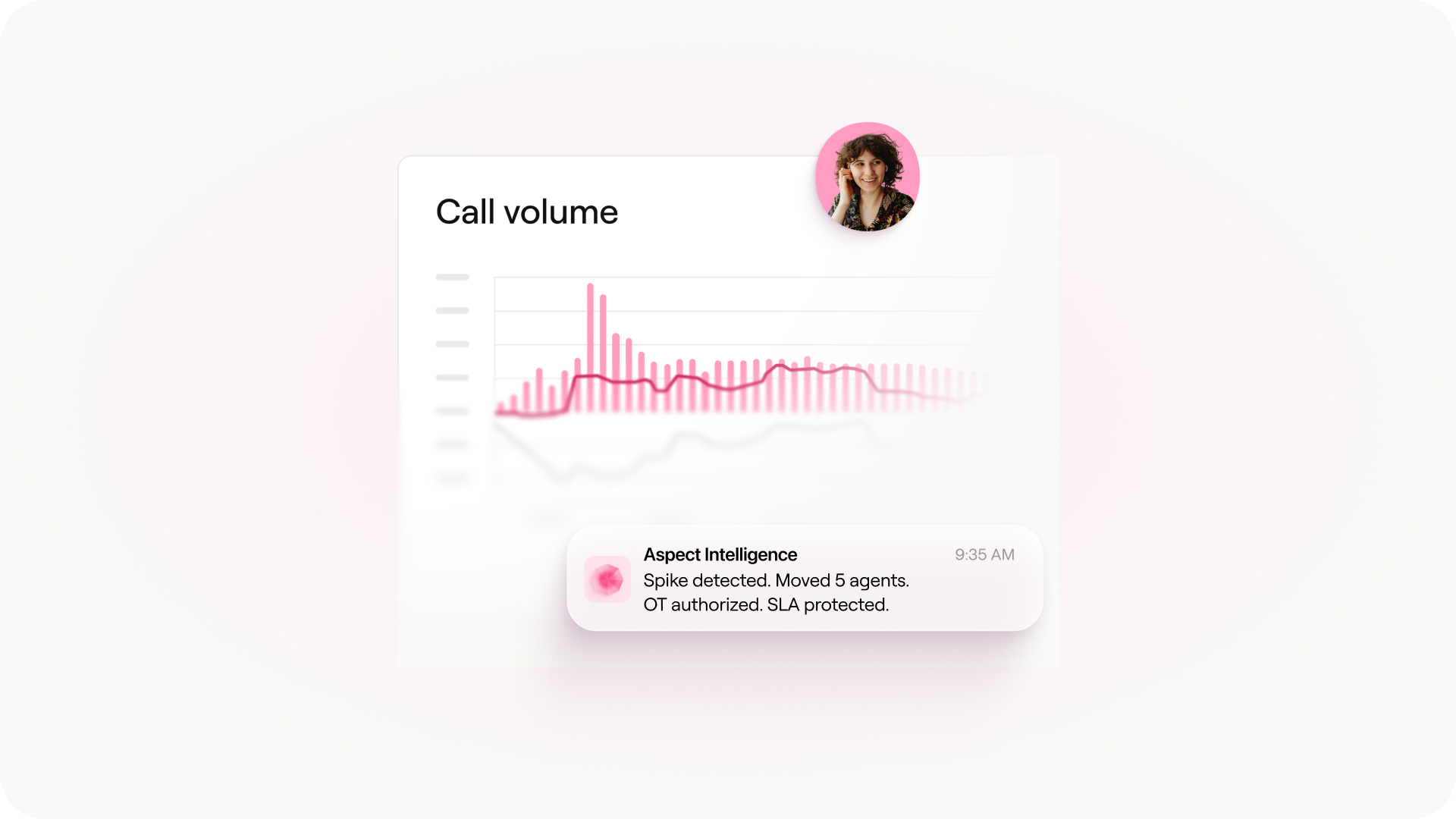
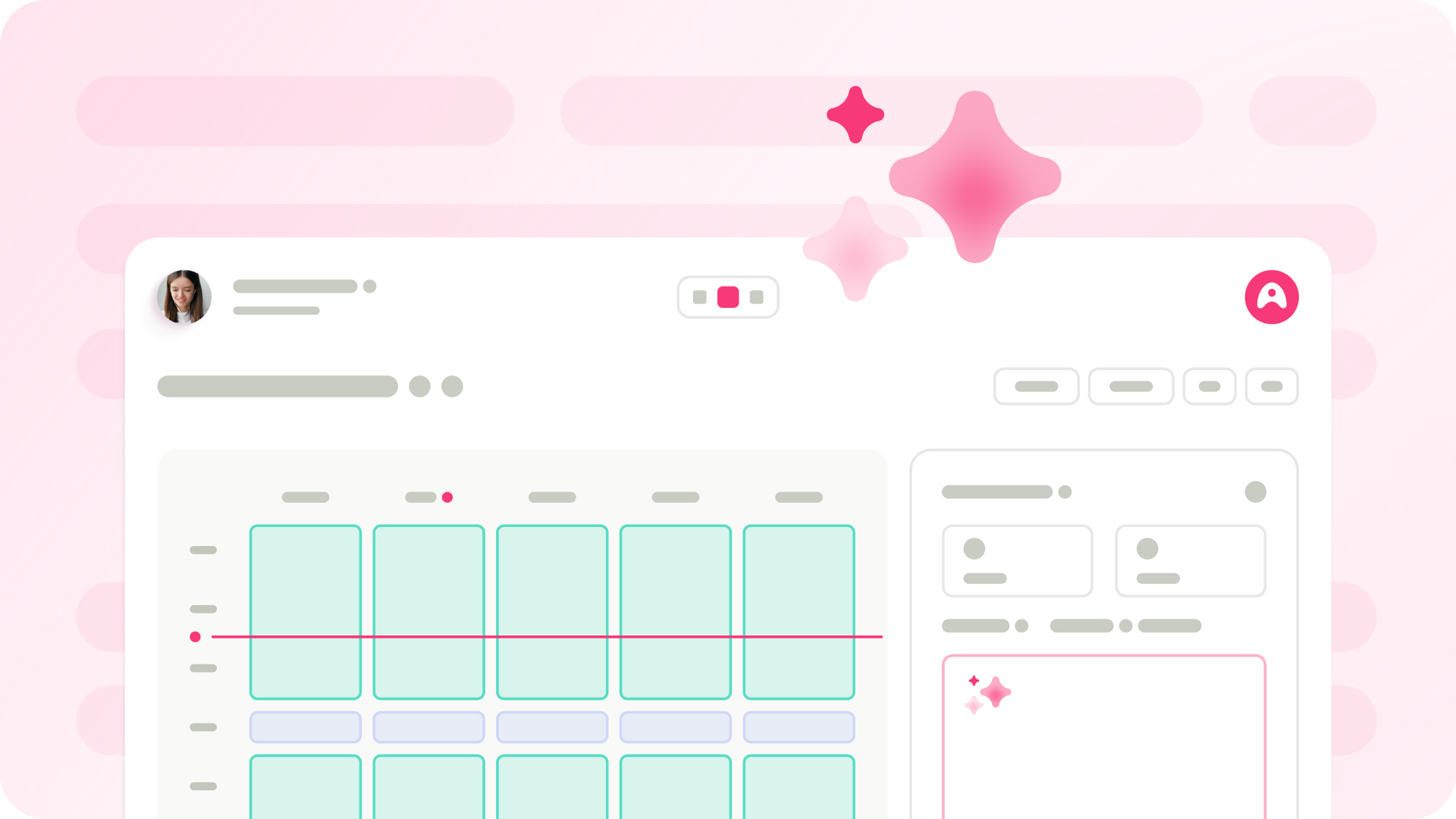
AI belongs in the connective work of closing the loop, spotting the patterns between operational decisions and customer outcomes that a human analyst would take days to find, while keeping the reasoning visible so people can trust and act on it. There is far too much data across forecast, adherence, quality, and CX for anyone to correlate by hand every week. This is where Aspect Intelligence works, connecting the real-time operational signal to the outcome data and surfacing what changed and what it appears to have caused.
The rule that keeps this useful is that the AI shows its reasoning rather than handing down a verdict. Policy-aware automation and guided intelligence means the system can flag that Thursday afternoon understaffing on chat coincided with a drop in resolution, and can recommend a schedule change, while showing the planner the data behind the recommendation so they can judge it. A manager who can see why the system reached a conclusion will act on it. A dashboard that just asserts a conclusion gets ignored, especially when it conflicts with what an experienced planner already suspects.
Closing the loop is the work that turns workforce management into Workforce Intelligence. Connect the decisions to the outcomes, review them together on a real cadence, shorten the time it takes to act, and use AI to find the patterns while keeping people in control of the calls. Do that, and every week of operation makes the next one a little sharper instead of repeating the same disconnected cycle.
- What is closed-loop workforce intelligence?

- How is workforce intelligence different from workforce management?
- Why can't my team connect scheduling to CSAT?
- What metrics connect WFM to customer experience?
- Does closing the loop require AI?