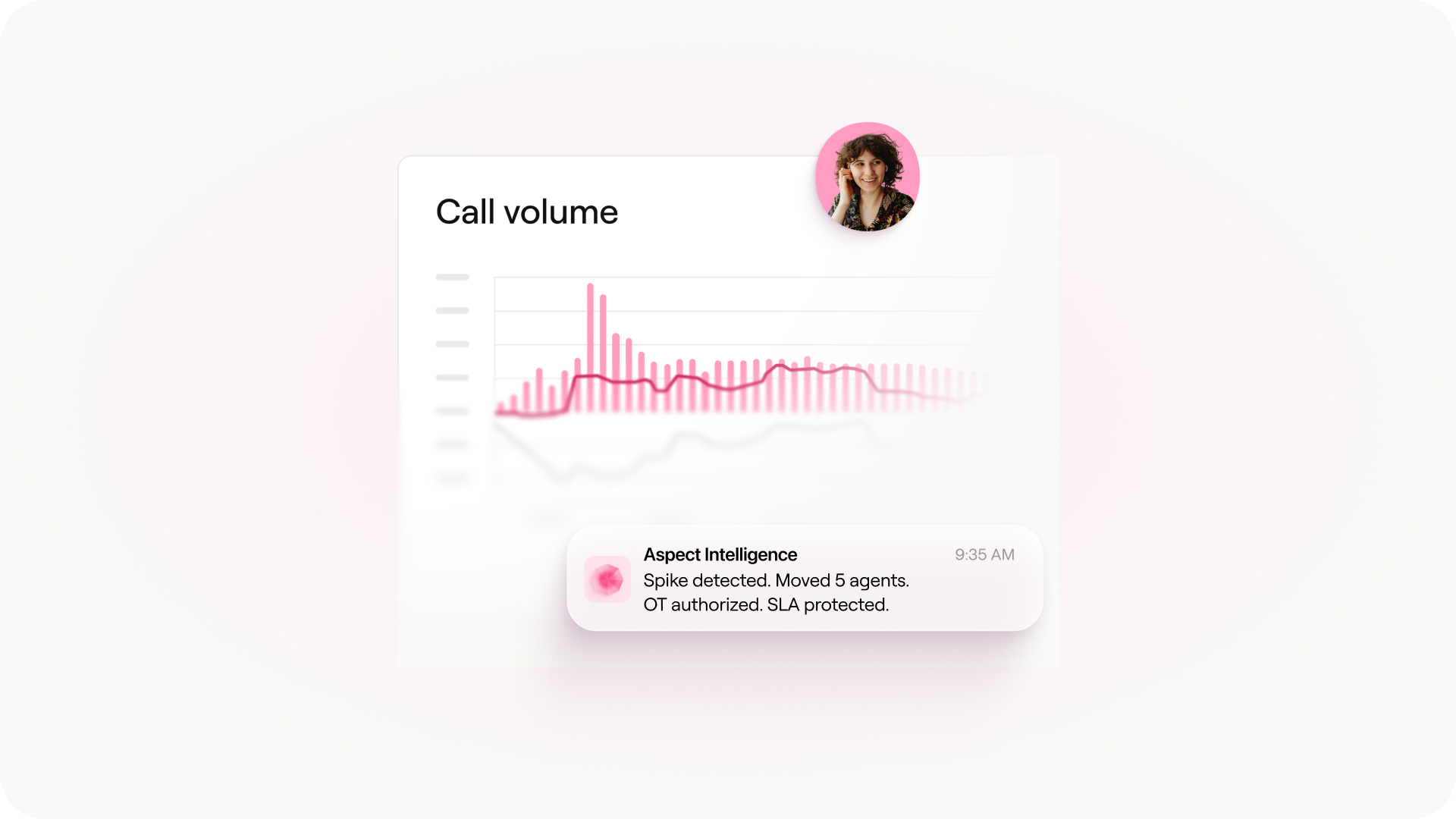


Managing workforce scheduling in a contact center has long relied on historical averages. But that approach no longer reflects how contact centers operate day to day.
Contact volumes shift by the hour. Channels fluctuate. Hybrid teams add complexity. Static schedules and manual adjustments can’t keep up, leading to inconsistent service levels, overstaffing or understaffing, and rising labor costs.
Predictive scheduling software changes that.
Modern workforce management (WFM) solutions like Aspect Workforce support connect forecasting models with real-time performance data to keep staffing aligned with actual demand. Instead of setting a fixed plan and reacting gaps, teams can anticipate changes and adjust proactively.
In this guide, you’ll learn how predictive scheduling software works in a contact center and how it helps teams protect service levels, control labor spend, and manage intraday performance with greater precision.
What is predictive scheduling software?
Predictive scheduling software uses forecasting models, historical performance data, and real-time operational inputs to adjust staffing levels dynamically based on changing demand.
In a contact center, it connects volume forecasts with live performance signals, so staffing can be adjusted throughout the day rather than locked in weeks in advance.
Traditional scheduling tools rely on historical averages and leave supervisors to manually react when conditions shift. Predictive scheduling software works differently. It anticipates change and guides adjustments before service levels are impacted.
Enterprise solutions like Aspect Dynamic Scheduling are designed for operational performance. They connect forecasts, real-time adherence data, intraday performance, and queue metrics to keep staffing and scheduling decisions aligned.
The result is a more stable operation. Less reactive firefighting, better use of labor, and more consistent customer and employee experience.
The limitations of traditional scheduling
Traditional scheduling methods weren't built for the pace and complexity of modern contact centers.
They rely on static plans in environments that are anything bust static, leading to gaps between expected and actual performance.
Here’s where they fall short:
Built on fixed assumptions
With the traditional approach, workforce managers analyze historical volume and apply shrinkage estimates to produce a plan based on ideal, expected conditions. When real-world conditions shift during the day, teams are left overstaffed during quiet periods and understaffed during demand surges.
Infrequent schedule updates
Once shifts are set, they become the source of truth for all operations and remain unchanged. With no system to account for real-time conditions, corrections come too late and service levels slip.
Reactive intraday corrections
By the time a supervisor notices service levels are slipping, the gap between planned and actual staffing has already been open long enough to hurt performance. Corrections happen only after the fact, and by then, customer experience has already suffered.
Overtime spikes and understaffing
Averaging volume patterns hides the periods when demand spikes. During those surges, agents get overloaded, handle times rise, queues grow, and service levels miss targets. When demand is overestimated, the opposite happens: paid time sits unused, creating labor waste that adds up across the operation and drives costs higher without improving service.
Service-level volatility
Without real-time adjustment capability, it is harder to track performance fluctuations. Besides hurting customer satisfaction, unstable service levels can, over time, lead to financial penalties. Agents also feel the impact through uneven workloads that increase stress and contribute to burnout and attrition.
How predictive scheduling software works
Predictive scheduling software operates as a connected set of capabilities that feed into each other. Let's break down each layer.
Historical data
Predictive scheduling analyzes historical contact volumes, seasonal patterns, channel mix, and expected demand changes to calculate how many agents are needed by skill, interval, and channel.
Unlike static schedules that are built on weekly or monthly averages, predictive scheduling works at a more granular level. That means staffing needs reflect what demand is likely to look like during a specific window, not what it averaged last month or last quarter.
Real-time data inputs
Conditions change throughout the day, which means no forecast stays perfect for long. Agents call out, volume spikes, average handle time (AHT) runs long, or a digital channel surges after an outage.
Predictive scheduling software monitors real-time adherence and queue performance to track the gap between planned and actual staffing. When that gap widens, the system flags it rather than waiting for a supervisor to notice a service-level dip on their dashboard.
That early signal is what makes intraday response faster and less reactive.
Automated schedule adjustments
Predictive systems can recommend or, in some configurations, automatically trigger schedule changes.
These adjustments may include moving breaks, reallocating agents across channels, or offering voluntary time off during slow periods. In some environments, updates can be automated within predefined rules. In others, supervisors review and approve recommended actions.
The goal is to reduce the manual work of identifying where an adjustment is needed and figuring out what adjustment to make. Human judgment still remains a part of scheduling decisions. However, with the right software, supervisors spend less time watching dashboards and more time acting on what matters.
Continuous optimization
Predictive scheduling improves as the system gathers more data. Over time:
- Forecast models are refined based on actual performance.
- Staffing decisions are evaluated against outcomes.
- Patterns in demand, adherence, and productivity feed back into future planning cycles.
The underlying model learns from outcomes, and the compounding accuracy that this creates is where the long-term operational gains come from.
Key benefits of predictive scheduling software for contact centers
When staffing aligns with actual demand, it improves the entire operation. Here are key areas where predictive scheduling delivers results:
Reduced overtime and labor costs
More accurate staffing reduces the need for last-minute fixes.
When forecasts closely match expected demand, schedules start with the right coverage. Factoring in realistic shrinkage helps prevent hidden gaps that often surface later and drive overtime.
Fewer surprises during the week mean supervisors spend less time patching holes with premium pay or emergency shift changes. The impact shows up in measurable ways:
- Lower overtime rates as fewer emergency shifts are needed.
- Reduced idle time from tighter alignment between staffing and demand.
- More predictable labor spend across weeks and months.
Improved service-level performance
Service-level agreements (SLAs) can be fragile under static scheduling. A single unexpected spike in volume or an agent’s absence can push performance below target for hours before corrective action is taken.
Predictive scheduling shortens the time between a problem emerging and a supervisor learning about it. Because the system continuously monitors adherence and queue performance against the forecast, it detects issues earlier.
Supervisors get alerts while there is still time to adjust coverage, which helps prevent small gaps from becoming missed service levels.
Better agent experience and retention
Unpredictable schedules are a leading cause of agent dissatisfaction. Last-minute changes, inconsistent shift patterns, and sudden workload spikes contribute to burnout and turnover.
According to research, replacing a single contact center agent typically costs $10,000-$20,000 in direct recruiting, training, onboarding, and ramp-up productivity loss.
Predictive scheduling creates more stability for agents. When staffing aligns with demand from the start, fewer emergency adjustments disrupt agents’ plans and work-life balance. Workloads also stay more consistent across the team, reducing the pressure that builds on individuals during understaffed periods.
Over time, that stability helps lower attrition and reduce hiring and training costs.
Greater operational agility
Volume spikes, channel shifts, unexpected absences, and changes in handle time all reflect the same reality: contact centers are constantly changing. Even well-built static schedules can fall out of alignment when conditions shift faster than forecasts can keep up.
Predictive scheduling helps teams respond without losing control of cost or performance. Real-time signals inform staffing decisions, giving leaders options before service levels are at risk. Shifts can be adjusted, skills reallocated, and coverage optimized based on current conditions.

The biggest challenges in predictive scheduling
When implemented well, predictive scheduling delivers real operational value. However, contact centers must navigate challenges when applying it in practice.
Data quality and forecast accuracy
Predictive models are only as good as the data they ingest. Problems like siloed data sources and disconnected historical records can degrade forecast quality before the model even runs.
This is a common obstacle for organizations moving off legacy systems or pulling data from multiple tools. If the underlying data does not accurately reflect how demand flows through the contact center, the forecasts will reflect those gaps.
Addressing this starts with integration, so contact data, staffing records, shrinkage inputs, and channel performance metrics feed into one shared view.
Cleaning the data is just as important. Historical volumes should be normalized to account for anomalies, outages, or one-time events that can distort projections.
Over-reliance on manual adjustments
Even with strong forecasts, many contact centers still manage intraday performance using spreadsheets and ad hoc coordination.
Supervisors monitor queues and email break changes, one group at a time. That may work for smaller teams, but it becomes fragile as volume rises or channels expand.
Manual intraday management slows response time. By the time coverage gaps are identified and corrected, service levels may already be impacted. Manual processes also make it harder to scale across large, multi-site operations where consistency and speed are critical.
Predictive scheduling delivers value when insights translate into timely action. Without automated workflows and system-driven coordination, even accurate forecasts can be constrained by manual effort, leaving potential benefits untapped.
Read more: Intraday management: The real control point in modern WFM.
Best practices for more accurate predictive scheduling
Getting the most out of predictive scheduling requires more than the right software. How teams use it matters just as much as the software’s capabilities.
Here are the practices that make the biggest difference:
Improve forecast accuracy
Forecast accuracy starts with data quality. Missing historical records, inconsistent shrinkage assumptions, and disconnected channel reporting can introduce errors before forecasting logic even runs.
Workforce managers who regularly audit data inputs and address issues like gaps in historical volume or outdated seasonal patterns see steadier forecast performance over time. Small input-level fixes compound into meaningfully tighter staffing plans down the line.
Integrate scheduling with real-time adherence
When scheduling and adherence data live in separate systems, the gap between planned and actual staffing can widen for hours before anyone notices.
Connecting scheduling to real-time adherence monitoring gives supervisors a live view of how staffing aligns with the plan at every interval. This visibility helps teams course-correct while there is still time, rather than after service levels have already fallen.
Monitor leading indicators
Metrics like average handle time, occupancy, adherence, and first-call resolution are early warning signs of stress or gaps in coverage. If only revealed after the fact, these signals come too late to prevent service disruptions.
Monitoring these metrics during the day, rather than reviewing them in end-of-day reports, gives managers more lead time to act before customer-facing performance is affected.
Align scheduling with CX goals
Staffing decisions based only on cost or headcount can push teams toward the wrong target. For example, a plan that lowers labor spend but repeatedly misses service levels during peak hours is not truly efficient.
A better approach is to set staffing targets based on the service levels the business aims to deliver, then determine the forecast accuracy and schedule efficiency needed to meet them. When scheduling starts with customer experience goals in mind, it becomes easier to balance cost and coverage.
Why enterprise contact centers choose Aspect for predictive scheduling
Aspect helps contact centers move from reactive staffing to a more predictable, performance-driven approach.
By combining forecasting, scheduling, intraday management, and real-time monitoring in a single platform, leaders gain the visibility and control to align staffing with actual demand while keeping costs in check.
Forecast-driven scheduling
Aspect translates demand patterns into schedules that match expected volume, incorporating historical trends, shrinkage, and channel mix. This reduces idle time and produces schedules based on real operational needs rather than averages or assumptions.
Real-time adherence monitoring
Supervisors can see how staffing tracks against planned schedules in each interval. When deviations appear, they can respond quickly by adjusting shifts or adding coverage before service levels are affected, helping keep performance steady throughout the day.
Intraday management
Volume spikes, absences, and channel shifts happen constantly. Aspect enables managers to respond as changes occur, using system-driven workflows to maintain coverage without relying on spreadsheets or ad hoc coordination. This keeps teams productive and service consistent, even in volatile conditions.
Scalable workforce optimization
From single-site centers to multi-location operations, Aspect scales to support growing teams. Managers can balance staffing across sites, channels, and shifts while maintaining fairness and consistency. Labor costs become more predictable, overtime declines, and coverage stays aligned with customer-facing priorities.
Integration across workforce systems
All relevant operational data, including contact histories, schedules, shrinkage inputs, and performance metrics, flows into one unified view. By connecting these systems, planners spend less time reconciling reports and more time using insights to improve accuracy and operational impact.
- What is predictive scheduling software?

- What is the difference between predictive scheduling laws and predictive scheduling software?
- How does predictive scheduling improve labor cost control?
- How is predictive scheduling different from traditional workforce scheduling?
- How does predictive scheduling impact service levels?