Many contact center leaders treat high turnover in the workforce as a people problem. The response tends to be HR-driven, focusing on better pay, recognition programs, and culture initiatives. Those things matter, but rarely address the root cause of employee attrition.
The real drivers are operational failures, not cultural deficiencies. Unpredictable schedules, uneven workloads, poor visibility into performance, and reactive management all contribute to agents leaving.
Workforce management (WFM) is the system that shapes employees’ day-to-day experiences and controls how contact centers plan, schedule, and keep staffing aligned with actual demand. When it works well, agents have stable workloads and predictable shifts. When it doesn't, attrition follows.
This article breaks down the operational root causes of attrition and shows how stronger workforce management practices directly improve call center employee retention.
Why Employees Leave Contact Centers
Most attrition in contact centers traces back to common operational failures, such as:
- Burnout from uneven workloads: When forecasting is off, some agents handle back-to-back volume spikes while others sit idle. When left unaddressed, that imbalance affects employee well-being over time.
- Unpredictable schedules: Shifts that change without notice or ignore agent preferences make planning outside work difficult.
- No visibility into performance: When agents don't know how they're being measured or how scheduling and workload decisions are made, the operation feels arbitrary.
- Poor workload distribution: Without accurate staffing data, some agents handle far more volume than others, and the agents carrying the heaviest load are likely to burn out.
- Reactive management: When supervisors are reactive, agents feel the instability and slowly lose confidence in how the operation is run.
Retention Starts Before Day One
A large share of early contact center turnover occurs within the first 90 days, and in most cases, traces back to a gap between what candidates were told during the hiring process and what the role actually turned out to be.
Applying the practices below during hiring will help reduce early attrition.
Setting clear expectations early
Candidates need a realistic view of the role before accepting the offer, including:
- Call volume and pace of the work
- Shift patterns, rotation frequency, and shift variability
- The working environment and what a typical day looks like
- How team schedules are managed and how often they change
Beyond expectations about the role, candidates must have specifics about the hiring process, including the different stages involved and how long it takes from application to offer.
Defining the role with clarity
Candidates must understand exactly what they are hired to do. Job descriptions and interviews must outline core responsibilities, reporting structures, and what they are accountable for.
It's important to outline agent performance metrics, the tools and systems they will use daily, and what success looks like in the first 30 to 90 days.
Aligning job promises with the actual working conditions
The misalignment between what is promised and actual job realities is a major reason new hires leave. When agents feel misled, their trust is broken before they've had a chance to settle in.
Consistently applying these strategies in hiring practices reduces the risk of early attrition, creating a more stable workforce. Contact centers that set honest expectations from the start build trust with new hires before their first shift, and that trust is what carries agents through the early weeks of a demanding job.
The Role of Pre-Onboarding and Onboarding in Retention
How a new agent feels before they move into live operations is determined by the quality of their pre-boarding and onboarding experience.
Setting up new hires for success involves:
- Investing in training quality: Training should go beyond product knowledge and process walkthroughs. Coaching sessions must mirror real call scenarios and complex customer interactions so agents feel better prepared and confident.
- Making expectations clear: Vague performance standards equal a high risk of employee attrition. Reiterating schedules, workloads, and success metrics during onboarding reinforces what agents were told at hiring and leaves less room for doubt when they move into live operations.
- Providing ramp-up support: Moving new agents into peak demand shifts or assigning them full workloads immediately after training raises the risk of errors and early burnout. Contact centers that gradually expose agents to ramp-up periods give new hires time to build competence before taking on the full pressure of the role.
While there may be outliers, it’s important to have a realistic picture of new hire performance and productivity. It takes time for agents to find their footing, and the operation needs to be set up to support their adjustment.
Proven Strategies to Retain Contact Center Employees
High contact center employee retention comes down to how well operations are run.
Here are practical workforce management strategies that contact centers use to improve retention:
Improve schedule predictability
Agents are more likely to stay when their schedules are stable and visible in advance. Building schedules from historical demand data reduces last-minute changes that disrupt employees’ routines.
Beyond enforcing consistent shift patterns, predictable schedules make it easier for agents to plan swaps and time-off requests without disrupting coverage.
Keep learning: Predictive scheduling software: How contact centers move from static plans to dynamic staffing
Balance workloads across the team
Uneven workload distribution can take a physical and emotional toll on agents over time. Staffing plans that align with forecasted demand ensure that the work is evenly distributed, even during high-volume periods.
Forecasts are not always perfectly accurate, and demand can shift in ways that even a well-built plan doesn't anticipate. For example, a contact center that forecasts 800 calls in a shift may end up handling 1,000. Regularly reviewing workload patterns in real time helps teams spot where actual demand has deviated from the plan and adjust coverage before agents start feeling the strain.
Increase visibility into performance
Agents perform better when they know where they stand. Access to real-time performance data gives them a clear picture of their progress and areas that require improvement. When coaching and feedback are tied directly to data rather than a manager’s perception, it feels fairer and more useful.
Create transparency in scheduling and shift allocation
When one agent always handles back-to-back high-demand shifts while another regularly gets the lighter end of the schedule, resentment builds fast. Applying consistent scheduling rules across the workforce and rotating high-demand shifts removes the appearance of favoritism and ensures that the operation is managed properly.
The Hidden Causes of Employee Attrition in Contact Centers
While there are obvious drivers of attrition in contact centers, there are also less visible ones that are just as damaging to retention.
When the following go unnoticed, agents will be overwhelmed and experience burnout.
- Inaccurate forecasting: Even a small error in volume predictions can throw staffing levels off. Understaffing increases pressure and leads to back-to-back shifts, while overstaffing leaves agents feeling underutilized.
- Poor adherence: When schedules are not followed consistently and there's no mechanism to address it, operations become unstable. As a result, the agents who do follow their schedules end up carrying the weight of those who don't. Over time, agents who feel workload distribution is uneven will become frustrated.
- Zero real-time visibility: Without timely insight into staffing gaps and workload strain, early signs of burnout may go unnoticed until they become a bigger problem. Supervisors who only react after problems emerge will spend more time managing crises than supporting their teams. The longer this continues, the faster dissatisfaction spreads.
How Workforce Management Technology Improves Retention
Operational strategies define what needs to change, but the right workforce management technology gives teams the tools to act on those changes consistently.
The following capabilities directly address the operational conditions that drive attrition, improving contact center employee retention.
Accurate demand forecasting
Modern forecasting tools analyze call patterns and live demand signals to build more accurate staffing plans. Better forecasting leads to more balanced shifts and reduces pressure on agents during peak periods.
Scheduling systems
WFM tools, like Aspect, convert agent preferences and skill sets into actionable plans. Agents can bid for shifts that suit their availability and submit time-off requests through self-service tools. Schedules built around these inputs reduce disruption and create more stability across the operation.
Real-time adherence
Live visibility creates accountability across the team and makes it easier for managers to address the fairness issues that quietly cause resentment to build over time. Operations feel more equitable and unbiased once agents know that adherence is being monitored and consistent.
Performance tracking
Workforce platforms connect performance data to daily operations. Dashboards display individual and team metrics, giving a shared view of what’s working and making it easier to spot gaps before they become bigger concerns.
Unified workforce data
When forecasting, scheduling, and performance are unified, leaders make more consistent decisions without relying on manual updates or disconnected reports.
Why Enterprise Contact Centers Choose Aspect
Enterprise contact centers need workforce systems that go beyond basic scheduling and close the operational gaps that cause attrition. Aspect supports this through integrated workforce management capabilities designed for large-scale operations.
Here’s how it makes a difference:
Intelligence-driven forecasting
Aspect’s multi-model forecasting engine analyzes historical call data and real-time demand signals to build accurate staffing plans by skill level and channel.
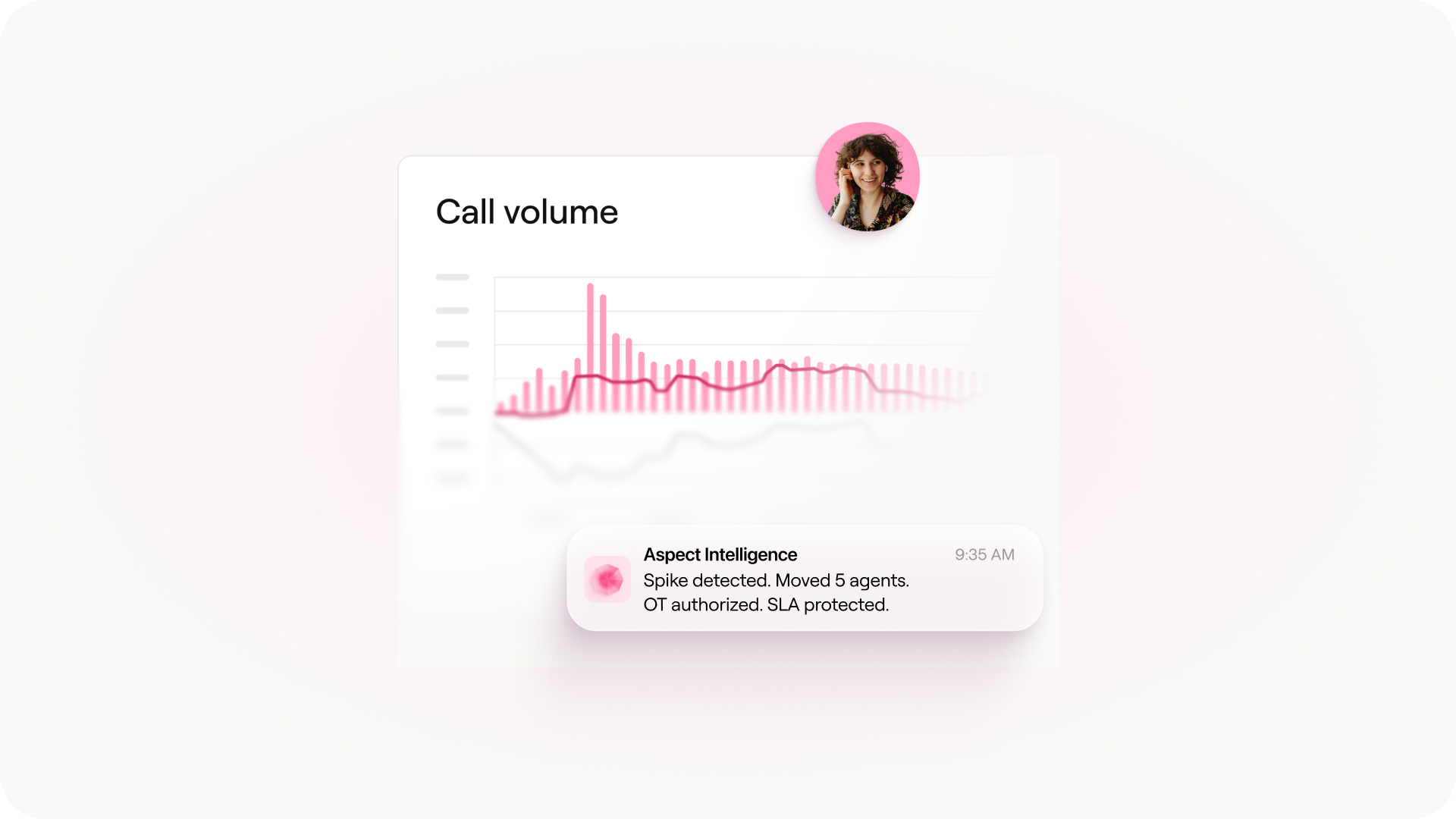
When the volume shifts unexpectedly, the platform automatically flags coverage gaps and recommends staffing adjustments in real-time. This keeps coverage intact without driving up labor costs and lowers the risk of overloading agents during peak periods.
Scheduling built around agent preferences and business needs
Aspect’s dynamic scheduling system accounts for certifications, shift limits, union agreements, and overtime regulations from the start, incorporating these rules into every staffing decision.
Agents can manage their schedules through self-service tools that give them mobile access to view shifts, swap times, and submit time-off requests.
Real-time operational visibility
The platform’s Integrated dashboards give managers a single line of view of adherence, productivity, and staffing levels, eliminating reliance on disconnected tools.
Instead of reacting after conditions have already affected service, managers can make faster, more accurate adjustments based on what is actually happening on the floor.
Performance transparency
Aspect Performance standardizes performance indicators across teams, giving agents clear visibility into where they stand and how their individual goals connect to broader team objectives. When that connection is visible, feedback becomes easier to act on, and coaching becomes more targeted.
Want to go deeper into improving retention for your contact center? Download the Workforce Intelligence whitepaper to learn how better decision-making supports long-term retention.
- What is call center employee retention?

- Why is employee retention important in contact centers?
- What causes high attrition in contact centers?
- How does workforce management impact employee retention?
- How can scheduling improve employee retention?