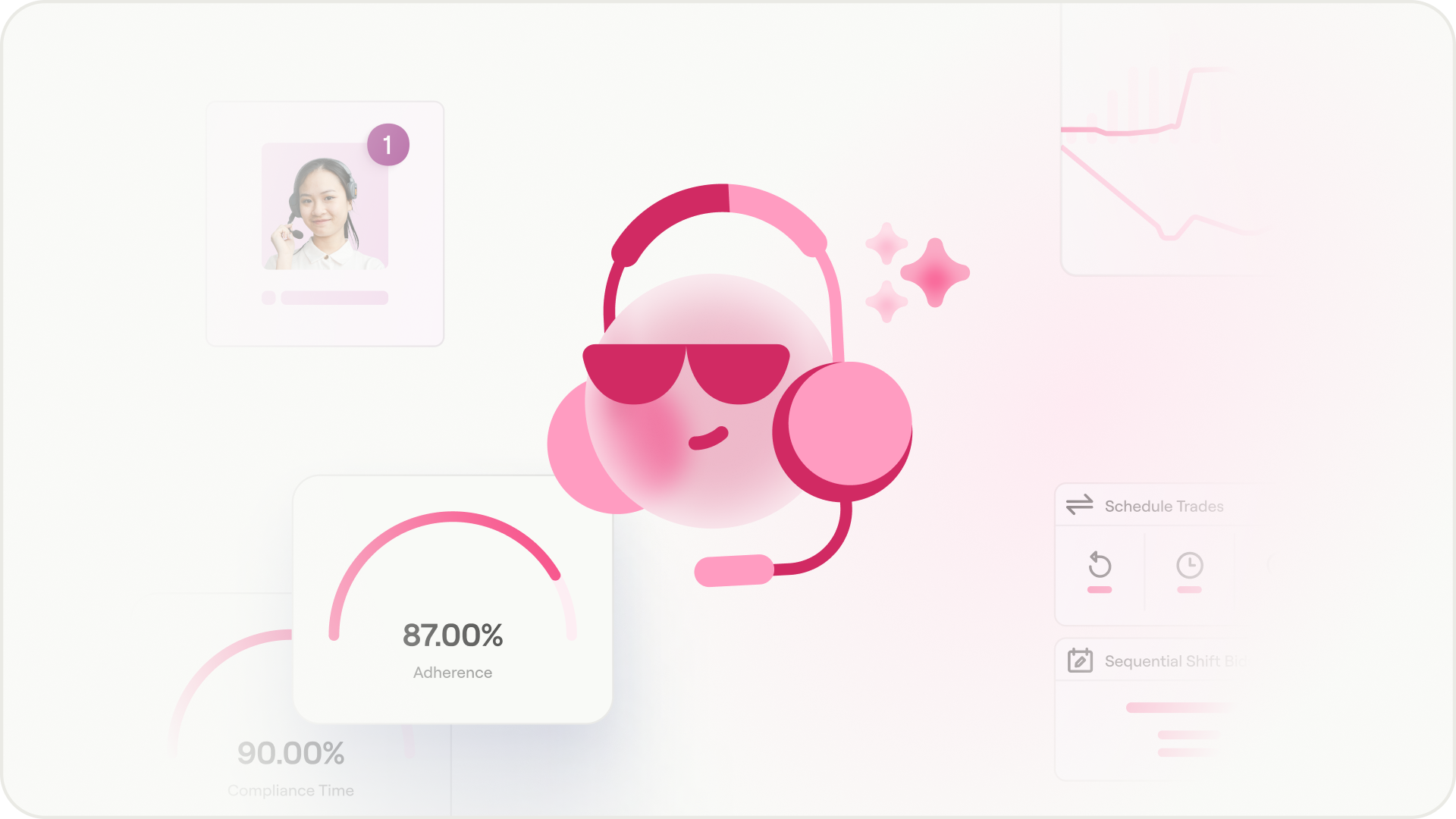



Workforce data analytics transform how enterprise contact centers make decisions about staffing, forecasting, and employee performance by replacing guesswork with evidence-based strategies.
For large operations struggling with daily fire drills, rising operational costs, and agent burnout, data-driven workforce management delivers measurable cost reductions, higher service levels, and improved agent retention that directly impact the bottom line.
What is workforce analytics?
Workforce analytics is the process of collecting and analyzing customer, employee, and operational data. These insights help workforce leaders make smarter decisions about scheduling, forecasting, and employee engagement.
In enterprise contact centers, workforce analytics might reveal exactly how many agents you need for Thursday's afternoon shift, pinpoint why certain teams consistently miss adherence targets, or predict which agents are at risk of leaving. The goal is to connect data points like schedule adherence, forecast accuracy, and customer outcomes so leaders can make informed decisions.
Unlike traditional reporting, which tells you what already happened, like last month's adherence or yesterday's call volume, workforce analytics is proactive and actionable. It flags when demand is likely to spike, identifies agents who are at risk of burnout, and suggests schedule changes that will cut overtime costs while creating fairer shifts for your team.
From workforce analytics to workforce intelligence
Workforce analytics and workforce intelligence are related but distinct capabilities and understanding the difference matters for how you act on data.
Workforce analytics identifies patterns and trends in your operational data. It answers questions like:
- What happened?
- Why did it happen?
- What is likely to happen next?
Workforce intelligence builds on those insights to answer a more critical question: What should we do right now?
Instead of surfacing insights for a supervisor to interpret and act on, workforce intelligence drives intraday decisioning, automated recommendations, and direct operational intervention. Organizations that make this shift move from passive reporting to AI-driven workforce optimization closing the gap between a signal detected and an action taken.
Types of workforce analytics
Descriptive analytics
Descriptive analytics focuses on historical data. It helps leaders see what normal operations look like before implementing changes, like attendance trends, schedule adherence, peak call times, or agent turnover rates.
This type of analysis answers questions like:
- How many agents were absent last month?
- How many calls were handled last month?
- What shifts had the highest overtime costs?
- Which teams showed the best schedule adherence?
- Where did turnover spike during the past year?
While descriptive analytics doesn't predict the future, it provides the context leaders need to understand performance baselines.
Predictive analytics
Predictive analytics uses statistical models to forecast workforce demand and staffing needs. Instead of only showing past trends, it forecasts what is likely to happen based on historical patterns and external factors.
By analyzing patterns in customer interactions, predictive models can estimate how many agents will be needed next Tuesday at 2 p.m., or how call volume might spike during a product launch. These forecasts help leaders schedule the right number of people at the right times, reducing both overstaffing and understaffing.
AI and machine learning have made predictive analytics significantly more accurate. These technologies can analyze years of historical contact center data, account for seasonal trends, and adjust forecasts based on real-time conditions.
Prescriptive analytics
Prescriptive analytics goes beyond prediction by providing specific recommendations to improve scheduling, workload distribution, and employee engagement. It answers questions like:
- Which agents should we assign to this campaign?
- How should we adjust schedules to meet service level targets?
- What changes will reduce overtime cost?
- How can we apply skill-based scheduling to match the right agents with the right tasks?
For example, prescriptive analytics might recommend reassigning high-performing agents to a complex customer queue or suggest adjusting break times to align with call volume patterns.
But prescriptive analytics is just the first step. Where workforce intelligence takes over, recommended actions become operational execution. This means:
- Dynamic staffing recommendations that adjust in real time to actual conditions
- Intraday queue rebalancing triggered automatically when service levels shift
- Automated schedule adjustments that respond to absenteeism or demand spikes without supervisor intervention
- Real-time service level protection that acts on developing problems before they escalate
This distinction matters: prescriptive analytics tells you what to do; workforce intelligence helps make sure it actually gets done.
Key workforce analytics metrics to track
While every contact center has unique goals, the following metrics consistently deliver the most value for workforce planning and agent management:
- Schedule adherence. Measures how closely agents follow their assigned schedules. Low adherence rates can indicate problems with workload balance, training gaps, or employee disengagement. Improving schedule adherence starts with understanding why agents deviate from their schedules in the first place.
- Forecast accuracy. Tracks how closely actual call volume matches predicted volume. When forecasts miss the mark, the result is either overstaffing, which increases operational costs, or understaffing, which drives up wait times and overloads the team.
- Agent productivity. Measures how effectively agents use their time during shifts, including calls handled per hour, resolution rates, after-call work completion, and other measurable activities.
- Employee turnover. Measures how many agents leave within specific time periods and analyzes the patterns behind departures. High turnover usually signals serious operational problems: agent burnout from poor scheduling, inadequate management support, or limited career development.
- Customer satisfaction. Scores such as CSAT or first call resolution show how well agents meet customer needs. Low satisfaction often links back to staffing shortages, insufficient training, or high agent stress.
- Cost-to-serve. Calculates the labor cost required to handle each customer interaction, helping leaders assess whether changes in scheduling, forecasting, or training are improving efficiency.
Analyzing these metrics individually provides limited insight. High customer satisfaction scores might seem positive, but if they come with unsustainable turnover rates or excessive overtime costs, the operation is heading toward failure. Workforce leaders need to consider these metrics together to understand the full picture.
Workforce success: How a home appliance company used automation to save thousands of hours.
Turning workforce signals into operational decisions
These metrics aren't just KPIs, they are operational signals.
Adherence dips, forecast misses, rising handle times, and early turnover indicators don't exist in isolation. They tell a connected story about how the workforce is functioning right now and where it's heading. The challenge for most contact centers is that these signals live in separate systems, get reviewed on separate cadences, and require a human analyst to synthesize them into a recommendation.
Workforce intelligence platforms change this by:
- Detecting patterns across signals in real time, across channels and teams
- Identifying risks early, before they cascade into service failures or attrition
- Recommending operational actions, not just reporting on what happened
This is the signal → decision → outcome loop that separates reactive operations from proactive ones. When a platform can connect a forecast variance to an adherence trend to a projected service level miss and surface a recommended action in minutes, supervisors can intervene with confidence instead of instinct.
Workforce analytics in practice
Real-world applications of workforce analytics address the challenges that create operational and financial pressure in enterprise contact centers.
Optimizing staffing to reduce overtime
Many contact centers operate reactively, struggling to cover unexpected absences, call spikes, and scheduling conflicts that lead to expensive overtime or service failures.
Workforce analytics changes this pattern by analyzing adherence trends, seasonal demand patterns, and historical data to predict where staffing issues will occur before they happen.
Improving forecasting accuracy to cut costs
Inaccurate forecasting creates a cascade of expensive problems. When forecasts underestimate demand, service levels suffer and remaining agents face excessive workloads, increasing burnout risk. When forecasts overestimate demand, labor costs increase unnecessarily.
With better forecasts, contact centers can align schedules more closely to actual demand, preventing overstaffing during slow periods and understaffing during peak times.
Identifying performance trends to boost engagement
Workforce analytics can identify early warning signs of agent disengagement before performance deteriorates and valuable employees leave. Declining productivity, increasing adherence problems, higher absence rates, and lower satisfaction scores often cluster together weeks before agents quit.
Early detection allows leaders to intervene with targeted coaching, schedule adjustments, or career development opportunities, at a fraction of the cost of replacing departing agents.
To learn more, explore our guide: ‘Why employee engagement is the key to performance management success.’
Balancing service quality with cost control
Every staffing decision requires balancing between service levels, agent experience, and operational costs. Workforce analytics provides the data needed to make informed choices, rather than guessing at the impact.
Intraday management and real-time adjustments
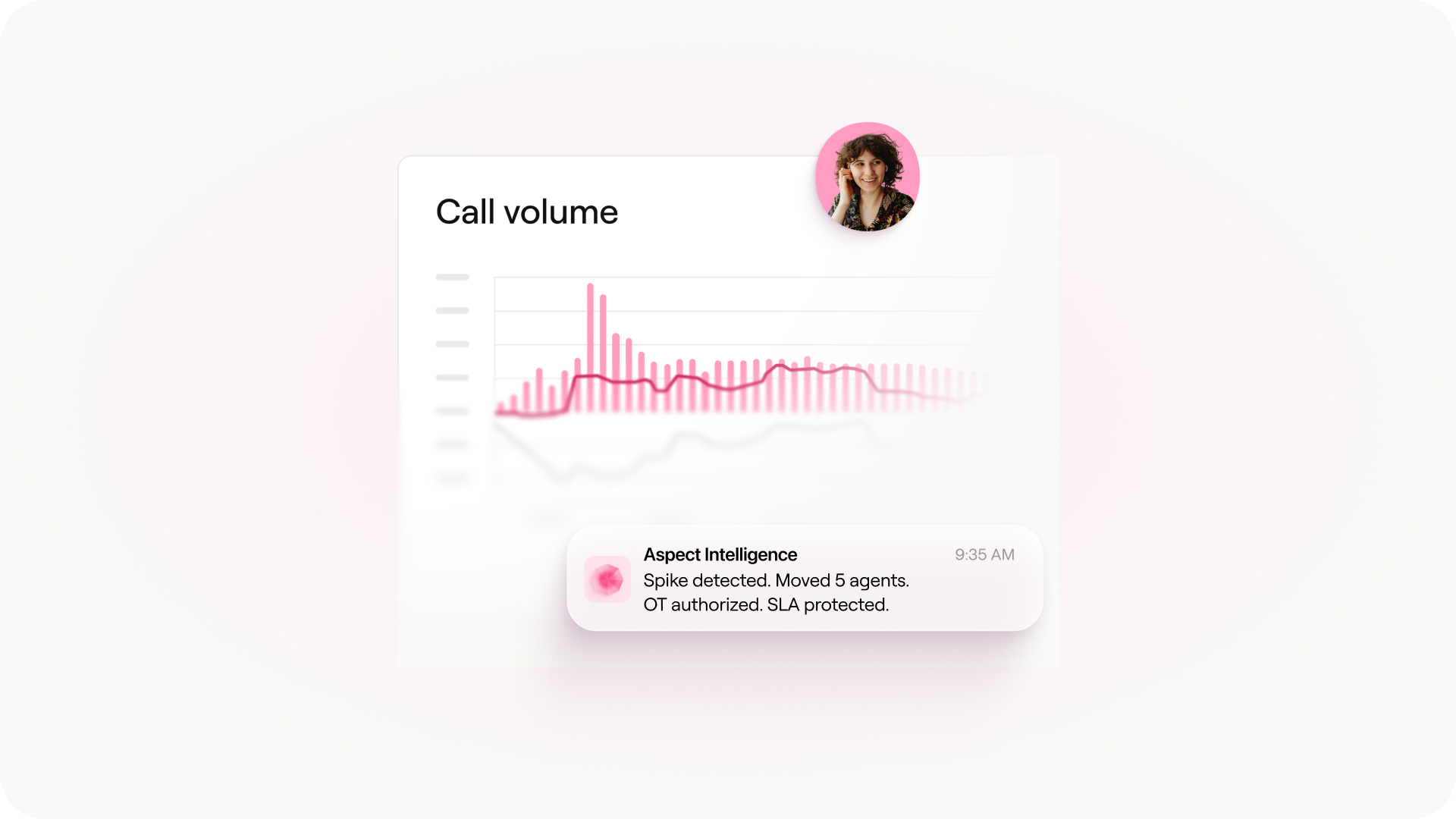
Even the most accurate forecasts can’t predict every surprise. Equipment failures, weather events, viral social media posts, or breaking news can dramatically alter call patterns within minutes. AI-powered analytics systems monitor actual conditions throughout each shift, detecting problems as they develop and recommending immediate responses.
This might involve reassigning agents between different queues, calling in backup staff, adjusting break schedules, or modifying service procedures to maintain targets without creating operational chaos.
Balancing service quality with cost control
Every staffing decision requires balancing between service levels, agent experience, and operational costs. Workforce analytics provides the data needed to make informed choices, rather than guessing at the impact.
Intraday management and real-time adjustments
Even the most accurate forecasts can't predict every surprise. Equipment failures, weather events, viral social media posts, or breaking news can dramatically alter call patterns within minutes.
This is where the gap between traditional analytics and workforce intelligence becomes clearest:
Traditional approach:
- Real-time dashboards surface the problem
- Supervisors interpret the data manually
- Decisions depend on individual judgment and availability
Intelligence-driven approach:
- Automated alerts fire as conditions deviate from forecast
- The system generates recommended actions immediately
- Operational playbooks guide response without lag
Practical examples include:
- Sudden call spikes: Agents are reassigned from lower-priority queues automatically
- Unexpected absenteeism: Backup staffing recommendations surface before service levels degrade
- Service level degradation: Break schedules adjust in real time to maintain coverage
- Channel traffic shifts: Workload rebalances across voice, chat, and messaging without manual coordination
This keeps operations efficient while protecting service quality, without creating chaos for the supervisors managing it.
Benefits of workforce analytics
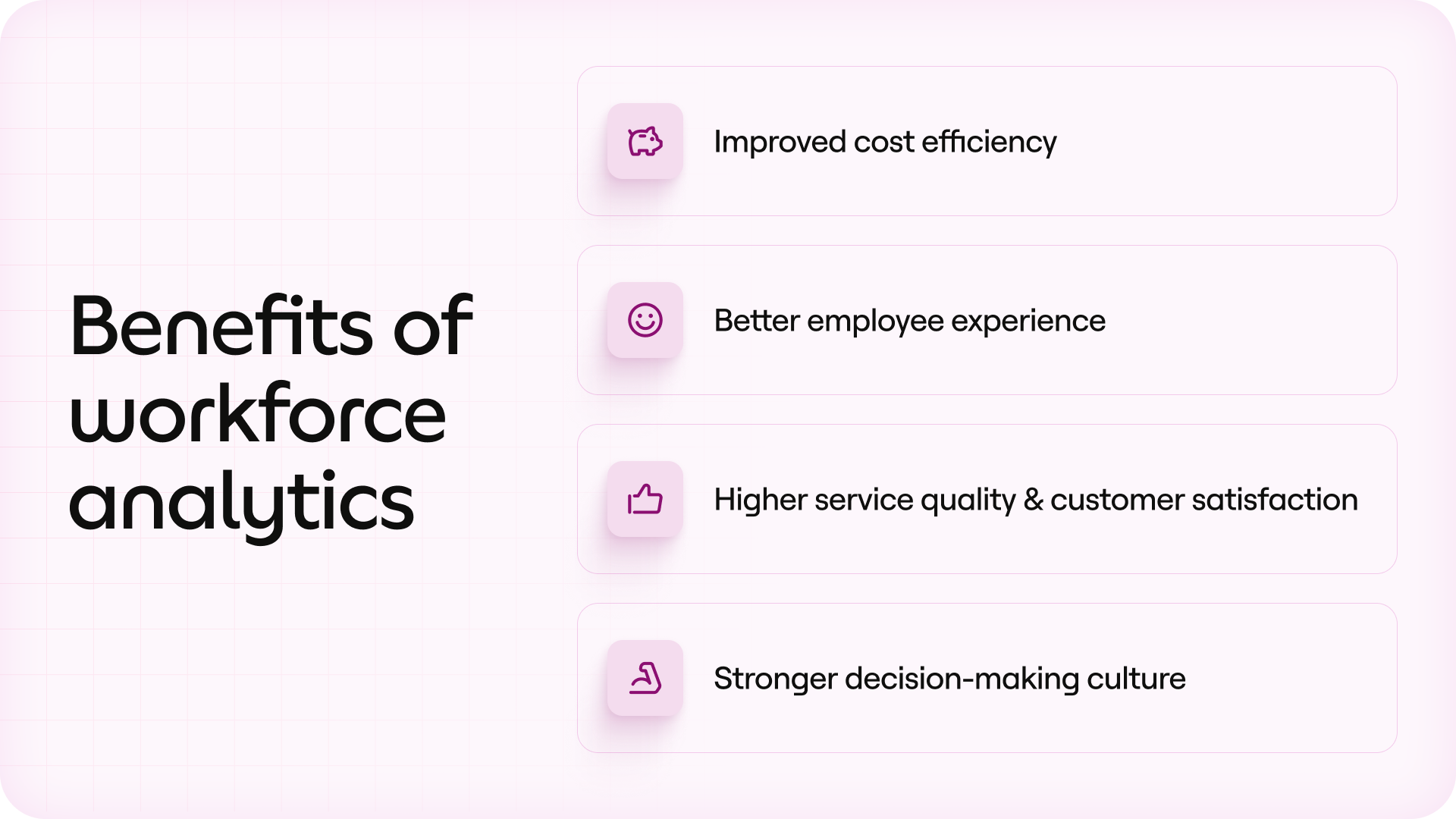
When properly adopted, workforce analytics delivers measurable benefits across contact center operations:
- Improved cost efficiency. More accurate forecasting reduces both overstaffing and overtime, while smarter scheduling ensures labor resources are used effectively. For large contact centers managing thousands of agents, even small efficiency gains can deliver significant cost savings.
- Better employee experience. With data highlighting where employees are struggling, leaders can act before burnout or disengagement occurs. More balanced workloads, dynamic scheduling, and tailored coaching lead to higher retention, stronger morale, and better performance.
- Higher service quality and customer satisfaction. When the right number of skilled agents is available, customers get faster, more effective service. Workforce analytics helps leaders maintain service levels without overwhelming employees.
- Stronger decision-making culture. Access to real-time data and predictive insights enables leaders to make more informed decisions — reducing risk and improving results across the board.
Challenges in adopting workforce analytics
Despite clear benefits, many enterprise contact centers struggle to implement effective workforce analytics programs.
Data silos
When workforce data lives in separate systems, it becomes difficult to get a complete view of workforce performance. Successful workforce analytics integrates these disconnected systems into a unified platform that provides accurate, timely, and complete information for decision-making.
Lack of skilled analysts
Effective workforce analytics requires people who understand both strategic analysis and contact center operations. Many organizations lack staff with this combination of skills. Building analytical capabilities requires either training existing staff or hiring people who can bridge the gap.
Resistance to change
Some teams resist shifting from intuition-based decisions to data-driven processes. Overcoming this resistance requires demonstrating how analytics enhances rather than replaces human judgment, and showing concrete examples of improved outcomes.
Best practices for implementing workforce analytics
- Define clear business objectives. Begin by identifying the specific problems you want to solve. Are you focused on reducing costs, improving service levels, or boosting employee engagement? Clear objectives make it easier to choose the right metrics and demonstrate value.
- Focus on actionable metrics. Start with metrics that have the most significant impact. Most enterprise contact centers benefit immediately from improved forecast accuracy, better schedule adherence monitoring, and early identification of agent performance issues.
- Ensure data integration. Analytics deliver the most value when data is unified. Pull information from HR, workforce management, quality management, and CRM systems into one view.
- Include leadership buy-in. Senior leaders are more likely to support analytics when they see clear benefits. Launch with a pilot project that delivers measurable results, then scale.
- Link insights to action. Analytics only matter if they change how work gets done. Build processes that translate data into action, automating schedule adjustments, flagging agents for coaching, or identifying employees ready for new opportunities.
Workforce analytics impact across industries

Workforce analytics creates value across multiple industries, but each sector faces distinct challenges that require tailored approaches.
Healthcare systems
Workforce analytics helps healthcare organizations predict demand spikes during flu season or after major health news events, allowing them to adjust staffing proactively. Analytics also ensure compliance with union agreements and labor regulations while optimizing shift patterns to reduce staff burnout.
Financial services and banking
Analytics platforms help financial contact centers maintain appropriate staffing levels during market turbulence while avoiding excessive labor costs during regular periods. Predictive models factor in economic indicators, marketing campaigns, and historical patterns to forecast demand accurately.
Retail operations
Retail contact centers experience extreme seasonal variations, promotional campaigns, and product launches that create staffing challenges across multiple channels. Workforce analytics allows retailers to prepare for predictable demand spikes while maintaining efficient operations during slower periods.
Utilities and energy companies
Analytics platforms help utilities predict call volumes based on weather forecasts, maintenance schedules, and historical patterns, enabling them to maintain adequate emergency response capability while optimizing routine operations.
What to look for in a workforce analytics platform
Choosing the right workforce analytics platform requires focusing on capabilities that transform raw data into decisions that improve daily operations.
- Real-time decision support. Modern platforms should do more than surface dashboards, they should detect anomalies, recommend staffing actions, and enable intraday adjustments without waiting for a supervisor to interpret the data. Leaders need to spot developing problems early enough to take corrective action before service levels suffer.
- Advanced forecasting & AI modeling. Forecast accuracy separates effective workforce analytics platforms from basic reporting tools. The strongest platforms use AI and machine learning to analyze historical data, identify trends, and forecast future demand with high precision, adjusting for seasonality, market shifts, and external factors.
- Smooth integration across platforms. Analytics delivers the most value when it connects with other tools. Look for solutions that integrate with WFM, HR platforms, CRM systems, and performance management tools to reduce manual work and keep data consistent.
- Intraday management capabilities. The platform should detect when actual conditions deviate from forecast and recommend mid-shift actions, adjusting break times, reassigning agents, or calling in backup staff to maintain service levels.
- Support for employee engagement. The right system goes beyond monitoring performance. Features like adherence tracking, productivity insights, and gamification help agents stay motivated and aligned with team goals.
Why choose Aspect for workforce analytics
Workforce data analytics is only valuable if it drives action — and that's exactly what Aspect Intelligence is built to do. Rather than stopping at insights, Aspect Intelligence connects operational signals across forecasting, adherence, and performance to close the loop between data and real-time workforce decisions.
Aspect's workforce engagement and workforce management platforms, powered by Aspect Intelligence, are purpose-built for large, complex contact centers that need more than surface-level reporting. By embedding intelligence directly into daily operations, our platform transforms analytics from a review activity into a continuous decision engine — combining real-time visibility, advanced forecasting, intraday optimization, and actionable recommendations so leaders can act faster and with greater confidence.
- Advanced forecasting. Aspect Intelligence applies AI and machine learning to historical and real-time data to predict staffing needs with precision, reducing both understaffing crises and expensive overstaffing situations before they occur.
- Productivity tracking. Aspect Intelligence gives leaders clear visibility into how agents spend their time across teams and channels, surfacing patterns that help recognize high performers, identify coaching opportunities, and rebalance workloads proactively.
- Adherence monitoring. Aspect Intelligence tracks schedule adherence in real time and flags deviations as they happen, so leaders can make targeted adjustments before service levels are impacted.
- Intraday optimization. When actual conditions deviate from forecasts, Aspect Intelligence recommends immediate adjustments such as shifting break times, reassigning agents, or activating backup staff, keeping operations efficient while protecting service quality.
- Performance analytics. Aspect Intelligence continuously monitors key metrics like handle time, first call resolution, and quality scores across agents and teams, surfacing performance gaps and guiding coaching efforts with data-backed precision.
- Support for complexity. From union compliance requirements to multi-channel operations and distributed workforces, Aspect Intelligence is designed to handle the full complexity of enterprise contact center environments.
Workforce leaders using Aspect's purpose-built WFM platform gain the tools to develop resilient operations that adjust to everyday challenges and improve performance across teams and customer experiences. For organizations that want to turn workforce analytics into workforce action, Aspect is your trusted partner.
Workforce analytics can help enterprise contact centers improve key metrics and make smarter, faster decisions.
Aspect’s unified workforce management platform integrates these capabilities. With AI-powered forecasting, real-time visibility, and built-in engagement tools, Aspect is designed to turn workforce data into measurable results.
Learn how Workforce Intelligence turns data into predictive, actionable insights. Download white paper here.
- How does AI improve workforce analytics?

- Which industries benefit most from workforce analytics?
- What are the most important metrics in workforce analytics?
- What is intraday management in workforce analytics?
- What is the difference between workforce analytics and workforce intelligence?