How well are your customers being served by your contact center? Are your employees delivering the best possible experience every time someone reaches out? These aren't just operational questions, they're performance questions, and the answers live in the data.
Knowing how well your customer support team is performing is essential for continuous improvement. It helps you manage your team more efficiently, reduce costs, and increase employee satisfaction, all of which directly impact sales and customer retention.
But tracking performance is only half the equation. The other half is motivation. That's where gamification in customer service comes in, and it's evolved well beyond engagement perks.
Gamification in customer service is no longer just about engagement, it's a way to translate real-time performance data into behaviors that improve service outcomes.
A report by PwC, Experience is Everything, found that customers are willing to spend as much as 16% more with companies that offer a great customer experience. Moreover, 63% are willing to share more personal information when a company provides a wonderful experience. On the flip side, 59% of consumers will stop doing business with a company after several bad experiences, and 32% will walk away from a brand they favor after just one.
The stakes are high. Here's how to build a gamification strategy that actually moves the needle.
What Is Contact Center Gamification?
Contact center gamification is the application of game mechanics such as points, badges, leaderboards, challenges, and rewards to the work environment in order to drive behaviors tied to measurable performance outcomes.
But not all gamification is created equal. There's an important distinction:
- Engagement gamification focuses on making work more enjoyable: social recognition, fun competitions, and team camaraderie.
- Performance-driven gamification goes further: it uses real-time data to align agent behavior with KPIs like CSAT, AHT, FCR, and adherence.
The most effective programs operate at the intersection of both, making work engaging and tying that engagement directly to outcomes that matter to the business.
Why Contact Center Gamification Matters for Service Performance
Contact centers face a persistent set of operational challenges: agent burnout from repetitive work, inconsistent performance across teams, and limited visibility into what's actually driving results. Gamification addresses all three, when it's done right.
Here's how gamification impacts the metrics that matter most:
- CSAT (Customer Satisfaction): Agents who are motivated and engaged deliver better interactions. Gamification reinforces the behaviors such as empathy, resolution speed, follow-through that drive positive customer sentiment.
- AHT (Average Handle Time): Challenges and leaderboards tied to handle time create friendly competitive pressure that encourages efficiency without sacrificing quality.
- FCR (First Contact Resolution): When agents are coached and incentivized to resolve issues on the first contact, resolution rates improve and repeat contacts decline.
- Agent Retention: High turnover is one of the costliest problems in contact centers. Gamification increases job satisfaction, reduces burnout, and gives employees a sense of progress and recognition, all of which improve retention.
Key insight: Gamification works because it reinforces behaviors tied to measurable KPIs, not just motivation.
Best Practices for Using Gamification to Improve Agent Performance
Not every gamification program delivers results. Here's what separates the programs that move metrics from those that just add noise:
1. Align gamification with KPIs, not vanity metrics
Points and badges are meaningless if they're not tied to outcomes. Every gamification element should map directly to a business goal: CSAT, AHT, FCR, schedule adherence, or save rate.
2. Build in real-time performance visibility
Agents can't improve what they can't see. Real-time dashboards and live leaderboards give agents immediate feedback on where they stand, and what they need to do to improve.
3. Balance competition with fairness
Healthy competition motivates. Unfair competition demoralizes. Segment competitions by tenure, role, or skill level to keep things equitable. Recognize team wins alongside individual achievements.
4. Focus on coaching, not pressure
The best gamification programs aren't punitive, they're developmental. Use performance data surfaced through gamification to inform coaching conversations, not to create anxiety.
The best-performing programs align directly with business goals and measurable outcomes.
Real Examples of Gamification in Customer Service
What does effective gamification actually look like in practice? Here are a few patterns that drive real results:
- Leaderboards tied to CSAT or FCR: Agents can see how their scores compare in real time, creating motivation to close the gap or defend their standing.
- AHT reduction challenges: Short-term competitions with clear rules encourage agents to streamline their call-handling without cutting corners on quality.
- Team competitions for SLA attainment: Group-based challenges build camaraderie and shared accountability for hitting service level targets.
- Training gamification: Badges, certifications, and progression systems applied to onboarding and ongoing training make skill-building feel rewarding rather than obligatory.
The key principle: behavior → outcome. Every gamification element should be traceable to a specific agent behavior that produces a measurable service outcome.
Want to see examples with results?
Read our success stories with ARA Diagnostics
Benefits of Contact Center Gamification
When executed well, contact center gamification delivers across the board:
- Increased engagement and motivation: Agents who find meaning and recognition in their work perform at a higher level consistently.
- Improved KPIs: CSAT, FCR, and resolution rates all improve when agents are aligned to clear, visible, and rewarded performance targets.
- Lower attrition: Recognition, progression, and a sense of achievement significantly reduce turnover, one of the most expensive problems in contact center operations.
- Better coaching visibility: Gamification surfaces performance data that makes it easier for supervisors to identify who needs support and where.
Gamification improves motivation, engagement, and performance while reducing turnover.
Strategies to Leverage Gamification in Contact Centers
Think of gamification not as a feature, but as a system. Here's a four-step framework:
Step 1: Define Customer Support KPIs
KPIs provide insight into how well employees are performing relative to company goals. These are the metrics that appear most consistently across high-performing contact center gamification programs:
First Contact Resolution (FCR)
FCR is the percentage of support tickets resolved on the first contact. It measures both the efficiency of your support team and how effectively agents navigate knowledge bases and resolve issues independently. FCR correlates strongly with customer satisfaction.
Average Handle Time (AHT)
AHT measures the average length of a transaction from initiation to resolution, including hold time, talk time, and after-call work. It's key for staffing decisions. Improving AHT means decreasing handle time while increasing customer satisfaction, not just rushing calls.
Strategies to improve AHT include:
- Optimize call routing
- Build a robust knowledge base
- Streamline processes
- Improve training and coaching
- Implement gamification as a service software
Abandon Rate
The percentage of calls where a customer hangs up before speaking to an agent. Reducing abandon rate often involves improving queue management and offering ring-back options.
Customer Satisfaction (CSAT)
CSAT measures customer sentiment about your support services, typically via post-interaction surveys. It's the north star metric for most contact center teams.
Service Level
A calculation of the support team's capacity to meet the standards in your Service Level Agreement, a direct measure of whether you're delivering on your commitments.
Save Rate
The percentage of at-risk customers retained through service interactions. Given that it costs far more to acquire a new customer than retain an existing one, save rate is a critical metric for contact centers that support revenue retention.
Net Promoter Score (NPS)
NPS measures the likelihood that a customer would recommend your business. Respondents scoring 9–10 are promoters; 0–6 are detractors. NPS = % promoters − % detractors. Apple consistently achieves an NPS of 75–85%.
Do you still have questions about CSAT and NPS? Read our blog to understand which CX metric you should choose
Step 2: Motivate Contact Center Employees to Constantly Do Better
Motivating employees to perform well is challenging. Motivating them to continuously improve is harder still. That's what Aspect League™ is built to do.
Aspect League's gamification tools apply game mechanics to contact center performance, adding leaderboards, points, badges, contests, avatars, and virtual currency to create a dynamic where agents are rewarded for improvement, not just activity. This leads to greater employee satisfaction, better customer experiences, and measurable performance gains.
Gamification can be used across the full agent lifecycle: hiring and onboarding, ongoing performance monitoring, training, and coaching. It fosters positive, friendly competition among individuals and teams alike.
Step 3: Build Visibility into Performance
Gameification only works when agents can see their progress in real time. Dashboards, live leaderboards, and instant feedback loops give agents the information they need to self-correct and improve—without waiting for a weekly coaching session.
Visibility also helps supervisors: when performance data is surfaced in real time, it becomes much easier to identify coaching opportunities before they become persistent problems.
Step 4: Continuously Optimize
Gamification isn't a set-it-and-forget-it solution. The most effective programs are constantly refined—adjusting KPI weights, introducing new challenges, retiring metrics that no longer align with business priorities, and listening to agent feedback about what's working.
Treat your gamification program like a product: it should be iterated, not installed.
How Aspect League™ Powers Gamification at Scale
Aspect League™ is more than a gamification platform, it's a performance system.
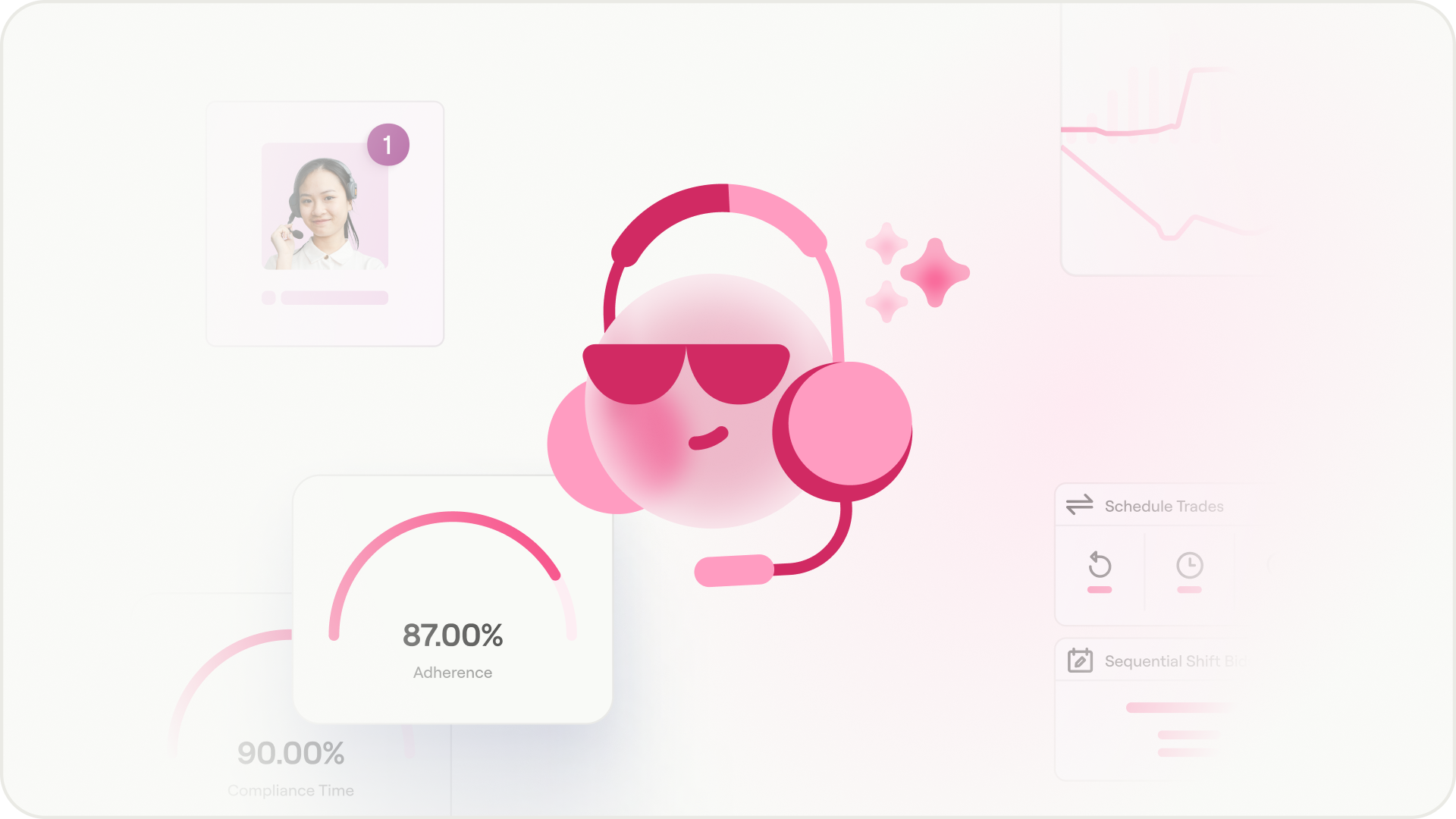
While traditional gamification tools focus on engagement mechanics, Aspect League connects those mechanics to real-time performance data, behavioral signals, and operational outcomes. That means supervisors get visibility into what's actually driving results, and agents get meaningful feedback that helps them grow.
Aspect League supports:
- Real-time performance insights tied directly to KPIs
- Behavioral signal tracking that goes beyond basic activity metrics
- Scalable program management across large and distributed contact center teams
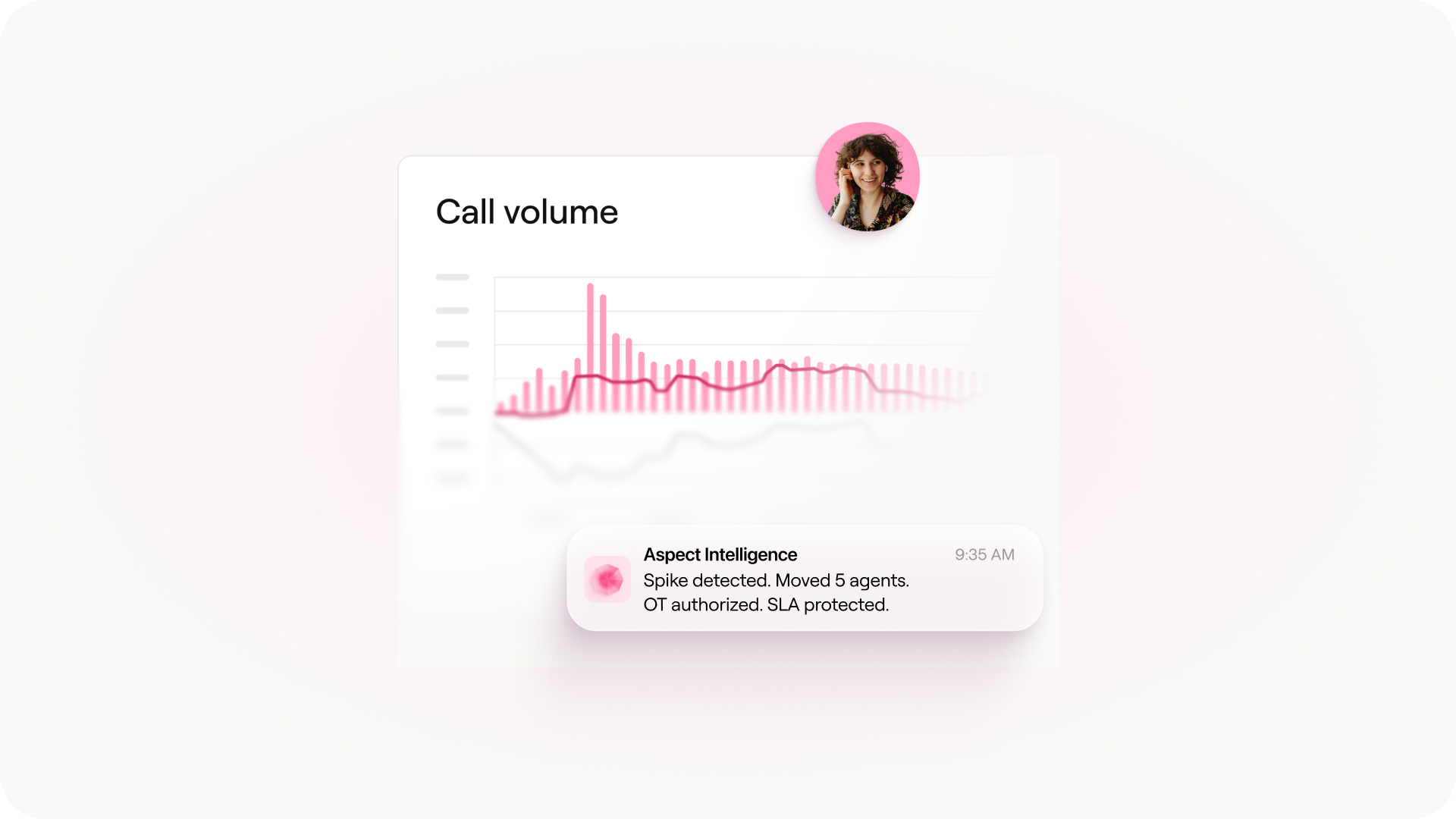
- Integration with Aspect Intelligence for smarter, AI-informed performance visibility
The result: a gamification program that doesn't just make work more fun, it makes your contact center measurably better.
Using game mechanics to motivate and engage contact center employees seamlessly aligns employee behaviors with company goals.
Learn about contact center gamification solutions with Aspect League™
- What is contact center gamification?

- How does gamification improve customer service performance?
- What metrics should be used in gamification?
- Is gamification only for engagement?
- How does gamification impact agent retention?