


The healthcare industry is rapidly changing, and with it, expectations are rising on all sides. Patients want easier access to care, shorter wait times, and a more seamless experience throughout their treatment journey. At the same time, clinical and support staff want fair schedules, flexible work options, and well-being support.
Without clear visibility into how staff skills, time, and schedules align with real patient needs, it becomes difficult to deliver the quality of care people expect while also protecting the team delivering it.
Data-driven workforce management (WFM) solutions can help organizations meet these challenges. Advanced platforms like Aspect Workforce provide the tools needed to navigate healthcare's growing complexity while maintaining excellence in patient care.
Why effective workforce management matters in healthcare
Strong workforce management in healthcare means having qualified staff available when and where patients need them most—while controlling operational costs.
Patient demand fluctuates by season, time of day, and patient acuity. Without accurate scheduling and forecasting, operational managers risk understaffing—leading to stressed employees and dissatisfied patients—or overstaffing, which unnecessarily drives up labor expenses.
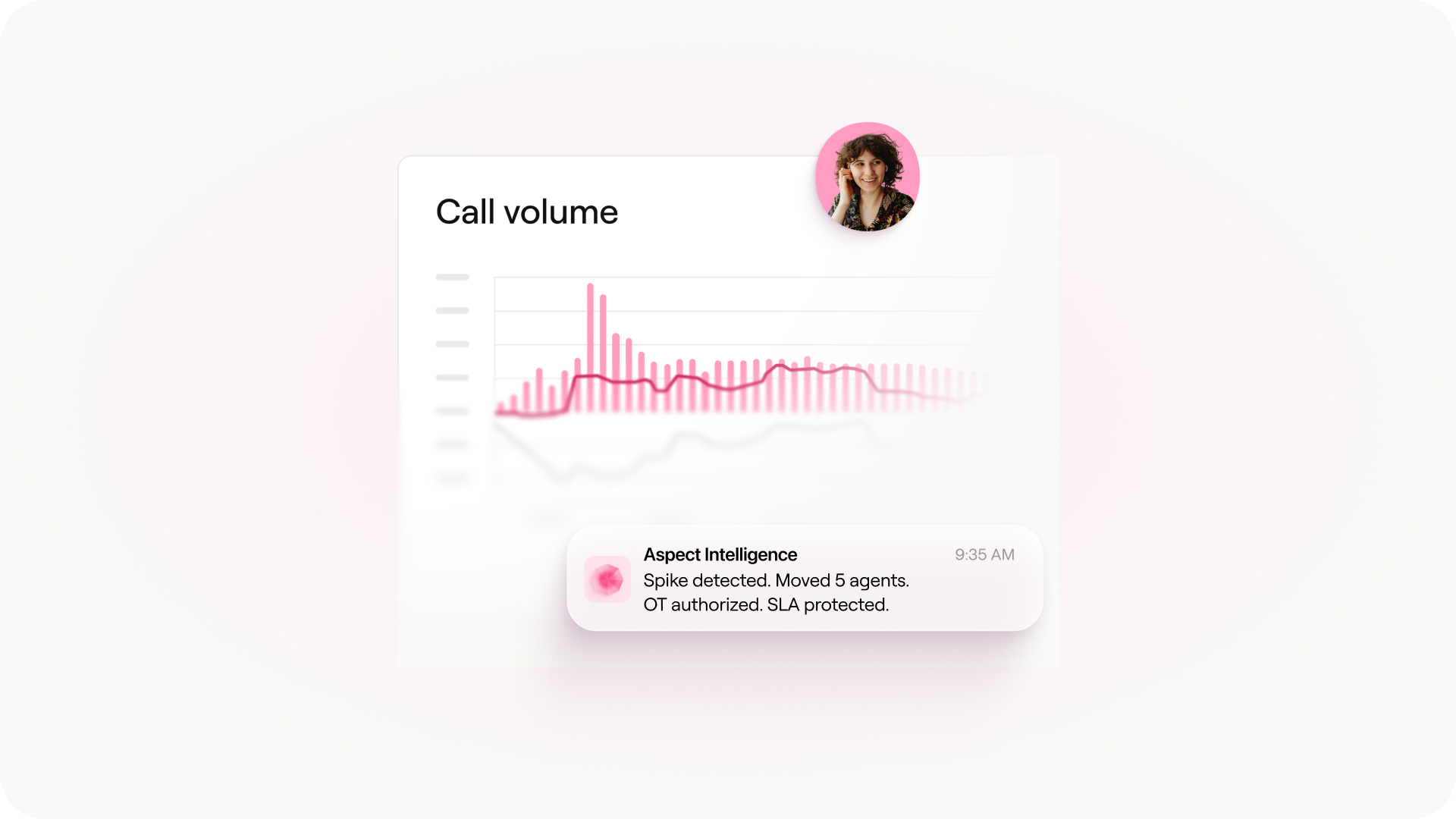
Advanced forecasting provides insights to predict patient volume and the skills needed for each shift. By analyzing historical data, trends, and upcoming events, workforce leaders can create more accurate and efficient schedules.
Dynamic scheduling tools add flexibility, allowing quick adjustments when unexpected situations arise—such as sudden admission spikes, staff callouts, or seasonal demand changes.
Better workforce management also protects staff well-being. Predictable workloads and schedules reduce the risk of burnout, leading to higher retention.
Common workforce management challenges in healthcare
Even well-run healthcare organizations face challenges when their workforce management tools can't keep up with modern demands. Common challenges from inefficient processes or limited systems include:
- Staff shortages: Limited staffing forces existing staff to work longer hours and can reduce the quality of care patients receive.
- Last-minute absenteeism: Unexpected staff absences happen. Each unplanned sick day or emergency leave creates coverage gaps, leading to more overtime and increased stress for the remaining team.
- Staffing and scheduling complexity: Managers must match staff skills and credentials while following union rules, managing time-off requests, and coordinating float pools. They also need to balance permanent staff with per-diem, traveler, and agency labor. Hospitals must also manage inpatient, outpatient, and virtual care—each with unique workloads and demands.
- Compliance risks: Manually managing credentials, licensure, union agreements, overtime rules, and regional regulations increases the risk of errors. Mistakes can lead to fines, legal challenges, and operational disruptions.
- Mental health: High workloads and unpredictable schedules increase stress and anxiety among staff, negatively impacting their mental health. Without proper PTO management, these challenges are compounded.
- Burnout and fatigue: Long hours and inequitable shift assignments contribute to physical and emotional exhaustion. Overworked or unsupported staff are more likely to leave, creating coverage gaps and destabilizing teams.
Aspect's workforce management platform helps healthcare workforce managers tackle these challenges head-on, providing the tools needed to keep staff engaged, reduce costs, and maintain consistent, high-quality patient care.
Trends shaping healthcare workforce management in 2026

These workforce management trends will define how leading healthcare organizations manage staffing, streamline operations, and improve patient outcomes in 2026:
Predictive analytics for smarter planning
Lasting improvement starts with reliable historical data. Metrics like staff utilization, real-time demand signals, seasonal patterns, and patient flow help leaders anticipate staffing needs before issues arise.
Predictive analytics removes the guesswork from scheduling and capacity planning, helping teams align coverage with patient demand more accurately.
AI-driven scheduling that adapts in real time
When powered with the right data and clinical context, AI-powered WFM systems can build schedules that balance skills, certifications, individual preferences, and regulatory requirements. This reduces manual work and ensures more consistent coverage.
Managers can also adjust schedules in real time to maintain coverage during peak periods while giving staff more control over their schedules.
Flexible staffing models that scale with patient needs
Healthcare organizations are increasingly adopting flexible staffing models that combine full-time, part-time, and on-demand staff. Self-scheduling and shift bidding tools give staff greater control over their work schedules, while hybrid and virtual care models introduce new coverage requirements.
These approaches allow organizations to respond quickly to patient volume changes, fill coverage gaps, and reduce the administrative work of frequent schedule adjustments.
Workforce engagement through self-service tools
Transparent scheduling systems and mobile self-service tools simplify shift swaps, time-off requests, and schedule access—building trust and giving staff more control over their work lives. When staff feel supported and fairly scheduled, stress decreases and retention improves, directly benefiting the quality of care they provide.
System integrations that reduce complexity
Healthcare leaders are investing in workforce management tools that integrate seamlessly with existing software and systems—without complex or manual connections.
These systems connect with EHR, HRIS, payroll, and communication tools, giving managers a complete view of staffing needs. Integration reduces manual work and simplifies patient demand management.
The role of AI and automation in healthcare staffing
AI and automation are changing how healthcare organizations plan and manage their workforce. AI tools analyze historical patient data, seasonal trends, and external factors to provide insights such as:
- Peak times for patient appointments and admissions.
- Departments that consistently experience staffing shortages.
- How appointment cancellations or emergencies affect daily workloads.
- When additional staff is needed to maintain care quality.
- Real-time credential validation, license expirations, and required coverage checks.
- Forecasted appointments to recommend staffing by role and skill.
AI can also model planning scenarios to show how changes in patient volume or staff availability will affect schedules before you make staffing decisions.
Automation reduces manual effort by streamlining routine tasks—assigning shifts, calculating overtime, running compliance checks, and sending shift reminders to staff.
Despite these benefits, many healthcare organizations hesitate to integrate AI due to concerns about compliance, transparency, and staff trust. Leaders need assurance that AI tools comply with labor laws and privacy requirements.
Aspect's AI capabilities are built with compliance at their core. They address complex scheduling rules, union requirements, and labor regulations. From shift preferences to forecasting and scheduling, our solutions support granular configuration and responsible AI implementation.
Read more about our commitment to responsible AI here.
Improving staff engagement and retention with dynamic scheduling

Retention is one of the biggest challenges in healthcare workforce management.
For many healthcare professionals, their schedule is the frontline of their experience with the organization. When shifts feel inflexible, unpredictable, or unfairly assigned, burnout increases, absenteeism rises, and turnover becomes harder to control.
Healthcare professionals face demanding workloads, long hours, and emotionally intense environments. Dynamic scheduling supports them by aligning shifts with their preferences, skill sets, fatigue limits, and work-life balance—while still ensuring coverage and compliance.
Dynamic scheduling also improves visibility and control. Staff can easily view shifts, request changes, or submit time-off requests without navigating complicated processes. When people have this level of control and clarity, they feel heard and respected, which boosts morale and reduces turnover.
Aspect is designed to prioritize both operational needs and employee experience. Dynamic scheduling automatically accounts for labor rules and patient demand while giving employees self-service tools—such as shift trading and bidding, or adjusting preferences through a mobile app.
Workforce success: How ARA Diagnostics incentivized employee performance.
Best practices for implementing workforce management in healthcare
Effective workforce management in healthcare requires more than new software—it needs a clear, actionable implementation strategy.
Here are a few best practices to guide your approach:
Define clear staffing KPIs
Start by identifying the metrics that matter most to your organization—such as schedule adherence, overtime hours, patient-to-staff ratios, or turnover rates. Setting measurable goals helps you track progress and adjust your strategy as needed.
Connect workforce tools with core systems
To maximize the value of workforce management, your WFM software must integrate with the systems that power daily operations—including your EHR, HRIS, payroll, credentialing systems, and secure messaging tools.
When these systems work together, they reduce manual work and eliminate delays from disconnected tools, giving teams more time to focus on patient care.
Start with high-impact departments
Organizations don't need to overhaul their entire system at once. Starting with departments that experience frequent staffing fluctuations—such as emergency, intensive care, or outpatient clinics—allows the WFM software to demonstrate its value early. Broader adoption can then be implemented gradually over time.
Build adoption through transparency
Change works best when staff understand the benefits that come with it. Healthcare leaders should share how WFM supports fairness, compliance, and better work-life balance, and use clear change management practices such as training sessions and open feedback so staff feel involved and supported.
When staff see that the system benefits both them and patients, they're more likely to engage and trust the process.
How smart scheduling improves patient care

Smart scheduling ensures the right staff with the right skills are available to meet patient demand.
With real-time adherence tracking, workforce managers can identify staffing gaps and adjust before they impact patients. When shifts are optimized and workloads are distributed fairly, nurses and physicians can focus on delivering care rather than scrambling to cover last-minute gaps. This reduces fatigue and burnout, two persistent challenges in hospitals and clinical settings.
Better workforce visibility also enables precise skill matching. For example, if an ICU experiences a surge in critically ill patients, managers can schedule nurses with advanced critical care certifications and allocate support staff accordingly.
Over time, smart scheduling delivers measurable operational and clinical benefits:
- Higher patient satisfaction.
- Reduced missed shifts.
- Greater performance and consistency across healthcare operations.
- Lower turnover rates and improved staff engagement.
Why choose Aspect for healthcare workforce management
Aspect offers a smarter approach to workforce management in healthcare. Built with AI and designed for flexibility, it helps organizations manage the complex demands of modern healthcare and its unique challenges.
AI-forecasting for accurate patient demand planning
Aspect uses advanced machine learning to predict staffing needs based on historical data and patient flow patterns. AI-driven forecasting helps teams build right-sized staffing plans by unit and acuity level.
Plan ahead with confidence, reduce overtime, and maintain balanced coverage across departments. When patient volumes shift unexpectedly, real-time adjustments keep operations running smoothly without compromising care quality.
Intuitive tools for managers and teams
Aspect's interface is designed for clarity and efficiency. Dashboards display staffing levels, performance metrics, and patient demand in a single view, giving managers the information they need at a glance.
By reducing reliance on spreadsheets and manual updates, workforce managers can make faster, better-informed decisions—freeing your team to focus more on patients and less on administrative tasks.
Dynamic, transparent scheduling
The platform creates schedules that balance staff preferences, shift limits, and the credentials required for each role. Staff can manage their shifts through self-service tools—including mobile access and shift swaps.
Managers maintain control through automated rules that flag coverage gaps and ensure consistent staffing across all shifts.
Compliance-first governance
Healthcare scheduling involves complex rules—from labor laws and union agreements to rest periods and credentialing requirements.
At Aspect, compliance is built into the platform by design, embedding rules directly into scheduling and staffing decisions. Automated checks reduce errors, protect your organization from penalties, and free managers to focus on patient care.
Aspect helps healthcare organizations balance operational efficiency with workforce well-being. By combining AI forecasting, dynamic scheduling, and self-service tools, Aspect reduces burnout, strengthens engagement, and supports better patient outcomes.
Learn more about Aspect’s workforce management features.
- What is workforce management in healthcare?

- How can AI improve healthcare staffing and scheduling?
- What are the biggest challenges in managing a healthcare workforce?
- How does workforce management impact patient care quality?
- What features should healthcare leaders look for in WFM software?