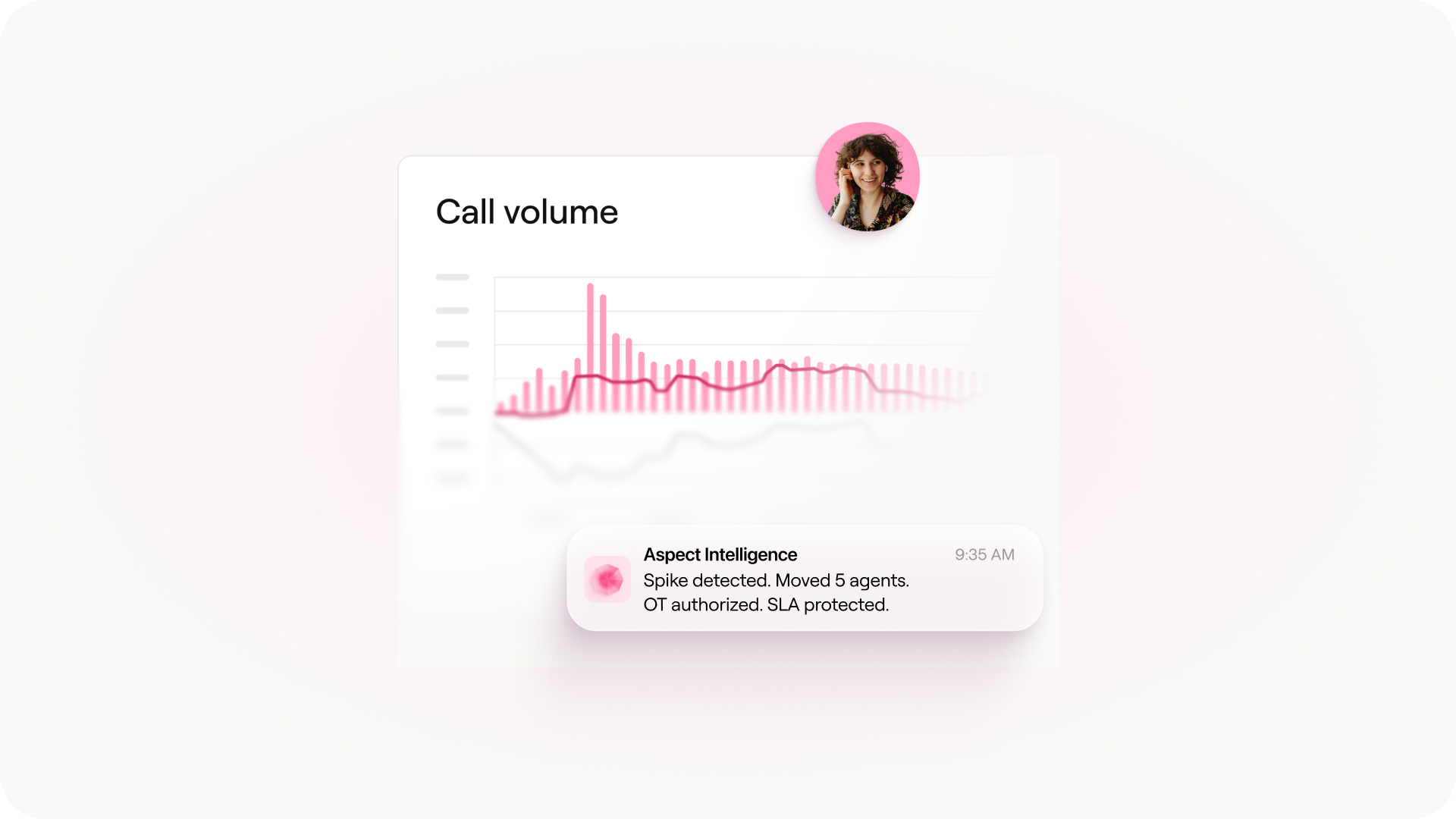



Labor is one of the most sensitive levers in customer experience.
Staffing decisions influence wait times, service levels, agent workload, and ultimately customer satisfaction. Yet many organizations still rely on traditional cost-cutting tactics like hiring freezes and schedule reductions.
While these approaches may lower labor spend in the short term, they often create longer queues, agent burnout, higher attrition, and increased operational costs over time.
Contact center leaders know workforce expenses must be carefully managed, but how can they do so without degrading service levels and agent experience?
Workforce cost optimization isn't about cutting staff. Instead of reducing headcount, leading organizations use forecasting, real-time insights, and intelligent workforce management to align staffing with demand and control labor spend without sacrificing service quality.
In this guide, we'll explore how modern contact centers reduce labor costs while protecting customer experience and agent engagement.
What is workforce cost optimization?
Workforce cost optimization is the strategic practice of aligning staffing, schedules, and skills with actual customer demand to reduce unnecessary labor spend while maintaining target service levels.
In a contact center, this means minimizing overstaffing and idle time without creating longer wait times or degrading customer experience. It also involves optimizing how agents are scheduled and deployed across channels to ensure the right resources are available at the right time.
Workforce cost optimization is a data-driven, ongoing process. Demand patterns, agent availability, and business priorities constantly change, so organizations must continuously forecast, adjust, and refine staffing decisions to control costs while protecting performance.
Learn more: What is workforce optimization (WFO)?
Why workforce cost optimization matters
Contact centers are under constant pressure from rising labor costs, unpredictable demand, and increasing customer expectations across voice and digital channels. Even small staffing gaps can quickly lead to longer wait times, lower satisfaction, and higher operational costs.
Traditional staffing approaches based on fixed schedules or manual adjustments struggle to keep pace with today's multi-channel complexity. Fluctuating interaction volumes and channel mix create frequent peaks and troughs that amplify the financial impact of even minor inefficiencies.
Overstaffing results in wasted labor spend, while understaffing drives overtime, agent stress, and service-level risk.
Workforce cost optimization provides a more precise approach by connecting labor planning to real-time operational insight. With better visibility into demand and performance, contact center leaders can control costs while maintaining service quality, employee engagement, and customer experience.
Common workforce cost optimization mistakes to avoid

Reducing labor costs is a priority for most contact centers, but some cost-cutting approaches can create unintended consequences. Short-term savings lead to higher attrition, declining service levels, and hidden operational costs.
The most common workforce cost optimization mistakes include:
Across-the-board headcount reductions
Uniform staff cuts may lower payroll immediately, but they often create coverage gaps, longer wait times, and increased agent stress. Blanket reductions ignore actual demand patterns and typically increase costs elsewhere.
Over-reliance on historical averages
Staffing decisions based only on past trends fail to account for seasonality, channel shifts, or unexpected demand spikes, leading to persistent over- or understaffing.
Excessive overtime usage
Relying on overtime to close staffing gaps increases labor costs, contributes to agent fatigue, and leads to higher turnover.
Understaffing during peak periods
Scheduling too close to expected demand may reduce planned labor hours, but often results in last-minute adjustments, service-level risk, and lost customer loyalty.
Ignoring skills and shift alignment
Even when headcount appears sufficient, mismatches between agent skills, schedules, and channel demand reduce efficiency, increase handle time, and drive up total cost per interaction.
How contact centers optimize workforce costs
Modern contact centers achieve workforce cost optimization by improving planning accuracy and making real-time adjustments instead of relying on across-the-board cost cuts.
Improving forecasting accuracy
Inaccurate forecasts are one of the primary drivers of unnecessary labor costs.
When prediction models are off, overestimating demand leads to idle time, while underestimating it causes overtime, agent stress, and service delays. Even small improvements in forecast accuracy can significantly reduce labor variability before schedules are created.
By analyzing historical interaction patterns, seasonal trends, and expected demand changes, workforce managers can gain clearer visibility into when and where agents are needed. This allows staffing to align more with actual demand, reducing wasted labor while protecting service levels.
Learn more: Workforce forecasting: A guide to strategic staffing.
Increasing scheduling efficiency
Once forecasts are established, efficient scheduling turns those insights into operational results.
Adjusting shift lengths, break times, and skill alignment minimizes idle time and reduces the need for last-minute adjustments. Effective scheduling balances coverage with agent workload, helping prevent burnout while maintaining consistent service performance.
When schedules reflect real demand, contact centers can reduce overtime, improve productivity, and control labor costs without sacrificing customer experience.
Managing intraday variability
No forecast can perfectly predict real-time conditions, and contact center supervisors must respond to fluctuations throughout the day.
Intraday management adjusts staffing to match changing demand, whether that means shifting agents between channels, adding temporary coverage, or reallocating skills during unexpected peaks.
Acting quickly helps prevent service disruptions and keeps labor costs from escalating unnecessarily, while maintaining consistent customer support.
Reducing attrition and burnout as a cost lever
Turnover and burnout are among the most expensive workforce costs, yet they are often overlooked in cost-reduction strategies.
Research from McKinsey & Company estimates that replacing a single contact center agent can cost between $10,000–$20,000, including recruiting, training, onboarding, and lost productivity during ramp-up.
By using more precise forecasting, dynamic scheduling, and proactive intraday management, organizations reduce workload volatility and improve work-life balance. Lower attrition not only reduces recruitment and training expenses, but also preserves institutional knowledge, improves service consistency, and stabilizes workforce performance.
Workforce cost optimization metrics every contact center should track

Effective workforce cost optimization depends on the right operational metrics. These indicators reveal where labor is being used efficiently, where waste occurs, and where targeted changes can reduce costs without impacting service quality.
The most important workforce cost optimization metrics include:
Forecast accuracy
Measures how closely predicted contact volume matches actual demand. When forecasts miss the mark, contact centers either overstaff (creating idle time) or understaff (driving overtime and service delays). Improving forecast accuracy reduces wasted labor hours and prevents cost variability before schedules are created.
Schedule efficiency
Indicates how well scheduled hours translate into actual coverage that aligns with demand. Poor break placement, uneven shift distribution, or skill mismatches leave gaps that increase cost despite adequate headcount.
Overtime rate
Frequent overtime often indicates problems earlier in the planning process. Spikes can come from forecast gaps, poor schedules, or weak intraday management. Reducing overtime lowers labor costs and reduces pressure on agents.
Shrinkage
Represents paid time when agents are unavailable for customer interactions, including training, meetings, absences, and technical downtime. Accounting for shrinkage ensures staffing plans remain realistic and prevents hidden costs.
Learn more: Call center shrinkage: Calculate, manage, and optimize agent scheduling.
Cost per contact
Evaluates labor expenses at the interaction level. When analyzed alongside volume, handle time, and service levels, this metric reveals which channels or workflows are driving higher costs and where optimizations will deliver the greatest impact.
Service-level stability
Consistent performance over time indicates that staffing is aligned with demand. Large changes in service levels often signal reactive management or inefficient labor allocation.
From traditional cost control to intelligence-driven optimization
Traditional workforce cost control in contact centers is typically built around fixed plans and manual oversight. Staffing decisions are often made weeks in advance using historical averages, with limited visibility into changing demand across channels.
When conditions shift, managers are forced to react, adding overtime, cutting hours, or accepting temporary service declines. Reporting often tends to look backward, explaining what happened after labor costs have already increased.
Intelligence-driven workforce cost optimization takes a different approach. Instead of relying on static assumptions, modern contact centers use ongoing data and automation to understand how demand is evolving in real time.
Forecasts are refined dynamically, staffing plans adjust as conditions change, and decisions are guided by current performance rather than past results alone. This shifts labor management away from reactive corrections to proactive, day-to-day optimization that better controls costs while protecting service levels.
The difference is most evident when conditions change quickly. Teams that can identify emerging issues and take action before performance declines spend less time firefighting and less money correcting avoidable mistakes.
The next step is understanding how modern workforce management and intelligence platforms make this level of precision at scale.
Learn more: What is Workforce Intelligence? The complete guide to AI-driven workforce optimization.
How Aspect helps contact centers optimize workforce costs smarter
Aspect provides contact centers with a unified approach to workforce cost optimization, helping organizations control labor spend while maintaining high service levels.
By connecting forecasting, scheduling, intraday adjustments, and analytics within a single platform, Aspect enables workforce leaders to make smarter decisions across the entire staffing lifecycle. The result is better cost control, fewer operational surprises, and more consistent customer experiences.
- Advanced forecasting aligns staffing with real demand, reducing idle time and unnecessary overtime.
- Dynamic scheduling translates demand insights into the right coverage at the right time, improving productivity without increasing headcount.
- Real-time performance monitoring allows managers to adjust quickly when conditions change, preventing service dips and last-minute labor costs.
- Data-driven workforce insights highlight where costs are increasing and which actions have the biggest impact.
With Aspect Workforce, contact centers can maintain service quality (even when demand shifts unexpectedly) while ensuring every staffing decision supports both operational efficiency and long-term cost optimization.
See how leading contact centers are reducing labor spend with Workforce Intelligence. Download the white paper: Workforce intelligence: An AI-fueled approach to WEM.
- How can contact centers reduce labor costs without hurting customer experience?

- How do you reduce labor costs without cutting staff?
- What are the biggest drivers of workforce cost inefficiency?
- How does forecasting accuracy impact workforce costs?
- Is workforce cost optimization only about cutting expenses?