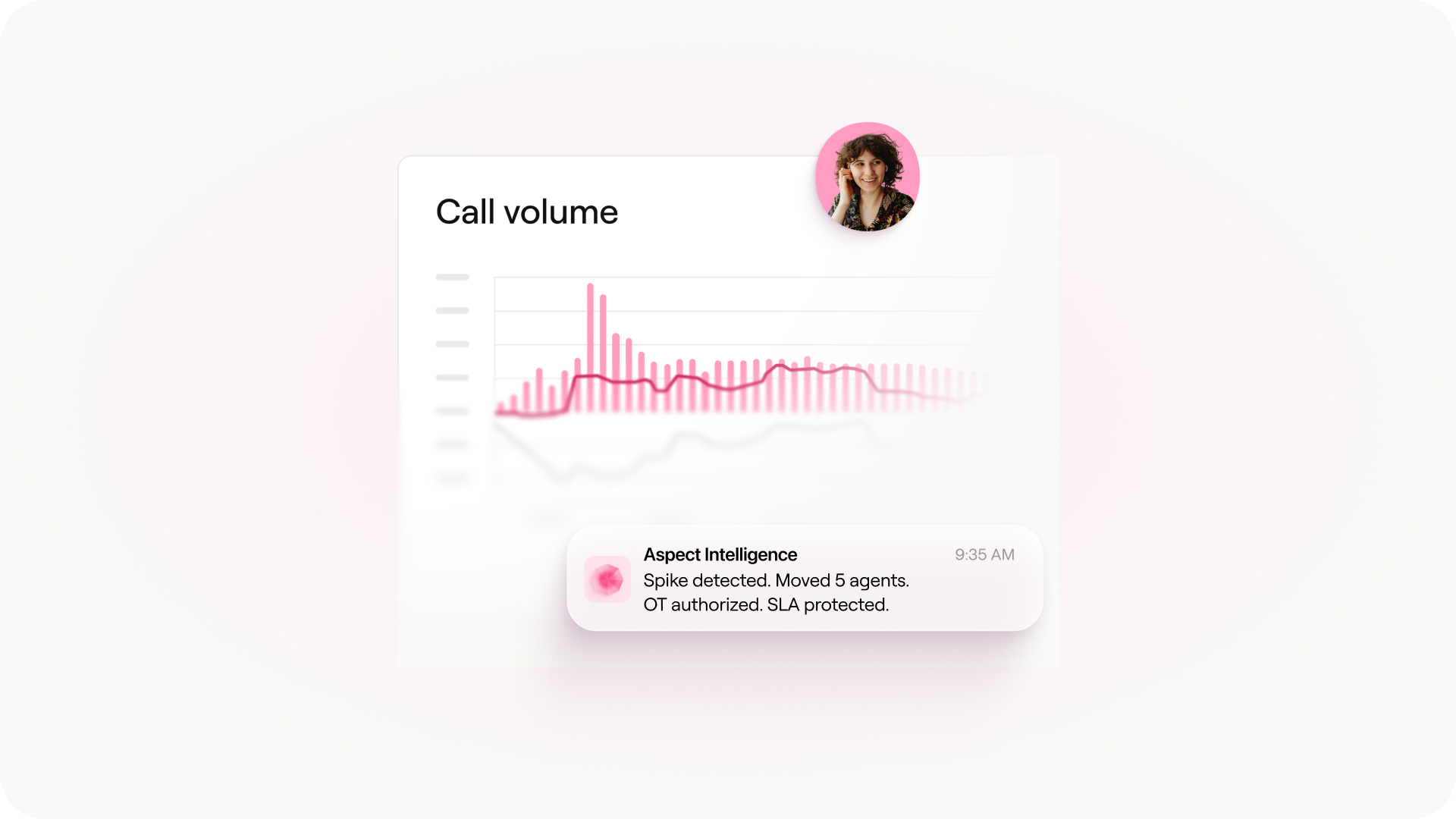



AI has evolved from a buzzword into a daily partner for workforce management, helping managers and agents automate routine tasks and focus on complex work. Workforce managers now spend less time on reactive scheduling and forecasting, creating more opportunities for human-centric tasks like coaching and training.
However, AI is only as effective as the data it receives. Continuous data inputs and audits keep forecasts accurate, scheduling efficient, and your organization running smoothly.
In this blog, we'll explore why data quality is essential to getting the most out of AI and automation in your workforce management platform.
The dynamic nature of workforce management
Contact centers are dynamic spaces where call volume and customer demands constantly shift. Workforce management software must adapt in real-time to meet the needs of onboarding new employees, seasonal variations, and spikes in customer service volume.
AI models trained on historical data alone can't consistently account for these changes. Continuous data inputs allow AI models to learn, adapt, and deliver more accurate results based on fluctuating data.
What is model drift in AI and why does it matter in WFM?
Model drift occurs when machine learning models lose accuracy over time as their training data diverges from real-world conditions.
For example, consider a contact center that provides customer support for the insurance industry. Agents serving regions prone to natural events like snowstorms, hurricanes, and tornadoes may experience surges in call volume during certain seasons. Due to the seasonality and unpredictability of these events, historical data alone may not provide accurate forecasting, leading to model drift and data degradation.
AI models for workforce management systems must also account for additional factors beyond shifting call patterns. These include changes in employee behaviors and the emergence of new communication channels like web chat and social media.
Learn more: Transforming property and casualty insurance with WFM solutions.
The importance of continuous data input in contact centers
Continually feeding workforce data to your AI platforms is critical for the following reasons.
- Maintaining model accuracy. Fresh data helps support high levels of model accuracy that is consistent with changing workforce patterns.
- Adapting to business changes. As your organization scales, your workforce platform should too. Continuous data inputs help AI models adapt to new organizational changes.
- Improving predictive capabilities. Continuous data input enhances the accuracy of predictive solutions, improving forecasting, scheduling, and allocating resources across contact centers.
It's important to note that having fresh data is only one piece of the puzzle. Your workforce data also must be clean and high-quality to ensure accuracy. Training an AI model on inaccurate or biased data creates drift and unreliable outputs.
The role of data audits in contact centers
Ethical AI and data practices are critical in every industry, including contact centers where agents handle sensitive customer data.
Many organizations face growing challenges with data privacy and security as they develop processes to meet compliance standards and governance policies.
Regularly auditing data ensures:
- Data quality and accuracy. Identify data inconsistencies and biases that can compromise the performance of your model.
- Detection of anomalies. Auditing data helps you identify trends and patterns that may indicate larger issues in your data collection process that require adjustments to your model.
- Proper compliance and governance. Data audits ensure compliance with privacy regulations and maintain ethical AI practices in workforce management.
The frequency of data audits depends on several factors: the risk level of the model in your workforce management software, the industry your organization serves, regulatory requirements, and how often the model changes. Some industries may only need annual audits, while high-risk sectors like healthcare and finance typically require quarterly audits.
Learn more: Why security is critical in workforce management.
Best practices for clean, continuous data workflows
Just as humans learn over time, AI models can only learn based on the information they're given. Your workforce data needs to be clean and continuous for your systems to adapt and create outputs that inform proactive solutions for your contact center.
Consider following these best practices to support streamlining data flows in your workforce management systems.
- Automated data collection systems: Set up automated pipelines that continuously feed relevant data into AI models without manual intervention.
- Real-time monitoring and validation: Implement real-time data quality checks to catch issues early and use validation processes to prevent problems from affecting model performance.
- Scheduled audit cycles: Establish regular audit schedules (weekly, monthly, or quarterly) based on your business needs and adjust frequency based on model risk to maintain data quality.
- Feedback loops: Create mechanisms for human experts to validate AI outputs and feed corrections back into the system for continuous improvement.
- Data standardization and governance: Standardize data formats and naming conventions across all sources and implement governance policies that define data ownership and accountability.
- Data documentation and tracking: Use version control for datasets to track changes over time, document data lineage to understand how information flows through your system, and establish clear protocols for handling missing or incomplete data
Measuring the impact of continuous data management
Continuous data management of AI in workforce management can be quantified in several ways, depending on the KPIs that your organization values the most.
Forecasting accuracy improvements
- Metric: Reduction in forecast error percentage (e.g., from 15% to 5% error rate)
- ROI Calculation: Cost savings from reduced overstaffing and understaffing incidents multiplied across all contact center hours
- Example: A 10% improvement in forecast accuracy for a 500-agent center can save $500K-$1M annually in labor costs
Schedule adherence optimization
- Metric: Increase in schedule adherence rates (target: 90%+ adherence)
- ROI Calculation: Improved service levels + reduced overtime costs + decreased need for real-time adjustments
- Example: Each 1% improvement in adherence can translate to 0.5-1% reduction in required staffing buffer
Agent productivity gains
- Metric: Reduction in time spent on manual schedule adjustments and approvals
- ROI Calculation: (Hours saved per week × hourly rate × number of managers) × 52 weeks
- Example: Automating schedule changes can save supervisors 5-10 hours per week
Turnover reduction
- Metric: Decrease in agent attrition rates through better schedule flexibility
- ROI Calculation: (Reduction in turnover % × number of agents × cost per hire) + training cost savings
- Example: Reducing turnover by 5% in a 500-agent center saves $250K-$500K annually (assuming $5K-$10K replacement cost per agent)
The bottom line: Data quality drives AI success in workforce management
AI models in workforce management aren't "set and forget" solutions. No matter how advanced or intelligent an AI model may be, it requires ongoing care through continuous data input and regular audits to ensure you're getting the most out of your software.
Organizations that invest in ethical and sustained data management will see better AI performance and business value over time.
Learn more about Aspect's commitment to ethical AI and how we're building intelligent workforce management systems for a better world of work.