


Most contact center forecasts were built for a world where one contact meant one unit of human work. A call came in, an agent handled it, and you could reason backward from volume to staffing with a fairly stable handle time. AI has quietly broken that assumption, and a lot of teams have not updated their model to match.
Here is the short version. Deflection reduces the number of contacts that reach a human, but it does not reduce the total workload your operation has to plan for. Self-service and AI agents resolve the easy, repetitive contacts, which leaves your people with a harder and more emotionally loaded mix. If you forecast the leftover volume with the old average handle time, you will understaff during exactly the hours your customers need the most help.
The fix is to stop forecasting a single blended demand line and start forecasting AI-assisted work and human-assisted work as separate streams, each with its own volume pattern, handle time, failure mode, and recontact behavior. That is the core change the agentic era demands, and it is where Workforce Intelligence earns its keep.
What does "deflection" actually do to your contact volume?
Deflection moves the easy work off your human queue and leaves the hard work behind, which changes the shape of demand more than the size of it. When a bot resolves password resets and order-status checks, those contacts disappear from the human forecast. What remains is the billing dispute, the multi-account mess, the customer who already tried the bot twice and is now annoyed, the edge case the script never covered. Your contact count drops and your average handle time climbs, and if your forecast only tracks count, it will look like things got easier right before service levels fall over.
Gartner's data makes the scale of this clear. A survey of 5,728 customers found that only 14% of service issues are fully resolved in self-service, and even for issues customers describe as very simple, just 36% resolve without a human. So the promise that automation quietly absorbs half your volume rarely survives contact with real customers. Most of the time the customer starts in self-service, gets partway, and arrives at your human agents having already spent effort and patience. That handoff is workload, and it belongs in your forecast.
There is a second-order effect worth naming. When the bot handles the simple contacts, your agents lose the short, easy interactions that used to give them breathing room between hard ones. The rhythm of the day changes. Occupancy feels heavier even when the raw numbers look lighter, and that shows up later as burnout and attrition if you do not plan for it.
Why does the old forecasting model break when AI enters the mix?
The old model breaks because it assumes a stable relationship between contact volume and required staff, and AI makes that relationship move around week to week. When you deploy or tune an AI agent, the containment rate shifts, the mix of what reaches humans shifts, and the handle time distribution shifts with it. A forecast built on twelve months of history now includes months that no longer describe how work arrives.
This is where coordination costs show up. The team that tunes the AI agent usually sits in a different group from the WFM team that builds the forecast, and the two rarely reconcile their numbers. The automation team celebrates a higher containment rate. The planning team sees handle time creeping up and cannot explain it. Nobody connects the two, so the forecast drifts and the staffing plan quietly gets worse. That gap between what one team changed and what another team has to absorb is the hidden tax that Workforce Intelligence is meant to remove.
Gartner also projects that by 2028 at least 70% of customers will use a conversational AI interface to start their service journey. If most customers begin with AI, then the AI layer becomes the front of your demand funnel, and the volume and difficulty of what reaches your people depends entirely on how well that layer performs. You cannot forecast human staffing accurately without modeling the behavior of the automation sitting in front of it.
How should you forecast AI-assisted and human-assisted work separately?
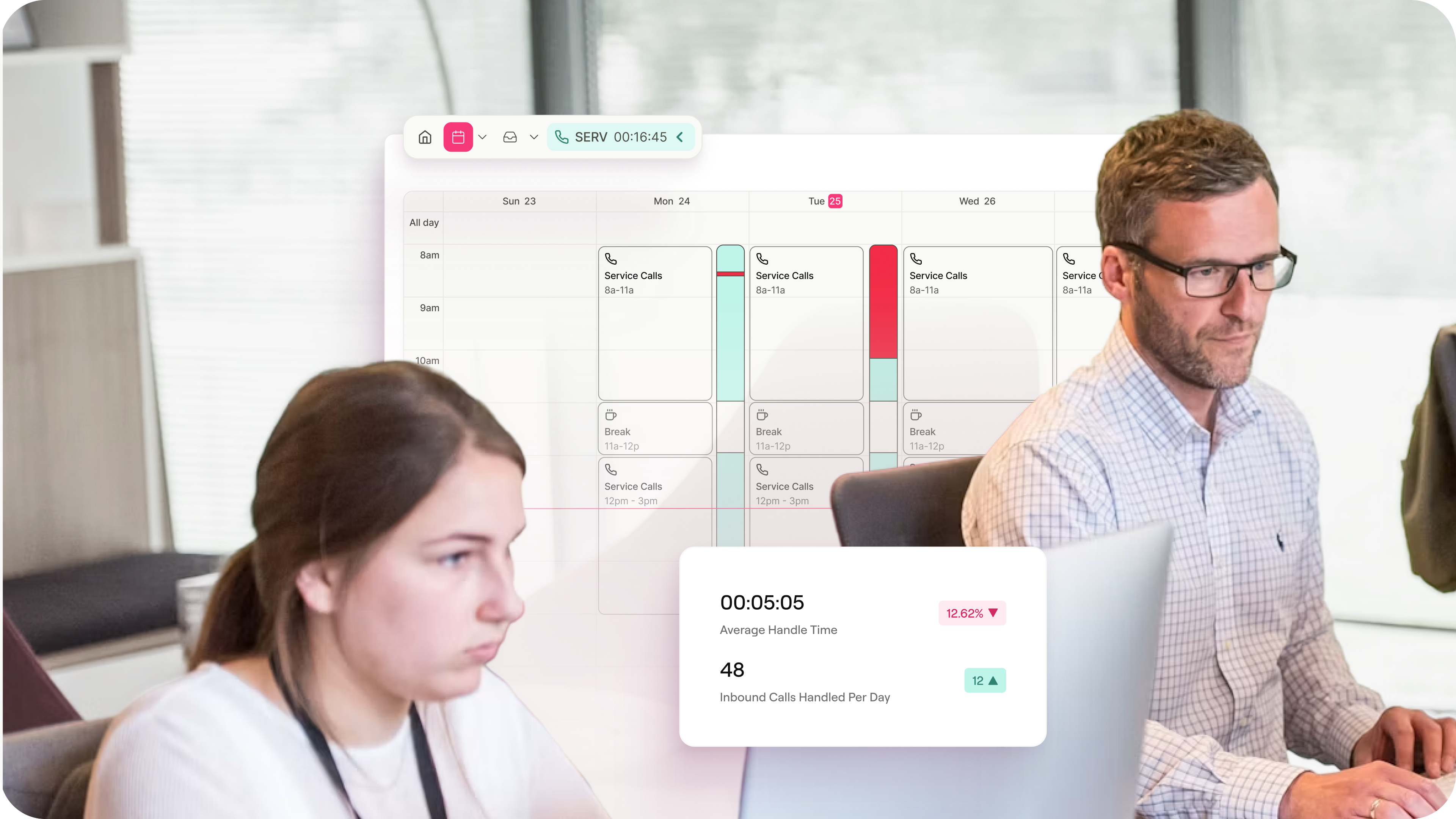
Split your demand into the work AI handles end to end and the work that reaches a person, then forecast each with its own drivers rather than forcing them into one blended line. For the AI-assisted stream, track containment rate and the rate at which contained interactions come back within a day or two, because a resolution that generates a repeat contact was never really resolved. For the human-assisted stream, forecast the escalated and net-new volume with its own handle time, which will be higher than your historical blended average because the easy contacts are gone.
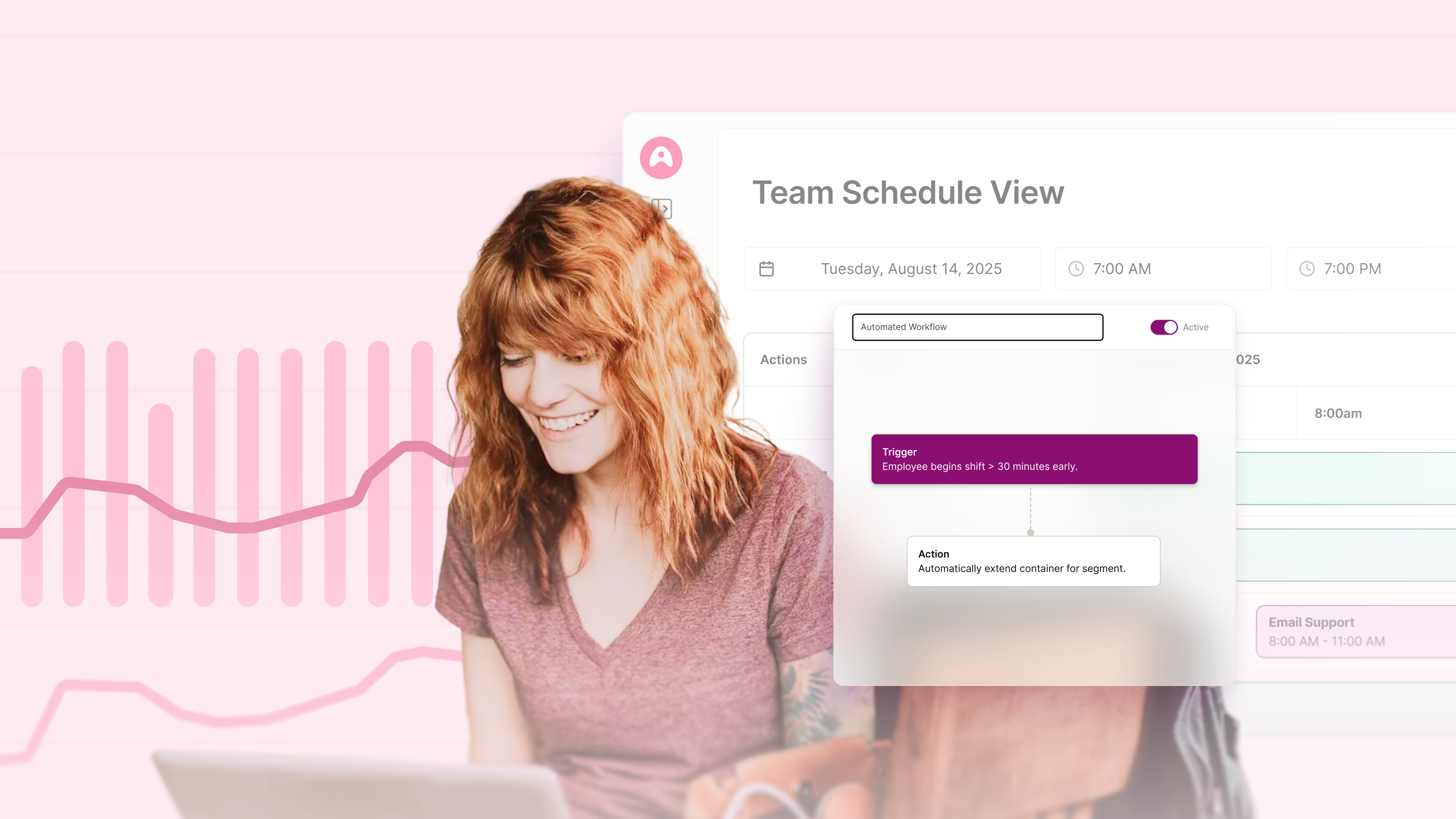
In practice this looks like a few concrete moves. Build a forecast segment for AI-contained work and watch its recontact rate as closely as you watch containment. Build a separate segment for the escalations coming out of AI, since those arrive with context already spent and take longer to resolve. Keep your voice, chat, and email forecasts distinct rather than converting everything into a single contact-equivalent, because the handle characteristics genuinely differ across channels. And revisit your segmentation whenever the automation team ships a change, because a retuned bot can move the boundaries between these streams overnight. This is the unified multichannel forecasting approach behind Aspect's Predictive Multi-Channel Forecasting, which models voice, chat, and email together while keeping their distinct patterns intact instead of flattening them into one number.
The payoff is that your staffing plan finally matches the work that actually shows up. When the automation team tunes the bot and containment jumps, you see the escalation stream change in the same view, and you adjust the human forecast before the service-level miss instead of after.
What should planners measure every week in the agentic era?
Measure the handful of signals that tell you whether your automation is shifting demand faster than your plan can keep up. Containment rate on its own is a vanity metric, so pair it with the recontact rate on contained interactions and the escalation rate into human queues. Watch handle time on the human stream specifically, because that is where the difficulty concentrates, and watch shrink and occupancy for early signs that the changed rhythm of the day is wearing people down.
A weekly cadence works well here. Once a week, sit the automation owner and the planner in front of the same numbers and reconcile what changed. If containment went up four points, where did that volume go, and did the human handle time move to match? If a new intent got automated, which segment lost volume and did the forecast reflect it? These conversations take twenty minutes and they close the coordination gap that otherwise quietly destroys forecast accuracy.
One more point on accuracy itself. High forecast accuracy is worth less than the ability to act when reality diverges. You can hit 90% accuracy on the wrong segmentation and still be understaffed on your hardest hour. Aspect's own view is that accuracy matters, and operational agility, the speed at which you can see a change and respond to it, is what separates teams that cope from teams that scramble.
Where does automation fit without taking the forecast out of human hands?
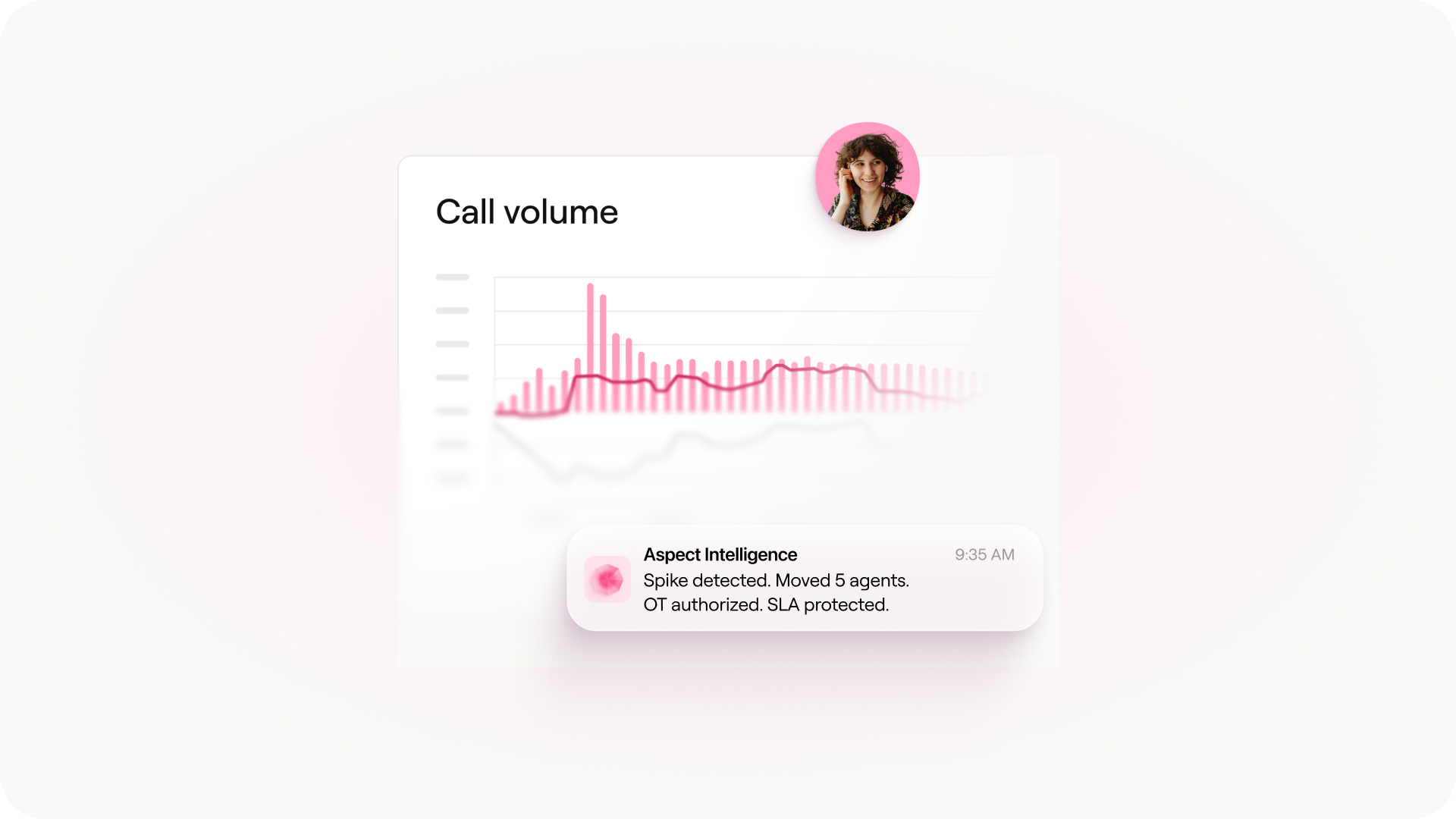
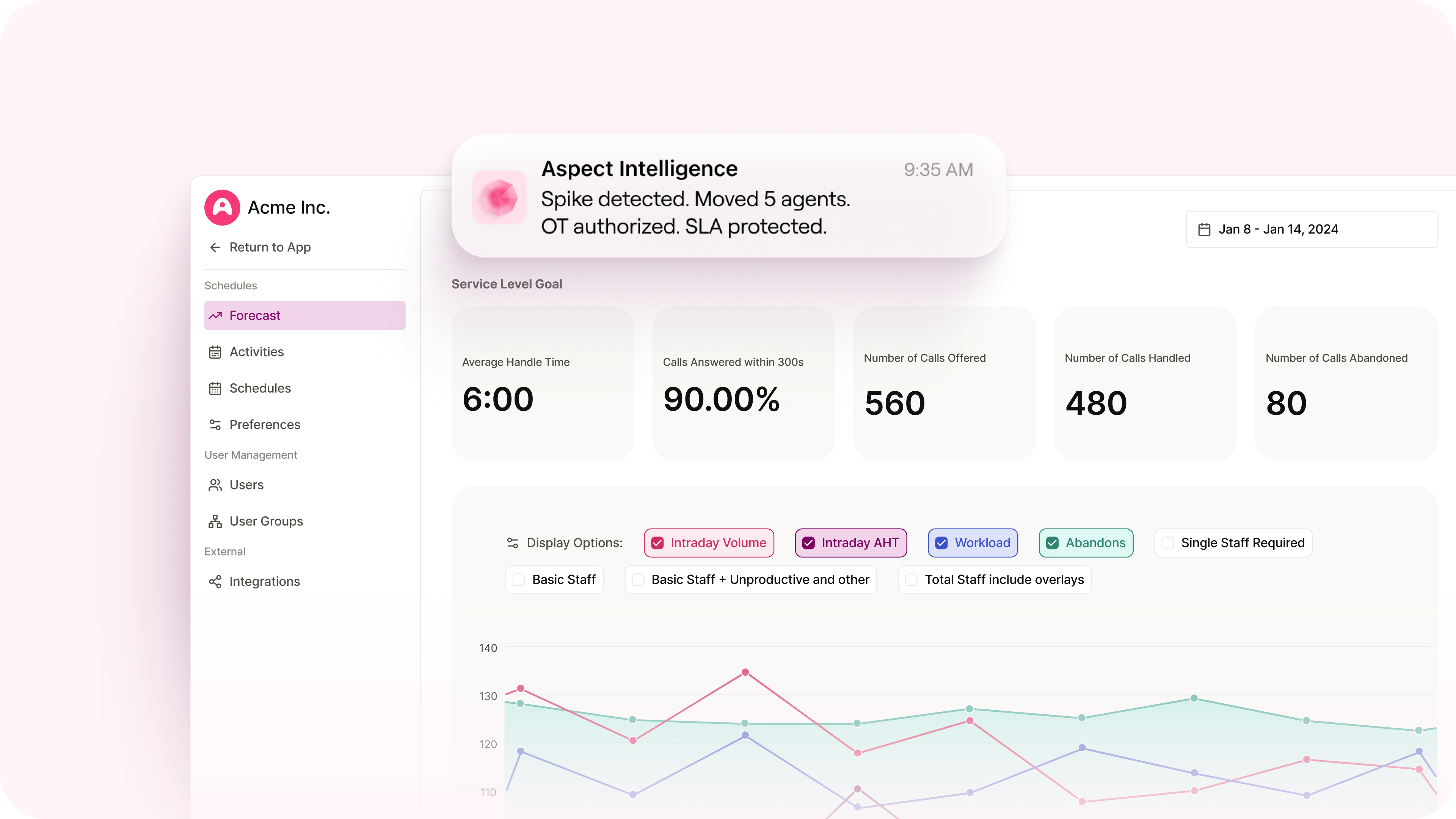
Automation belongs in the parts of forecasting that are repetitive and high-frequency, with a planner always able to see the reasoning and override it. Re-forecasting intraday as volume patterns shift is a good example. Doing it by hand every thirty minutes is impossible, so this is where Aspect Intelligence uses NowCasting to re-forecast the rest of the day in real time as demand moves, and it surfaces the change to the planner rather than silently rewriting the plan. That is what policy-aware automation and guided intelligence means in practice: the system does the heavy, repetitive calculation, and the human stays in the loop to shape the decision and catch the cases the model gets wrong.
The line I would draw is simple. Let automation propose and calculate. Keep humans deciding on anything that moves staffing, changes a schedule, or affects a customer commitment. A planner who can see why the system suggested a change, and can adjust or reject it, will trust and use the tool. A black box that reshuffles the plan overnight with no explanation gets switched off within a month, usually right after it makes one confident, wrong call during a peak.
Forecasting in the agentic era is less about chasing a perfect number and more about modeling how AI reshapes the work, keeping your teams reconciled, and giving planners fast, transparent control over the response. Do that, and deflection becomes something you plan around instead of something that surprises you in yesterday's report.
- Does AI deflection reduce contact center staffing needs?

- What is the difference between AI-assisted and human-assisted demand?
- Why is my average handle time rising after deploying AI?
- How often should I re-forecast in an AI-heavy contact center?
- What should WFM and automation teams review together?