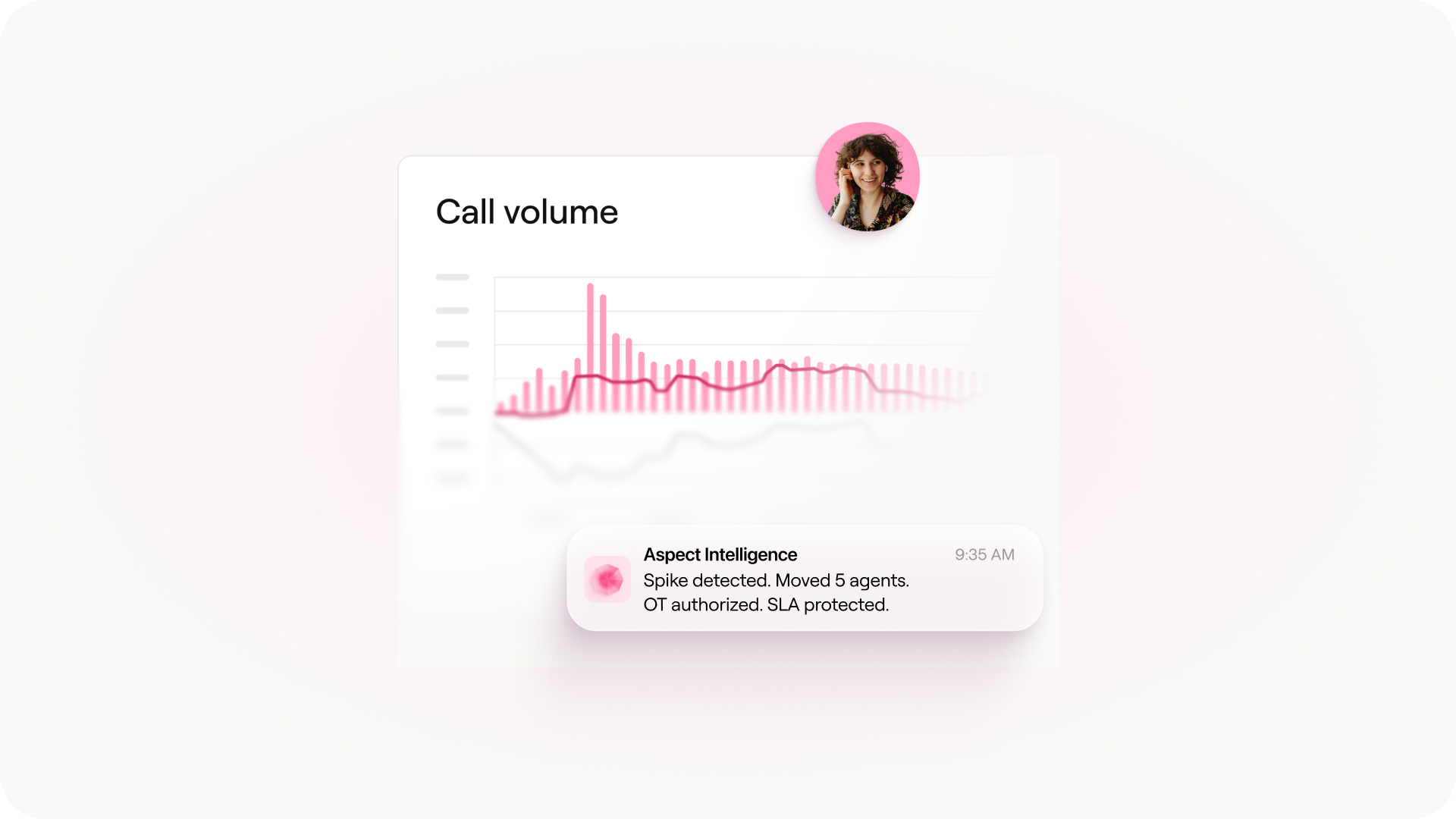
Workforce technology is a strategic investment, and the bar for measuring its return has changed. ROI today is no longer just about cutting costs or streamlining schedules. Modern contact center leaders are asking harder questions: Are we predicting demand accurately enough to prevent overstaffing? Are our intraday decisions fast enough to stop SLA breaches before they happen? Are we catching performance signals early enough to protect both CX and cost?
The shift from reactive workforce management to intelligence-driven workforce decisions is the defining ROI lever of this era. Modern workforce management ROI comes from:
- Predicting demand more accurately to right-size staffing before the day begins
- Making real-time staffing decisions that prevent cost and service failures in the moment
- Preventing cost and service issues before they occur through early signals and automated guidance
This guide walks through six strategic steps to help your contact center capture that full ROI, and shows how Aspect can help you get there.
1. Understand total cost of ownership (TCO), including the cost of bad decisions
A TCO analysis remains essential when evaluating workforce management software. But traditional TCO misses a critical category: the cost of poor decisions.
Every time a forecast is wrong, every hour a supervisor waits for lagging reports, every overtime shift triggered by a reactive staffing gap, those are costs your TCO model may not be capturing. Workforce Intelligence reframes TCO as cost + risk + volatility.
Static TCO categories still matter:
- Initial software investment: licensing fees, customizations, per-seat or per-employee costs
- Deployment and implementation costs: cloud vs. on-premises and integration complexity
- Training and adoption: the time and budget required to drive meaningful usage
- Maintenance and upgrade costs: ongoing, and highly dependent on deployment model
But a decision-aware TCO also accounts for:
- The cost of forecast error: every percentage point of inaccuracy translates directly into over- or understaffing spend
- The cost of delayed intraday response: hours lost reacting to volume spikes that real-time visibility could have anticipated
- The hidden cost of manual, lagging data: supervisors spending time chasing reports instead of coaching agents or adjusting staffing in the moment
When you evaluate WFM software, build this full picture into your TCO. The platform with lower licensing costs may carry far higher decision costs.
Learn more about evaluating contact center software and ways to explore your vendor options in our “How to buy contact center software” series.
2. Reduce costs through intelligence levers, not just efficiency tactics
Cost savings in the contact center don't come from a single lever. But they do cluster around four intelligence-driven drivers that compound over time:
Forecasting accuracy → reduced overstaffing and overtime
Improved forecast precision means you enter each day with the right number of agents, avoiding the twin costs of overstaffing (idle labor) and understaffing (reactive overtime). Even modest gains in forecast accuracy can yield significant labor savings at scale.
Scheduling efficiency → lower shrinkage and admin effort
Optimizing schedules against accurate demand forecasts reduces shrinkage by ensuring coverage aligns with real volume patterns. It also cuts the administrative burden on workforce planners, freeing them to focus on strategic adjustments rather than manual schedule repairs.
Intraday management → fewer SLA breaches and emergency costs
Real-time visibility into adherence, volume, and queue performance allows supervisors to make micro-adjustments before service levels erode. Preventing a single SLA breach can eliminate the downstream costs of re-work, escalations, and customer churn.
Retention insights → reduced hiring and onboarding spend
Engagement data and performance signals help managers identify at-risk agents before they leave. Retaining top talent through smarter coaching and scheduling reduces the ongoing cost of recruiting, hiring, and onboarding replacements.
Want to read further about the importance of workforce scheduling? Check out these blogs on reducing contact center shrinkage and ways to improve agent schedule adherence.
3. Measure performance through leading indicators, not just outcomes
Workforce Intelligence is about prevention, not post-mortems. That means shifting your performance measurement framework from lagging outcome metrics toward the leading indicators that predict and influence those outcomes.
Aspect's workforce solutions give managers near-real-time visibility into the signals that matter most:
- Near-real-time agent productivity and adherence: so managers can provide coaching and schedule adjustments while there's still time to course-correct, not after the damage is done
- Early warning signals: volume trending, adherence drift, and queue pattern changes that surface before they become SLA issues or overtime events
- SLA and CSAT as decision results: not isolated KPIs to track, but outcomes of better forecasting, smarter intraday decisions, and more consistent agent performance
Goal-setting aligned across agents, teams, and the broader organization reinforces this model, when individuals understand how their performance connects to business outcomes, both engagement and efficiency improve.
Explore additional reading about performance management strategies to drive success and get the best ROI in your contact center.
4. Build for continuous intelligence maturity, not just future-proofing
Long-term ROI doesn't come from a one-time implementation. It compounds as your organization develops continuous intelligence maturity, the ongoing improvement of models, decisions, and adoption over time.
This means:
- Ongoing model improvement: forecasting models and intraday rules that learn from historical patterns become more accurate over time, delivering compounding returns on scheduling and staffing precision
- Smarter feature adoption tied to business outcomes: rather than activating every new capability at once, prioritize features with clear ROI impact and build adoption progressively
- Integration quality as an ROI multiplier: workforce software that integrates cleanly with your CRM, ACD, and QM platforms ensures data consistency, eliminates manual reconciliation, and unlocks cross-system intelligence
Aligning your Aspect Intelligence deployment to these maturity milestones protects your ROI trajectory and ensures the platform scales with your business, not just your headcount.
5. Use ROI calculation as a decision tool, not just a formula
Calculating contact center ROI involves more variables than most spreadsheets capture:
- Workforce size
- Training and onboarding time
- Average employee pay and tenure
- KPIs like AHT, calls handled, shrinkage, and adherence
But the real value of an ROI model isn't the number it produces, it's the conversations it enables. Used well, an ROI calculator becomes a scenario modeling tool that helps executives weigh cost vs. service tradeoffs, stress-test staffing assumptions, and build the business case for technology investment.
The Aspect ROI Calculator provides a strong baseline for your analysis. Our sales team offers free, tailored ROI consultations to go deeper, modeling your specific volume patterns, workforce size, and performance targets to produce a calculation that holds up in executive conversations.
6. Prove intelligence-led ROI with real-world outcomes
In 2023, The ROI Institute awarded Aspect with the Best ROI Forecast, recognizing our workforce engagement management platform for credible and conservative ROI methodology.
Aspect customers across industries have demonstrated that intelligence-led workforce decisions, not just software deployment, drive the outcomes that matter:
Sekure Merchant Solutions transformed their workforce operations after implementing Aspect Workforce. By shifting to data-driven scheduling and intraday management, they eliminated 1,500 hours of management tasks annually, reduced employee turnover by 62%, and saved $35,000 in deployment costs. The key was better staffing decisions, made earlier and with more confidence.
BC Services captured $70,000 in efficiency savings over nine weeks as agents, motivated by clearer goals and better engagement data, handled more customer interactions with higher quality. The accounts receivable management company also saw an 88% agent retention rate in just four weeks, a direct result of smarter engagement strategy powered by workforce intelligence.
Want to go deeper on Workforce Intelligence? Download the report: Workforce Intelligence: An AI-fueled approach to Workforce Engagement Management (WEM).
- What drives workforce management ROI today?

- How does forecasting accuracy impact labor costs?
- How do real-time workforce decisions affect ROI?
- What metrics matter most for contact center ROI?
- How does workforce intelligence improve ROI over time?