Every contact center leader has lived some version of this morning. You open the previous day's service-level report, you see the afternoon came apart between two and four o'clock, and you start reconstructing the miss from numbers that are already sixteen hours old. By the time you understand what happened, the customers who waited have made up their minds about you, and the overtime you approved to claw the queue back has already been spent.
Real-time workforce intelligence pulls the moment of detection forward. It watches the operation while the day is still moving, catches the early signals that a service-level miss is forming, puts a number on how bad that miss becomes if nobody steps in, and hands a planner a specific action while there is still time to change the result. Yesterday's report explains the damage after the fact. Real-time intelligence gives you a chance to prevent it.
This is harder and more valuable than it was two years ago, because the work reaching your agents has changed shape. AI now deflects a lot of the simple contacts, so the interactions that make it to a person tend to run longer and less predictably, and a forecast built on last quarter's mix quietly stops matching what is actually hitting the floor today.
What is real-time workforce intelligence, and how is it different from intraday reporting?
Real-time workforce intelligence turns live operational signals into staffing decisions before the interval closes, and the difference from intraday reporting comes down to timing and interpretation. Reporting shows you the gap after it opens. Intelligence sees the gap forming and tells you what to do about it.
Most intraday dashboards are rear-view mirrors with a live badge on them. They refresh every fifteen or thirty minutes and show where you stand against plan right now. A planner still has to notice the number, decide whether it is random noise or a real trend, diagnose the cause, and choose which lever to pull, and that interpretation work is exactly where the hours disappear and where a recoverable miss hardens into a bad afternoon. Real-time workforce intelligence does the noticing and the first pass of diagnosis for the planner, so the human spends their attention on the decision rather than on the detective work.

Why do service levels drift during the day when the morning forecast looked fine?
Service levels drift because a forecast is a snapshot of expected conditions, and real days rarely hold still. A forecast can be accurate at the daily or weekly level and still leave you exposed inside any given half hour, because the misses that hurt happen at interval granularity where small gaps compound fast.
The usual causes are familiar to anyone who has run a floor. A wave of unplanned shrink stacks up when three people get pulled into an unscheduled meeting and two more are stuck on an escalation. Handle time creeps because a product issue is generating longer calls than anything in the historical data. Volume arrives front-loaded into the morning instead of spread the way the plan assumed. None of these looks dramatic on its own, and that is the problem, because by the time any single one is obvious in the numbers, several of them have already combined into a miss.
This is also where coordination costs show up, the hidden operational tax you pay when workforce decisions get made in separate corners without a shared picture. The forecasting team, the intraday desk, the team leads on the floor, and the operations manager are often each holding one piece of the day, and the space between what one of them knows and what another one decides is where service level leaks out.
Which signals actually predict a service-level miss before it happens?
The signals worth watching are the ones that move before service level does, and there are four that reliably lead the miss. Watch for actual volume running ahead of or behind the interval forecast, real-time handle time diverging from the planned value, adherence and unplanned shrink climbing above the level your plan assumed, and a queue backlog building faster than your current staffing can clear it inside target.
Any one of these on its own is often noise. The predictive power comes from reading them together and projecting them forward. If volume is running eight percent hot while handle time is ninety seconds above plan and two people just dropped off adherence, you do not have a few small anomalies, you have the opening minutes of a service-level miss that will be undeniable within the hour. A system that models those signals together can tell you the probable service level at the end of the interval while you still have time to act, which is the entire point.
What should a planner do the moment the system flags intraday risk?

The planner should act on a ranked, specific recommendation rather than open a fresh investigation, and the value of real-time intelligence is that it turns a flag into a proposed action. A good system does not just say service level is at risk. It says how large the projected miss is and which specific moves would recover it, for example offering voluntary overtime to a particular skill group, shifting a set of scheduled activities out of the danger window, reskilling a handful of agents into the queue that is underwater, or holding a planned training session until the queue settles.
This is where policy-aware automation earns its place. Some of these moves are low risk and can run automatically inside rules you set, such as nudging an offline activity later when the queue is heating up. Others carry real consequences for cost or for an agent's day, and those should surface as a recommendation that a person approves. That is what guided intelligence means in practice. The system does the sensing and the math and proposes the move, while a human stays in the loop with the authority to see what is being suggested and to shape or overrule it. You get the speed of automation without handing the floor to a black box, which matters, because black-box decisions are the ones operations and risk teams refuse to sign off on.
How does catching drift early protect labor cost, not just service level?
Catching drift early protects labor cost because the cheapest fix is almost always the earliest one, and the price of every intervention climbs as the interval runs down. A small adjustment at ten past the hour, moving one training session or accepting a couple of voluntary overtime hours, costs far less than the panicked overtime and the abandoned contacts you pay for when you spot the same problem at the end of the day.
McKinsey has estimated that applying generative AI to customer care functions could raise productivity by a value equal to 30 to 45 percent of current function costs, which is a large prize, and the part that usually gets missed is that you only capture it if the intelligence changes what people do in the moment rather than sitting in a report nobody opens until tomorrow. Deloitte Digital's contact center research points the same way, finding that AI-centric contact centers were 85 percent more profitable than their low-maturity peers and 69 percent more likely to rate their customer experience as good or excellent, which is the compounding effect of thousands of small, timely decisions rather than one big technology purchase.
There is a staffing lesson underneath this too. Gartner has predicted that by 2027, half of the companies that cut customer service headcount and blamed AI will end up rehiring for similar work under new titles, which tells you that the answer to daily service-level pressure is rarely fewer people. The answer is better decisions about the people you already have, made while the day is still in play.
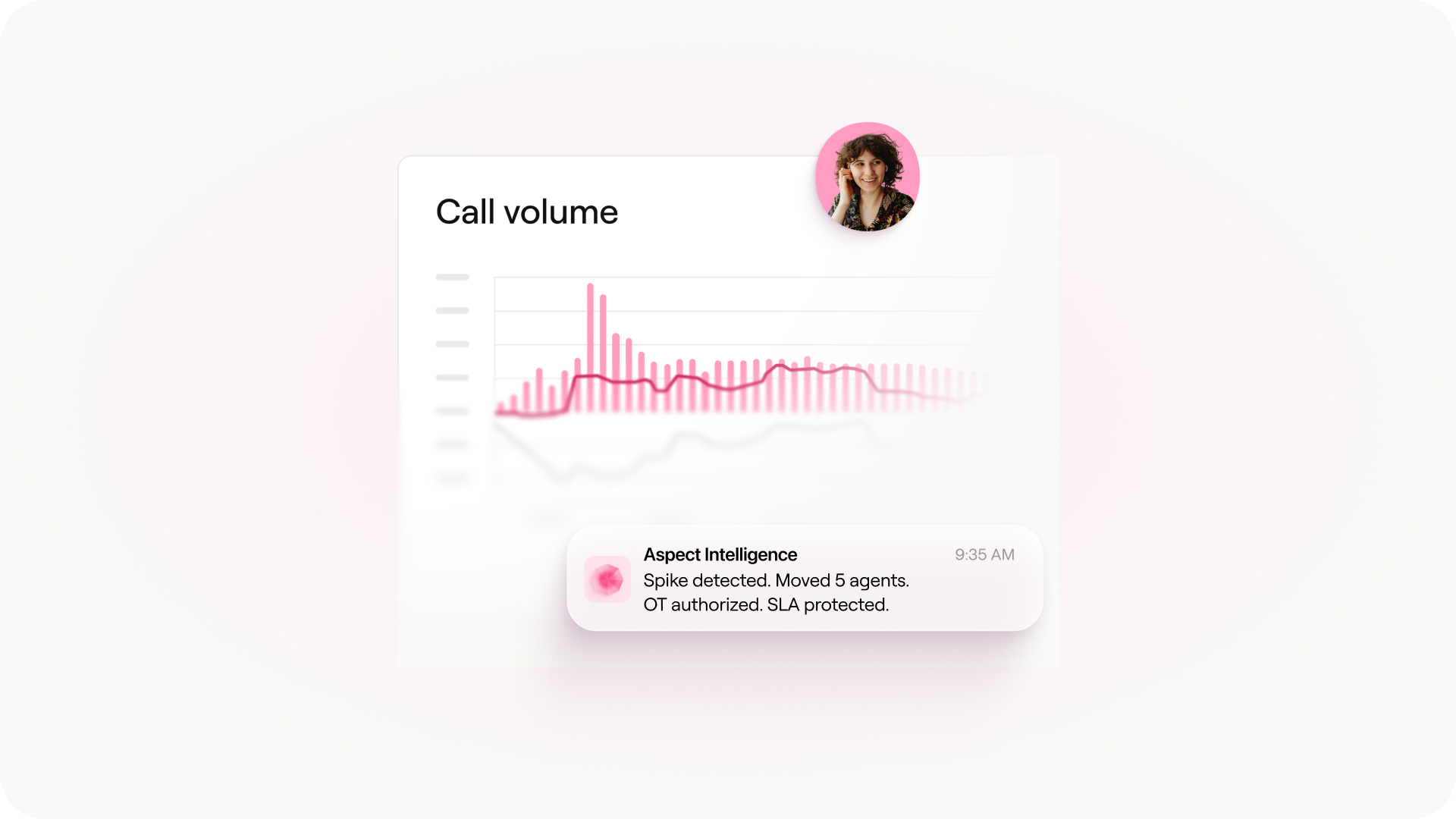
Real-time workforce intelligence is the core of what Workforce Intelligence means as a category, and it is the problem Aspect Intelligence was built to solve inside Aspect Workforce. The system re-forecasts through the day as conditions change, flags the risk while there is still room to act, and proposes moves you can approve or automate within guardrails you control. The goal is easy to state and hard to earn. You stop finding out about your worst afternoons the next morning.
- How is real-time workforce intelligence different from a live wallboard?

- Can real-time WFM help if my forecast is only average?
- What data does real-time workforce intelligence need to work?
- Does real-time intelligence replace the intraday analyst?
- How quickly can a contact center see results from real-time WFM?