

Staffing a contact center for seasonal peaks is hard because the two obvious approaches both fail expensively. Staff to the peak year-round and you carry idle cost through every quiet month. Staff to the average and you collapse when the peak arrives, missing service exactly when volume and customer stakes are highest. The operations that handle seasonality well reject both of these and plan for a demand curve that moves, building the flexibility to scale up for the peak and back down afterward without either the year-round overstaffing or the peak-season meltdown.
This is one of the oldest problems in workforce management and it is getting harder, not easier. Demand is more volatile than it used to be, peaks are sharper and less predictable, and a promotional event or a product issue can now create a surge that looks nothing like last year's pattern. A planning approach built on the assumption that this year's peak will resemble last year's is planning for a contact center that may not show up. The discipline that works is planning for the shape of demand as it actually moves, and building the capacity to flex with it.
Why do seasonal peaks break normal staffing plans?
Seasonal peaks break normal staffing plans because a plan built on average demand is wrong in both directions the moment demand stops being average. For most of the year that plan overstaffs, carrying agents against volume that is not there. Then the peak arrives and the same plan understaffs badly, because the average it was built on never anticipated the surge. A single static staffing level cannot serve a demand curve that swings widely across the year, and most operations feel this as a predictable annual crisis they somehow never quite plan for.
The deeper problem is that seasonal demand is not just higher, it is differently shaped. A holiday peak in retail does not simply scale up the normal week, it changes which contact types arrive, when they arrive, and how long they take. A tax-season surge in financial services brings a different mix than the quiet months. Planning for a peak as though it were just more of the usual volume gets the staffing level roughly right and the skills mix badly wrong, which is why operations that hit their headcount number during a peak can still miss service. The work changed shape, and the plan only accounted for the size.
How far ahead do you need to plan for a seasonal peak?
You need to plan far enough ahead that hiring and training can actually be completed before the peak arrives, which for most operations means months, not weeks. This is where seasonal planning connects to long-range capacity planning, because the decision to staff a peak with new hires has to be made early enough for recruiting, onboarding, and ramp time to finish before the surge. Leave it too late and the only levers remaining are overtime and hoping, both of which are expensive and neither of which fully covers a sharp peak.
The planning horizon is also where the cost tradeoffs get decided, and they deserve deliberate modeling rather than a default. For a given peak, is it cheaper to hire temporary staff, to lean on overtime from the existing team, to cross-train agents from a quieter function, or some blend of the three? Each has a different cost and a different service outcome, and the right answer varies by the shape and length of the peak. A short sharp spike favors overtime, a sustained seasonal surge often favors temporary hiring, and the only way to know for your situation is to model the options against the actual demand forecast rather than repeating whatever you did last year.

How do you handle unpredictable event-driven spikes?
You handle unpredictable spikes by watching demand in real time and having pre-agreed responses ready, because the whole point of an event-driven spike is that the annual forecast did not see it coming. A product recall, a viral complaint, an outage, a competitor's failure sending their customers to you, these create surges that no seasonal plan anticipated, and they are becoming more common as customer behavior gets more volatile. The seasonal plan handles the predictable curve. Something else has to handle the spike the curve did not include.
That something is real-time detection paired with a decision framework agreed in advance. When volume starts running hot against forecast in a way that signals more than normal variation, the operation needs to recognize it early and know what it will do: which levers to pull, who can authorize overtime, when to open voluntary shifts, how to reprioritize. The operations that manage event-driven spikes well are not the ones with better crystal balls. They are the ones that detect the surge early and have already decided how they will respond, so the reaction is fast and deliberate rather than a scramble invented under pressure.
Where does real-time intelligence fit in seasonal planning?
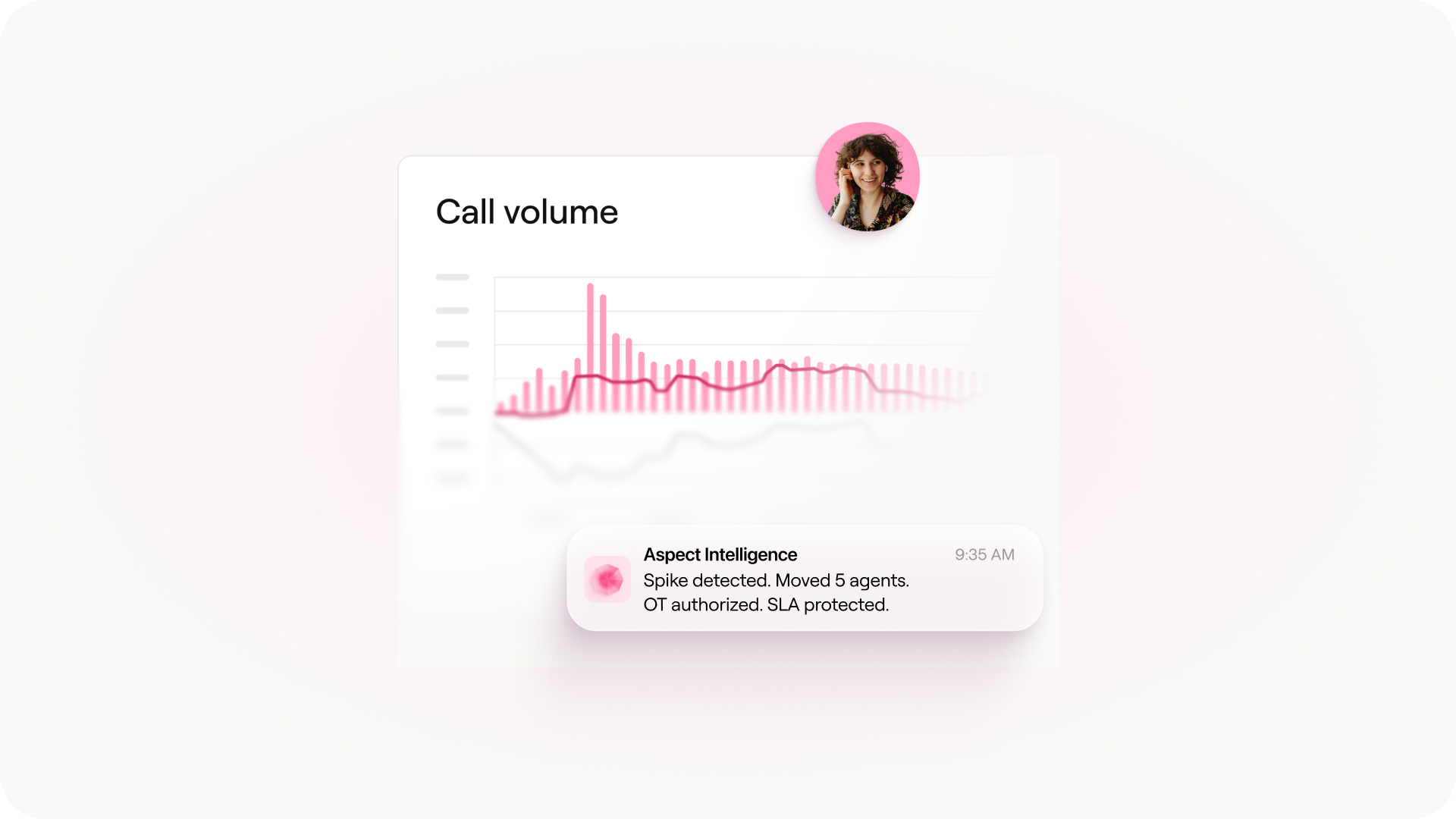
Real-time intelligence fits by catching the moments when actual demand diverges from even a good seasonal plan, so you can adjust while the peak is still unfolding rather than after it has passed. A seasonal forecast, however careful, is still a prediction, and real peaks rarely follow the prediction exactly. The value of watching the day against plan in real time is that it turns a seasonal forecast from a fixed bet into a plan you steer, correcting for the ways this year's peak differs from what you modeled.
This is how Aspect thinks about the connection between long-range planning and real-time intelligence. The seasonal capacity plan sets the shape, and Aspect Intelligence watches how each day unfolds against it, flagging when demand is diverging in a way that needs a response while there is still room to act. The planner owns the seasonal strategy and the real-time decisions, with the system doing the early detection that keeps a peak from becoming a crisis. A seasonal plan managed this way stops being a once-a-year guess you live with and becomes a plan you actively steer through the peak.
What this means for your workforce strategy
Seasonality is not a problem you solve once, it is a demand pattern you plan around every year, and the operations that treat it as a deliberate discipline rather than an annual surprise are the ones that hit service during the peak without overpaying through the quiet months. That means planning far enough ahead for hiring to land, modeling the cost tradeoffs rather than defaulting to last year's approach, and building a real-time response for the spikes the seasonal plan cannot predict.
As demand grows more volatile and peaks get sharper, the gap between operations that plan for a moving demand curve and those that staff to an average will keep widening. The ones that flex deliberately will serve their customers when it matters most and carry the least idle cost when it does not.
- Why is seasonal staffing so difficult for contact centers?

- How far ahead should you plan for a seasonal peak?
- Is it cheaper to use overtime or hire for a seasonal peak?
- How do you plan for unpredictable demand spikes?
- How does real-time intelligence help with seasonal peaks?